
Access free live classes and tests on the app
Download
+
Unacademy
  • Goals
    • AFCAT
    • AP EAMCET
    • Bank Exam
    • BPSC
    • CA Foundation
    • CAPF
    • CAT
    • CBSE Class 11
    • CBSE Class 12
    • CDS
    • CLAT
    • CSIR UGC
    • GATE
    • IIT JAM
    • JEE
    • Karnataka CET
    • Karnataka PSC
    • Kerala PSC
    • MHT CET
    • MPPSC
    • NDA
    • NEET PG
    • NEET UG
    • NTA UGC
    • Railway Exam
    • SSC
    • TS EAMCET
    • UPSC
    • WBPSC
    • CFA
Login Join for Free
avtar
  • ProfileProfile
  • Settings Settings
  • Refer your friendsRefer your friends
  • Sign outSign out
  • Terms & conditions
  • •
  • Privacy policy
  • About
  • •
  • Careers
  • •
  • Blog

© 2023 Sorting Hat Technologies Pvt Ltd

Watch Free Classes
    • Free courses
    • JEE Main 2024
    • JEE Main 2024 Live Paper Discussion
    • JEE Main Rank Predictor 2024
    • JEE Main College Predictor 2024
    • Stream Predictor
    • JEE Main 2024 Free Mock Test
    • Study Materials
    • Notifications
    • JEE Advanced Syllabus
    • JEE Books
    • JEE Main Question Paper
    • JEE Coaching
    • Downloads
    • JEE Notes & Lectures
    • JEE Daily Videos
    • Difference Between
    • Full Forms
    • Important Formulas
    • Exam Tips
JEE Main 2026 Preparation: Question Papers, Solutions, Mock Tests & Strategy Unacademy » JEE Study Material » Chemistry » Mohr Salt Titration

Mohr Salt Titration

It is possible to do redox titration by titrating potassium permanganate (KMnO4) against Mohr salt, as shown in the figure. In oxidation-reduction (redox) titrations, the action of the indicator is identical to that of the other forms of visual colour titrations when the endpoint is in close proximity to the indicator.

Table of Content
  •  

To compare the strength of a specific potassium permanganate solution to a standard ferrous ammonium sulphate (Mohr’s salt) solution in order to assess its potency.

In the presence of sulfuric acid, potassium permanganate is a powerful oxidant, according to theory. Mohr salt is a double salt that forms a single crystalline structure and has the formula (NH4)2. FeSO4. 6H2O. It is also known as Mohr’s salt. Mohr’s salt is referred to by its chemical name as ferrous ammonium sulphate.

It should be noted that in this titration, Mohr salt serves as a reducing agent and potassium permanganate serves as an oxidising agent. The reaction between Mohr’s salt and potassium permanganate is therefore classified as a redox reaction. The process takes place because the ferrous ion from Mohr’s salt is oxidised, and the pink manganese contained in potassium permanganate, which is in the +7 oxidation state, is reduced to the colourless manganese ion (Mn2+).
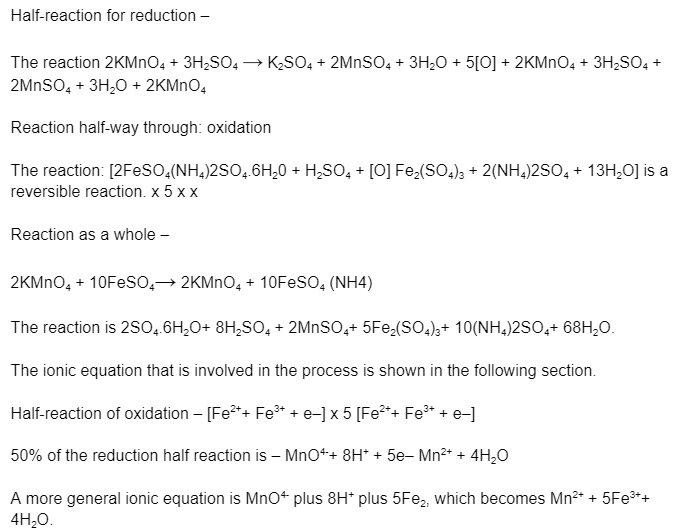
 

This titration is based on oxidation-reduction titrations, which are performed in a laboratory. When sulfuric acid is used to titrate ferrous ammonium sulphate solution against potassium permanganate solution in the presence of an acidic media, the results are positive. It is vital to use an acidic media in order to prevent the precipitation of manganese oxide. It is known as permanganate titration in this case because KMnO4 functions as a self indicator in the reaction.

Experiment 

Specify the materials you’ll need.

  1. Mohr’s salt is a type of salt (ferrous ammonium sulfate)
  2. Permanganate solution (potassium permanganate)
  3. Sulfuric acid should be diluted.
  4. Chemical Equilibrium
  5. Burette
  6. Stand for the burette
  7. Pipette
  8. Flask with a conical shape
  9. Funnel
  10. a flask for measuring
  11. Bottle for weighing
  12. The colour white is used in the tile.
  13. Burnet
  14. Wire gauze is a type of gauze that is made of wire.

Setup of the apparatus:

In the burette, a KMnO4 solution was used.

In a conical flask, combine 10 mL of ferrous ammonium sulphate (Mohr’s salt) with 1 mL of sulfuric acid indicator (Sulfuric acid indicator – Self indicator) (KMnO4)

Point of no return – Colourless to a permanent pale pink colour

Titration of Mohr salts using KMnO4

Procedure: (a) Prepare a 0.05M standard solution of ferrous ammonium sulphate by following the following steps:

To determine the amount of Mohr’s salt necessary for 250ml of a solution with a normality of 0.05N, use the following formula:

Molar mass of mohr’s salt is 392 g/mol (grams per mole).

Strength = Normality x Equivalent weight = (1/20) x 392 = 19.6 g/L Strength = Normality x Equivalent weight

When preparing 250mL of N/20 Mohr’s salt solution, the amount of Mohr salt required is (19.6/1000) x 250 = 4.9 grams (molecular weight).

Using a chemical balance, weigh an empty watch glass to see how much it weighs.

Measure and record the weight of 4.9g of Mohr’s salt on a chemical balance.

Use a funnel to put the Mohr’s salt into the measuring flask, then discard the funnel.

Remove the funnel from the flask and wash it with distilled water while keeping the funnel in place.

Using pure water, bring the solution up to the specified point and check to see that the Mohr’s salt has been completely dissolved.

A 0.05N standard solution of Mohr’s salt is used in this solution.

In order to compare potassium permanganate solution to conventional ferrous ammonium sulphate (Mohr’s salt) solution, the following procedure was used:

Wash and rinse the burette and pipette with distilled water before rinsing them with the solution that will be placed within them.

Using the potassium permanganate solution, rinse the burette and then fill the burette with the potassium permanganate solution.

The burette should be secured in the burette stand, and the white tile should be placed beneath the burette in order to appropriately locate the terminus.

Remove the pipette and conical flask from the solution and rinse them with normal ferrous sulphate solution.

Pipette 10ml of 0.05N standard Mohr’s salt solution into the conical flask using a sterile tip.

Sulfuric acid should be added to the test tube to avoid the oxidation of manganese and the formation of manganese dioxide.

Make a mental note of the initial reading in the burette before beginning the titration process.

The titration procedure is now initiated; titrate the solution against potassium permanganate solution while gently swirling the solution in the flask.

Initially, ferrous ammonium sulphate is used to remove the purple colour of KMnO4 from the solution. The emergence of a permanent pink colour indicates the completion of the process.

Continue the titration process until concordant values are achieved.

The upper meniscus should be noted down on the burette readings.

Take note of the reading and enter it into the observation table provided below in order to calculate how much KMnO4 is present in the solution.

Conclusion:

Therefore we can finally conclude that the molarity of the provided KMnO4 solution is moles per litre of solution. The concentration of potassium permanganate solution in the sample is g/L. Because potassium permanganate is a black compound, it is important to carefully read the top meniscus. Before using the pipette and burette, thoroughly rinse them. Acidification of potassium permanganate should be accomplished with weak sulfuric acid. Before beginning the experiment, thoroughly clean all of the apparatus with distilled water and then thoroughly rinse with the solution that will be used in them. Once it reaches the endpoint, it should take correct readings rather than settling for average results. It is not recommended to use a rubber cork burette since it can be affected by KMnO4. While taking the burette readings, make use of the antiparallel card or the auto parallax card. There should be no more than two decimal places used when calculating the strength of an unknown solution.

Related Links:

Actinides GuideNitration
Aluminium Chloride StructureOxalic-Acid vs KMnO4
Atoms and X-Rays Important Questionsp-Nitroacetanilide Study Material
Band TheoryPreparation of Aluminium Chloride
Lewis Dot StructuresReaction with Sulphuric Acid
Covalent and Ionic BondsSF4 Molecular Geometry and Bond Angles
Enthalpy of NeutralisationSteps in the Ring Closure
Formation of ComplexesTemporary Hardness of Water
Hepatic Portal SystemTypes of Impurity Defects
Law of ThermodynamicsVan’t Hoff Factor
faq

Frequently Asked Questions

Get answers to the most common queries related to the JEE Examination Preparation.

When it comes to permanganate titration, why is dilute sulfuric acid the best choice?

Ans. In an acidic environment, KMnO4 is ...Read full

What is the recipe for Mohr's salt, and how does it work?

Ans. Mohr’s salt is represented by the formula (NH4...Read full

What is the conventional solution to this problem?

Ans. It is possible to obtain a standard solution by using a solution whose concentration is known. The solutionR...Read full

What are the various types of titrations available?

Ans. The following are the several types of titration: ...Read full

What are the results when sulfuric acid is used to titrate ferrous ammonium sulphate solution against potassium permanganate solution in the presence of an acidic media?

Ans. When sulfuric acid is used to titrate ferrous ammonium sulphate solution against potassium permanganate solutio...Read full

Ans. In an acidic environment, KMnO4 is an excellent oxidising agent. A brown precipitate may result from the absence of acid, which is formed by the oxidation of MnO4 to MnO2.

Ans. Mohr’s salt is represented by the formula (NH4)2.FeSO4.6H2O.

Ans. It is possible to obtain a standard solution by using a solution whose concentration is known. The solution’s normality and molarity are both known in advance.

Ans. The following are the several types of titration:

  1. Titration using an iodometric metre
  2. Titration with permanganate
  3. Titration using complexometric equations
  4. Titration with precipitation
  5. Acid-base titration is a method of determining how acidic or basic a solution is.
  6. Titration of the redox potential

Ans. When sulfuric acid is used to titrate ferrous ammonium sulphate solution against potassium permanganate solution in the presence of an acidic media, the results are positive.

Crack IIT JEE with Unacademy

Get subscription and access unlimited live and recorded courses from India’s best educators

  • Structured syllabus
  • Daily live classes
  • Ask doubts
  • Tests & practice
Learn more

Notifications

Get all the important information related to the JEE Exam including the process of application, important calendar dates, eligibility criteria, exam centers etc.

Allotment of Examination Centre
JEE Advanced Eligibility Criteria
JEE Advanced Exam Dates
JEE Advanced Exam Pattern 2023
JEE Advanced Syllabus
JEE Application Fee
JEE Application Process
JEE Eligibility Criteria 2023
JEE Exam Language and Centres
JEE Exam Pattern – Check JEE Paper Pattern 2024
JEE Examination Scheme
JEE Main 2024 Admit Card (OUT) – Steps to Download Session 1 Hall Ticket
JEE Main Application Form
JEE Main Eligibility Criteria 2024
JEE Main Exam Dates
JEE Main Exam Pattern
JEE Main Highlights
JEE Main Paper Analysis
JEE Main Question Paper with Solutions and Answer Keys
JEE Main Result 2022 (Out)
JEE Main Revised Dates
JEE Marking Scheme
JEE Preparation Books 2024 – JEE Best Books (Mains and Advanced)
Online Applications for JEE (Main)-2022 Session 2
Reserved Seats
See all

Related articles

Learn more topics related to Chemistry
Zeolites

Aluminium silicate zeolites are microporous three-dimensional crystalline solids. Zeolites have small, fixed-size openings that allow small molecules to pass through easily but not larger molecules; this is why they are sometimes referred to as molecular sieves.

XeF6 Molecular Geometry and Bond Angles

In this article, we will learn about the XeF6 Molecular Geometry And Bond Angles in detail. We also learn the importance of XeF6 molecular geometry and bond angles importance and much more about the topic in detail.

XeF4 Molecular Geometry and Bond Angeles

A general overview of Lewis Structure, XeF4 Molecular Geometry and bond Angles meaning, valuable XeF4 Molecular Geometry and bond angle questions.

XeF2 Molecular Geometry and Bond Angles

Let us learn about the molecule XeF2, its molecular geometry and bond examples, and XeF2 Lewis structure.

See all
Access more than

10,505+ courses for IIT JEE

Get subscription
Challenge Yourself Everyday
Attempt 2023’s and previous year’s JEE Main
Download Important Formulas pdf
Attempt Free Test Series for JEE Main 2023

Trending Topics

  • JEE Main 2024
  • JEE Main Rank Predictor 2024
  • JEE Main Mock Test 2024
  • JEE Main 2024 Admit Card
  • JEE Advanced Syllabus
  • JEE Preparation Books
  • JEE Notes
  • JEE Advanced Toppers
  • JEE Advanced 2022 Question Paper
  • JEE Advanced 2022 Answer Key
  • JEE Main Question Paper
  • JEE Main Answer key 2022
  • JEE Main Paper Analysis 2022
  • JEE Main Result
  • JEE Exam Pattern
  • JEE Main Eligibility
  • JEE College predictor

JEE Coaching Centres

  • JEE Coaching in Nagpur
  • JEE Coaching in Ranchi
  • JEE Coaching in Gorakhpur
  • JEE Coaching in Bhubaneswar
  • JEE Coaching in Vijayawada
  • JEE Coaching in Dehradun
  • JEE Coaching in Indore
  • JEE Coaching in Gurugram
  • JEE Coaching in Muzaffarpur
  • JEE Coaching in Varanasi
  • JEE Coaching in Jammu
  • JEE Coaching in Kolhapur
  • JEE Coaching in Bikaner
  • JEE Coaching in Delhi Lajpat Nagar
Predict your JEE Rank
.
Company Logo

Unacademy is India’s largest online learning platform. Download our apps to start learning


Starting your preparation?

Call us and we will answer all your questions about learning on Unacademy

Call +91 8585858585

Company
About usShikshodayaCareers
we're hiring
BlogsPrivacy PolicyTerms and Conditions
Help & support
User GuidelinesSite MapRefund PolicyTakedown PolicyGrievance Redressal
Products
Learner appLearner appEducator appEducator appParent appParent app
Popular goals
IIT JEEUPSCSSCCSIR UGC NETNEET UG
Trending exams
GATECATCANTA UGC NETBank Exams
Study material
UPSC Study MaterialNEET UG Study MaterialCA Foundation Study MaterialJEE Study MaterialSSC Study Material

© 2026 Sorting Hat Technologies Pvt Ltd

Unacademy
  • Goals
    • AFCAT
    • AP EAMCET
    • Bank Exam
    • BPSC
    • CA Foundation
    • CAPF
    • CAT
    • CBSE Class 11
    • CBSE Class 12
    • CDS
    • CLAT
    • CSIR UGC
    • GATE
    • IIT JAM
    • JEE
    • Karnataka CET
    • Karnataka PSC
    • Kerala PSC
    • MHT CET
    • MPPSC
    • NDA
    • NEET PG
    • NEET UG
    • NTA UGC
    • Railway Exam
    • SSC
    • TS EAMCET
    • UPSC
    • WBPSC
    • CFA

Share via

COPY