Access free live classes and tests on the app
Download
+
Unacademy
  • Goals
    • AFCAT
    • AP EAMCET
    • Bank Exam
    • BPSC
    • CA Foundation
    • CAPF
    • CAT
    • CBSE Class 11
    • CBSE Class 12
    • CDS
    • CLAT
    • CSIR UGC
    • GATE
    • IIT JAM
    • JEE
    • Karnataka CET
    • Karnataka PSC
    • Kerala PSC
    • MHT CET
    • MPPSC
    • NDA
    • NEET PG
    • NEET UG
    • NTA UGC
    • Railway Exam
    • SSC
    • TS EAMCET
    • UPSC
    • WBPSC
    • CFA
Login Join for Free
avtar
  • ProfileProfile
  • Settings Settings
  • Refer your friendsRefer your friends
  • Sign outSign out
  • Terms & conditions
  • •
  • Privacy policy
  • About
  • •
  • Careers
  • •
  • Blog

© 2023 Sorting Hat Technologies Pvt Ltd

Watch Free Classes
    • Free courses
    • JEE Main 2024
    • JEE Main 2024 Live Paper Discussion
    • JEE Main Rank Predictor 2024
    • JEE Main College Predictor 2024
    • Stream Predictor
    • JEE Main 2024 Free Mock Test
    • Study Materials
    • Notifications
    • JEE Advanced Syllabus
    • JEE Books
    • JEE Main Question Paper
    • JEE Coaching
    • Downloads
    • JEE Notes & Lectures
    • JEE Daily Videos
    • Difference Between
    • Full Forms
    • Important Formulas
    • Exam Tips
JEE Main 2026 Preparation: Question Papers, Solutions, Mock Tests & Strategy Unacademy » JEE Study Material » Physics » work energy theorem

work energy theorem

This article covers study material notes on the work-energy theorem. The work-energy theorem states that the change in the kinetic energy of a body is equal to the net work done by the forces acting on it.

Table of Content
  •  

According to the work-energy theorem, the change in the kinetic energy of a body is similar to the network done by the forces acting on it. The work-energy theorem can also be derived from Issac Newton’s second law.

To state the work-energy theorem, we also need to understand the concept of work and energy. Both work and energy are closely associated with each other. When we try to move an object, we also change the object’s energy. Energy is spent in doing work. We can describe energy as the ability to do any work. 

Work

A work is said to be done when an application of force causes the displacement of an object. The SI unit in which work is determined is called Joules, i.e., 1 J = 1 N ⋅ m = 1 kg ⋅ m2/s2. Work is defined as the scalar quality as it only has magnitude and has no directions.

Mathematical formula: (F cos θ )d = F.d 

The SI unit of the work is Joule (J). Whereas in the CGS system, the unit of work is erg. The dimensional formula of work is ML2T-2.

For example: Suppose you use thread to pull a curtain over the floor, consider that the curtain is your system, and the force you are applying to pull the curtain is a type of external force. 

So, the amount of the work you are doing is equal to the force you are using to pull the curtain times the distance you moved it. 

According to the work equation, if there is no displacement, then work done is 0, which means no work has been done. It implies that there is no work is done when:-

  • Force = zero
  • the displacement = 0
  • Force and displacement make 90-degree angles or mutually perpendicular.

Energy

Kinetic energy is also known as the energy of motion. Any moving object has kinetic energy in it.

Potential energy is also called stored energy, and it has several forms. For example, gravitational potential energy is stored in the object, and it is due to the object’s position on the earth’s surface. You must be familiar with roller coaster rides. When a roller coaster is on the top, it has the potential gravitational energy to go down.

This can be represented mathematically by the work-energy theorem. 


v2 and v1 in this theorem refer to the final and initial velocity of the object.

The work-energy theorem is derived from Newton’s second law of motion and the force applied to a particle. The immediate power added to the system is determined by computing the scalar product of the forces with the particle’s velocity.

Work-energy theorem derivation

Work-Energy Theorem can be represented mathematically by the work-energy theorem.


v2 and v1 in this theorem refer to the final and initial velocity of the object.

The work-energy theorem is derived from Newton’s second law of motion and the force applied to a particle. The immediate power added to the system is determined by computing the scalar product of the forces with the particle’s velocity.

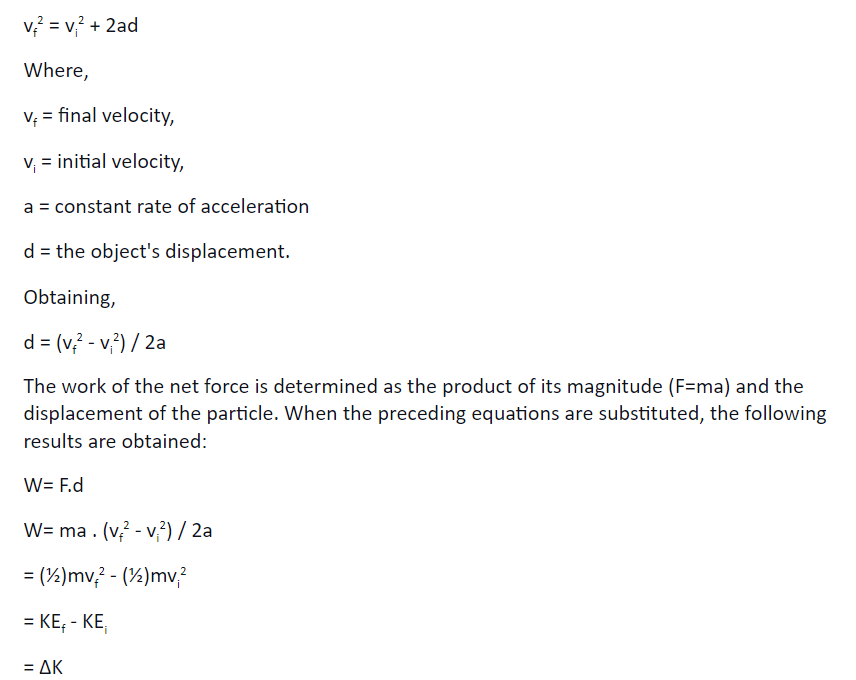
When the resulting force F is constant in size and direction and parallel to the particle’s movement, we can obtain the equation of the work-energy theorem. The particle follows a straight route and accelerates at a constant rate. 

The equation F = ma expresses the relationship between net force and acceleration, and the particle’s displacement d may be determined using Newton’s 2nd rule of movement:


The work-energy theorem is derived in this way. As a result, we can conclude that the work done on an object equals the change in the object’s kinetic energy.

Conclusion

From the article, we can conclude that how work and energy are linked together via the work energy theorem and we can also understand the application of the work energy principle. According to the work-energy theorem, the change in the kinetic energy of a body is equal to the total work done by the forces acting on it.


faq

Frequently asked questions

Get answers to the most common queries related to the JEE Examination Preparation.

What are the limitations of the work-energy theorem?

Ans. The limitations of the work-energy theorem are: ...Read full

What are the advantages of the work-energy theorem?

Ans. The advantages of the work-energy theorem are: ...Read full

Which factors affect the work done?

Ans. The factors that affect the work done are the force applied on the body, the displacement of the body, and the ...Read full

When does the work done equal the energy?

Ans. There is no external force or non-conservative force applicable to the system.

What is the relation between work energy and power?

Ans. Work is the energy needed to apply a force to move an object a certain distance. Power is the speed or rate at ...Read full

Ans. The limitations of the work-energy theorem are:

  • Though the work-energy theorem helps solve different types of problems, it cannot provide complete information about the real cause of motion.
  • We cannot apply the work-energy theorem for non-conservative forces.
  • We can’t use the work-energy theorem in the case of friction force and air resistance force. We have to use energy conservation instead.

Ans. The advantages of the work-energy theorem are:

  • The main advantage of this theorem is that we can easily find out the work done with the help of the energy applied to the body.
  • It helps us find the work done by unknown forces even when the amount of force or displacement is unknown.

Ans. The factors that affect the work done are the force applied on the body, the displacement of the body, and the angle between the force and displacement.

Ans. There is no external force or non-conservative force applicable to the system.

Ans. Work is the energy needed to apply a force to move an object a certain distance. Power is the speed or rate at which this work is done. So we can say that work energy and power are all correlated.

Crack IIT JEE with Unacademy

Get subscription and access unlimited live and recorded courses from India’s best educators

  • Structured syllabus
  • Daily live classes
  • Ask doubts
  • Tests & practice
Learn more

Notifications

Get all the important information related to the JEE Exam including the process of application, important calendar dates, eligibility criteria, exam centers etc.

Allotment of Examination Centre
JEE Advanced Eligibility Criteria
JEE Advanced Exam Dates
JEE Advanced Exam Pattern 2023
JEE Advanced Syllabus
JEE Application Fee
JEE Application Process
JEE Eligibility Criteria 2023
JEE Exam Language and Centres
JEE Exam Pattern – Check JEE Paper Pattern 2024
JEE Examination Scheme
JEE Main 2024 Admit Card (OUT) – Steps to Download Session 1 Hall Ticket
JEE Main Application Form
JEE Main Eligibility Criteria 2024
JEE Main Exam Dates
JEE Main Exam Pattern
JEE Main Highlights
JEE Main Paper Analysis
JEE Main Question Paper with Solutions and Answer Keys
JEE Main Result 2022 (Out)
JEE Main Revised Dates
JEE Marking Scheme
JEE Preparation Books 2024 – JEE Best Books (Mains and Advanced)
Online Applications for JEE (Main)-2022 Session 2
Reserved Seats
See all

Related articles

Learn more topics related to Physics
Zinc-Carbon Cell

The battery you use every day in your TV remote or torch is made up of cells and is also known as a zinc-carbon cell. Read on to know more.

ZEROTH LAW OF THERMODYNAMICS

Read about the Zeroth law of thermodynamics. Learn about the zeroth law definitions and their examples.

Zener Diode As A Voltage Regulator

Understand the concepts of Zener diodes. Also, learn about the efficiency and limitations of Zener Diode as a Voltage Regulator.

Zener diode as a voltage regulator

zener diode is a very versatile semiconductor that is used for a variety of industrial processes and allows the flow of current in both directions.It can be used as a voltage regulator.

See all
Access more than

10,505+ courses for IIT JEE

Get subscription

Trending Topics

  • JEE Main 2024
  • JEE Main Rank Predictor 2024
  • JEE Main Mock Test 2024
  • JEE Main 2024 Admit Card
  • JEE Advanced Syllabus
  • JEE Preparation Books
  • JEE Notes
  • JEE Advanced Toppers
  • JEE Advanced 2022 Question Paper
  • JEE Advanced 2022 Answer Key
  • JEE Main Question Paper
  • JEE Main Answer key 2022
  • JEE Main Paper Analysis 2022
  • JEE Main Result
  • JEE Exam Pattern
  • JEE Main Eligibility
  • JEE College predictor
combat_iitjee

Related links

  • JEE Study Materials
  • CNG Full Form
  • Dimensional Formula of Pressure
  • Reimer Tiemann Reaction
  • Vector Triple Product
  • Swarts Reaction
  • Focal length of Convex Lens
  • Root mean square velocities
  • Fehling’s solution
testseries_iitjee
Subscribe Now
. document.querySelector('.targetTopBtn').onClick = topFunction; function topFunction() { window.scrollTo({ top: 0, behavior: 'smooth' }) }
Company Logo

Unacademy is India’s largest online learning platform. Download our apps to start learning


Starting your preparation?

Call us and we will answer all your questions about learning on Unacademy

Call +91 8585858585

Company
About usShikshodayaCareers
we're hiring
BlogsPrivacy PolicyTerms and Conditions
Help & support
User GuidelinesSite MapRefund PolicyTakedown PolicyGrievance Redressal
Products
Learner appLearner appEducator appEducator appParent appParent app
Popular goals
IIT JEEUPSCSSCCSIR UGC NETNEET UG
Trending exams
GATECATCANTA UGC NETBank Exams
Study material
UPSC Study MaterialNEET UG Study MaterialCA Foundation Study MaterialJEE Study MaterialSSC Study Material

© 2026 Sorting Hat Technologies Pvt Ltd

Unacademy
  • Goals
    • AFCAT
    • AP EAMCET
    • Bank Exam
    • BPSC
    • CA Foundation
    • CAPF
    • CAT
    • CBSE Class 11
    • CBSE Class 12
    • CDS
    • CLAT
    • CSIR UGC
    • GATE
    • IIT JAM
    • JEE
    • Karnataka CET
    • Karnataka PSC
    • Kerala PSC
    • MHT CET
    • MPPSC
    • NDA
    • NEET PG
    • NEET UG
    • NTA UGC
    • Railway Exam
    • SSC
    • TS EAMCET
    • UPSC
    • WBPSC
    • CFA

Share via

COPY