Access free live classes and tests on the app
Download
+
Unacademy
  • Goals
    • AFCAT
    • AP EAMCET
    • Bank Exam
    • BPSC
    • CA Foundation
    • CAPF
    • CAT
    • CBSE Class 11
    • CBSE Class 12
    • CDS
    • CLAT
    • CSIR UGC
    • GATE
    • IIT JAM
    • JEE
    • Karnataka CET
    • Karnataka PSC
    • Kerala PSC
    • MHT CET
    • MPPSC
    • NDA
    • NEET PG
    • NEET UG
    • NTA UGC
    • Railway Exam
    • SSC
    • TS EAMCET
    • UPSC
    • WBPSC
    • CFA
Login Join for Free
avtar
  • ProfileProfile
  • Settings Settings
  • Refer your friendsRefer your friends
  • Sign outSign out
  • Terms & conditions
  • •
  • Privacy policy
  • About
  • •
  • Careers
  • •
  • Blog

© 2023 Sorting Hat Technologies Pvt Ltd

Watch Free Classes
    • Free courses
    • JEE Main 2024
    • JEE Main 2024 Live Paper Discussion
    • JEE Main Rank Predictor 2024
    • JEE Main College Predictor 2024
    • Stream Predictor
    • JEE Main 2024 Free Mock Test
    • Study Materials
    • Notifications
    • JEE Advanced Syllabus
    • JEE Books
    • JEE Main Question Paper
    • JEE Coaching
    • Downloads
    • JEE Notes & Lectures
    • JEE Daily Videos
    • Difference Between
    • Full Forms
    • Important Formulas
    • Exam Tips
JEE Main 2026 Preparation: Question Papers, Solutions, Mock Tests & Strategy Unacademy » JEE Study Material » Physics » Energy Levels and Hydrogen Spectrum

Energy Levels and Hydrogen Spectrum

To produce the atomic hydrogen emission spectrum, hydrogen molecules are first broken down into hydrogen atoms, and electrons are elevated to higher energies.

Table of Content
  •  

Lorem ipsum dolor sit amet, consectetur adipiscing elit. Ut elit tellus, luctus nec ullamcorper mattis, pulvinar dapibus leo.

Introduction:

Emission of radiation occurs when electrons return to their former states after absorbing energy and becoming excited, which causes them to jump from lower energy levels to higher energy levels. A well-known truth is that this is the case. This phenomenon explains the hydrogen emission spectrum, which is also called the hydrogen emission spectrum.

Using an electric discharge and a diffraction grating to study the light emitted from an excited gas, scientists discovered in the late 1800s that the resulting spectra did not consist of a continuous band but rather of discrete lines with clearly defined wavelengths. Scientists conducted experiments that revealed its unique wavelengths to better understand the chemical element that emitted the light. They were an atom’s interior structure that resulted in an atomic fingerprint.

Origins of the Hydrogen Emission Spectrum:

  • It is possible to express the hydrogen emission spectrum in a (relatively) simple equation. Simple whole integers can be used to calculate each line. A high voltage causes a chemical reaction that results in the emission of light.
  • Hydrogen’s electron is in the first energy level, which is closest to the nucleus when it is not excited. Electrons can be transported up or out of the atom depending on the amount of energy supplied to it. A discharge tube’s high voltage supplies such energy. Emitted electrons from hydrogen molecules are split apart and promoted to higher energy levels, which is why the atomic hydrogen emission spectrum is named after it.
  • Let’s say an electron has been stimulated to its third energy level as an example. A drop in altitude would cause it to lose energy once more. It has two options for accomplishing this. Alternatively, it may return to the second level and then make a second jump back down, returning to the first level.

Assigning specific electron jumps to specific spectral lines:

The amount of energy an electron loses when it falls from the 3-level to the 2-level is equal to the difference in energy between those two levels. As the electron loses energy, it emits light (which “light” includes UV and IR as well as visible radiation). The equation below explains how each frequency of light is linked to a specific energy.

                                             E = hv

Here h is Planck’s constant  and v is the frequency of the radiation.

  • Light’s energy rises in direct proportion to its frequency. Red light is produced when an electron falls from the third to the second level. 
  • This is where the hydrogen spectrum’s red line comes from.
  • The energy of the red light can be determined by its frequency. The energy gap between the hydrogen atom’s 3-level and 2-level must be exactly the same.

The highest frequency line in the spectrum will consequently be produced by the biggest drop in energy conceivable. A fall from infinity to one is the steepest.

The wavelength of the hydrogen spectrum:

  • Photon absorption leads electrons to transition to higher energy levels, for example, n = 1 or 2 for hydrogen. 
  • For example, when an electron in hydrogen has emitted a photon, the electron transitions from a higher energy level to a lower energy level (n = 3 to n = 2). 
  • Light is transmitted due to this descent from one level to another. These energy levels, quantized, are responsible for creating wavelengths of light that reflect these variations. 
  • For instance, the transition n = 3 n = 2 is shown by the line at 656 nm.

Hydrogen emission spectrum:

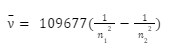
When Balmer proposed the equation for correlating the wave number of spectral lines and energy shells in 1885 based on experimental results, he revolutionised our understanding of hydrogen emissions. The following is the formula:


The Balmer series is a type of hydrogen emission spectrum. In the electromagnetic spectrum, this is the sole set of lines that can be seen. The value of 109,677 cm-1 is the Rydberg constant for hydrogen. The component of the hydrogen emission spectrum known as the Balmer series is responsible for the excitation of electrons in any shell other than the second. The series names for other transitions are similar. The following is a list of some of them.

  • A transition from one shell to another: the Lyman series, 
  • A transition from 2nd shell to another: the Balmer series
  • A transition from 3rd shell to another: the Paschen series, 
  • A transition from 4th shell to another: the Bracket series, 
  • A transition from 5th shell to another: the Pfund series. 

For the estimation of the wave number of hydrogen spectral line emissions owing to the transit of an electron from one orbit to another, Swedish scientist Johannes Rydberg created a generic formula. The following is the general formula for calculating the hydrogen emission spectrum:


Where,

  • n1 = 1, 2, 3, 4,…
  • n2 = n1 +1 

The hydrogen Rydberg constant has a value of 109,677 cm-1.

Conclusion:

Here are a few key takeaways from this learning:

  • Evidence for an atom’s quantized electrical structure can be found in the hydrogen spectrum. 
  • When an electric discharge is applied to a gaseous hydrogen molecule, the hydrogen atoms of the molecule dissociate. 
  • As a result, energetically excited hydrogen atoms emit electromagnetic radiation. The hydrogen emission spectrum consists of a range of frequencies. The scientists that discovered these radiation series gave them their names.
faq

Frequently asked questions

Get answers to the most common queries related to the JEE Examination Preparation.

What is the relationship between energy levels and hydrogen's spectrum?

Ans. An atom of hydrogen has a certain amount of energy because of the electron’s energy. The atom emit...Read full

What is hydrogen's energy density?

Ans. The energy levels of the electrons in a hydrogen atom must be within the permitted range. An electron mu...Read full

What's the connection between the emission spectrum and energy output?

Ans. On the atomic spectrum, electron transitions between energy levels produce emission and absorption lines...Read full

What is the most energetic transition in the hydrogen spectrum?

Ans: Hydrogen atoms release a photon of the highest frequency when they shift from n = 2 to n = 1. ...Read full

Ans. An atom of hydrogen has a certain amount of energy because of the electron’s energy. The atom emits photons when an electron changes levels, resulting in a loss of energy. When the electron’s n decreases from 3 to 2, visible light photons are emitted in the spectrum. Balmer’s Series is the name given to these lines.

Ans. The energy levels of the electrons in a hydrogen atom must be within the permitted range. An electron must have exactly -13.6 eV of energy in order to be in the first energy level of matter. It must have -3.4 eV of energy to be in the second energy level.

Ans. On the atomic spectrum, electron transitions between energy levels produce emission and absorption lines; if the electron loses energy, a photon is produced; if the electron absorbs a photon, it gains energy.

Ans: Hydrogen atoms release a photon of the highest frequency when they shift from n = 2 to n = 1. (10.2 eV).

Crack IIT JEE with Unacademy

Get subscription and access unlimited live and recorded courses from India’s best educators

  • Structured syllabus
  • Daily live classes
  • Ask doubts
  • Tests & practice
Learn more

Notifications

Get all the important information related to the JEE Exam including the process of application, important calendar dates, eligibility criteria, exam centers etc.

Allotment of Examination Centre
JEE Advanced Eligibility Criteria
JEE Advanced Exam Dates
JEE Advanced Exam Pattern 2023
JEE Advanced Syllabus
JEE Application Fee
JEE Application Process
JEE Eligibility Criteria 2023
JEE Exam Language and Centres
JEE Exam Pattern – Check JEE Paper Pattern 2024
JEE Examination Scheme
JEE Main 2024 Admit Card (OUT) – Steps to Download Session 1 Hall Ticket
JEE Main Application Form
JEE Main Eligibility Criteria 2024
JEE Main Exam Dates
JEE Main Exam Pattern
JEE Main Highlights
JEE Main Paper Analysis
JEE Main Question Paper with Solutions and Answer Keys
JEE Main Result 2022 (Out)
JEE Main Revised Dates
JEE Marking Scheme
JEE Preparation Books 2024 – JEE Best Books (Mains and Advanced)
Online Applications for JEE (Main)-2022 Session 2
Reserved Seats
See all

Related articles

Learn more topics related to Physics
Zinc-Carbon Cell

The battery you use every day in your TV remote or torch is made up of cells and is also known as a zinc-carbon cell. Read on to know more.

ZEROTH LAW OF THERMODYNAMICS

Read about the Zeroth law of thermodynamics. Learn about the zeroth law definitions and their examples.

Zener Diode As A Voltage Regulator

Understand the concepts of Zener diodes. Also, learn about the efficiency and limitations of Zener Diode as a Voltage Regulator.

Zener diode as a voltage regulator

zener diode is a very versatile semiconductor that is used for a variety of industrial processes and allows the flow of current in both directions.It can be used as a voltage regulator.

See all
Access more than

10,505+ courses for IIT JEE

Get subscription

Trending Topics

  • JEE Main 2024
  • JEE Main Rank Predictor 2024
  • JEE Main Mock Test 2024
  • JEE Main 2024 Admit Card
  • JEE Advanced Syllabus
  • JEE Preparation Books
  • JEE Notes
  • JEE Advanced Toppers
  • JEE Advanced 2022 Question Paper
  • JEE Advanced 2022 Answer Key
  • JEE Main Question Paper
  • JEE Main Answer key 2022
  • JEE Main Paper Analysis 2022
  • JEE Main Result
  • JEE Exam Pattern
  • JEE Main Eligibility
  • JEE College predictor
combat_iitjee

Related links

  • JEE Study Materials
  • CNG Full Form
  • Dimensional Formula of Pressure
  • Reimer Tiemann Reaction
  • Vector Triple Product
  • Swarts Reaction
  • Focal length of Convex Lens
  • Root mean square velocities
  • Fehling’s solution
testseries_iitjee
Subscribe Now
. document.querySelector('.targetTopBtn').onClick = topFunction; function topFunction() { window.scrollTo({ top: 0, behavior: 'smooth' }) }
Company Logo

Unacademy is India’s largest online learning platform. Download our apps to start learning


Starting your preparation?

Call us and we will answer all your questions about learning on Unacademy

Call +91 8585858585

Company
About usShikshodayaCareers
we're hiring
BlogsPrivacy PolicyTerms and Conditions
Help & support
User GuidelinesSite MapRefund PolicyTakedown PolicyGrievance Redressal
Products
Learner appLearner appEducator appEducator appParent appParent app
Popular goals
IIT JEEUPSCSSCCSIR UGC NETNEET UG
Trending exams
GATECATCANTA UGC NETBank Exams
Study material
UPSC Study MaterialNEET UG Study MaterialCA Foundation Study MaterialJEE Study MaterialSSC Study Material

© 2026 Sorting Hat Technologies Pvt Ltd

Unacademy
  • Goals
    • AFCAT
    • AP EAMCET
    • Bank Exam
    • BPSC
    • CA Foundation
    • CAPF
    • CAT
    • CBSE Class 11
    • CBSE Class 12
    • CDS
    • CLAT
    • CSIR UGC
    • GATE
    • IIT JAM
    • JEE
    • Karnataka CET
    • Karnataka PSC
    • Kerala PSC
    • MHT CET
    • MPPSC
    • NDA
    • NEET PG
    • NEET UG
    • NTA UGC
    • Railway Exam
    • SSC
    • TS EAMCET
    • UPSC
    • WBPSC
    • CFA

Share via

COPY