Access free live classes and tests on the app
Download
+
Unacademy
  • Goals
    • AFCAT
    • AP EAMCET
    • Bank Exam
    • BPSC
    • CA Foundation
    • CAPF
    • CAT
    • CBSE Class 11
    • CBSE Class 12
    • CDS
    • CLAT
    • CSIR UGC
    • GATE
    • IIT JAM
    • JEE
    • Karnataka CET
    • Karnataka PSC
    • Kerala PSC
    • MHT CET
    • MPPSC
    • NDA
    • NEET PG
    • NEET UG
    • NTA UGC
    • Railway Exam
    • SSC
    • TS EAMCET
    • UPSC
    • WBPSC
    • CFA
Login Join for Free
avtar
  • ProfileProfile
  • Settings Settings
  • Refer your friendsRefer your friends
  • Sign outSign out
  • Terms & conditions
  • •
  • Privacy policy
  • About
  • •
  • Careers
  • •
  • Blog

© 2023 Sorting Hat Technologies Pvt Ltd

Watch Free Classes
    • Free courses
    • JEE Main 2024
    • JEE Main 2024 Live Paper Discussion
    • JEE Main Rank Predictor 2024
    • JEE Main College Predictor 2024
    • Stream Predictor
    • JEE Main 2024 Free Mock Test
    • Study Materials
    • Notifications
    • JEE Advanced Syllabus
    • JEE Books
    • JEE Main Question Paper
    • JEE Coaching
    • Downloads
    • JEE Notes & Lectures
    • JEE Daily Videos
    • Difference Between
    • Full Forms
    • Important Formulas
    • Exam Tips
JEE Main 2026 Preparation: Question Papers, Solutions, Mock Tests & Strategy Unacademy » JEE Study Material » Physics » electric field

electric field

Electric fields are produced by electric charges or by time-varying magnetic fields. Let us see the effect on the electric field due to the infinite sheet.

Table of Content
  •  

The electric field is the most fundamental concept in electricity. In general, the electric field of a surface is calculated using Coulomb’s law, but understanding the concept of Gauss law is required to calculate the electric field due to the infinite sheet. It describes the electric charge enclosed in a closed surface or the electric charge present in a closed surface. We have studied Gauss law previously; according to Gauss’ law, the total electric flux out of a closed surface equals the charge enclosed divided by the permittivity. The electric flux in an area is defined as the electric field multiplied by the surface area projected in a plane perpendicular to the field. Let’s see how we can use Gauss law to calculate electric fields due to an infinite plane sheet of charge.

Electric field due to infinite sheet

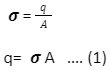
In the case of a uniformly charged infinite plane sheet, we consider the plane sheet’s surface charge density. For two-dimensional geometries, the surface charge density is defined as the total charge present per unit area of the plane sheet and is represented by the symbol 𝝈
jee_p1

As a result, the total charge on the plane sheet is σA.

We assume a cylindrical Gaussian surface with cross-sectional area A, length 2r and an axis perpendicular to the plane sheet to calculate the electric field intensity at r distance from the plane sheet. Let S1 and S2 represent the areas of the two circular faces of the cylindrical Gaussian surface and S3 and S4 represent the areas of the two curved faces of the cylindrical Gaussian surface. 


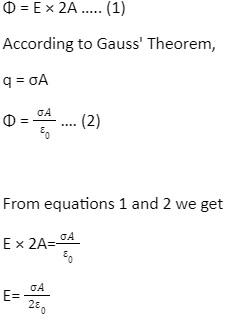
Electric flux passing through the cylindrical Gaussian surface can be given as: 

Φ = E× area of cross-section of the Gaussian cylinder


The flux due to the electric field of the plane sheet of charge passes only through two circular sections of the cylinder when the electric lines of force are parallel to the curved surface area of the cylinder.
jee_p2

The direction of the electric field due to the infinite sheet is perpendicular to the infinite plane sheet of charge and the nature of the charge is positive.

Electric field due to uniformly charged thin spherical shell

To calculate the total electric field due to uniformly charged thin spherical shell, we will have to divide it into three parts: 

  1. Electric field out of the shell 

  2. Electric field in the shell

  3. Electric field on the surface of the shell 

Electric field out of the shell 

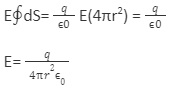
Consider the case of a point P located outside the spherical shell, OP = r in this case. The Gaussian surface is assumed to be a sphere with radius r. The intensity of an electric field, E, is said to be the same at every point of a Gaussian surface and is directed outwards.
jee_p3

We can see that the electric intensity at any point outside the spherical shell appears to be concentrated at the shell’s midpoint.

Electric field in the shell

Now, consider the position of point P within the shell. The radius of the Gaussian surface is denoted by r. The Gaussian surface is devoid of any charge.

Hence, 

q=0

And from this, we can conclude that the electric field inside the spherical shell always stays zero. 

E=0

Electric field on the surface of the shell 

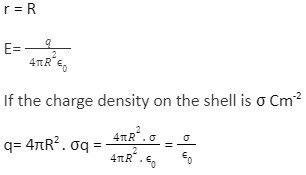
As the sphere we have considered is thin, it is safe to assume that the thickness of the shell will be close to negligible. 

Therefore- Inner radius = outside radius
jee_p4

Conclusion 

The electric flux through an area is calculated by multiplying the electric field by the area of the surface projected in a plane perpendicular to the field. Gauss’ law is a general law that can be applied to any closed surface. It is a useful tool because it allows the amount of enclosed charge to be calculated by mapping the field on a surface outside the charge distribution. It simplifies the calculation of the electric field for sufficiently symmetric geometries as we saw how it helped us in the calculation of electric field due to the infinite sheet and on a uniformly charged thin spherical shell.

faq

Frequently asked questions

Get answers to the most common queries related to the IIT JEE Examination Preparation.

How do we select the best Gaussian surface for each situation?

Ans. To select an appropriate Gaussian surface, we must consider the fact that the charge-to-dielectric constant ratio is given b...Read full

What is Gauss law? 

Ans. Gauss’ law is a fundamental law that describes the properties of electric, magnetic and gravitational fields. The elec...Read full

 Define Coulomb’s Law. 

Ans. Coulomb’s law describes the interactions of electrically charged particles. This states that the force between two ele...Read full

What is the difference between Coulomb's law and Gauss' law?

Ans. They are mathematically equivalent, but their physical interpretations differ. Coulomb’s law is commonly pictured as d...Read full

Ans. To select an appropriate Gaussian surface, we must consider the fact that the charge-to-dielectric constant ratio is given by a (two-dimensional) surface integral over the charge distribution’s electric field symmetry. We’ll need to know about three different cases.

  1. When the charge distribution is spherically symmetric, the shape is spherical.
  2. When the charge distribution is cylindrically symmetric, the charge distribution is cylindrical.
  3. When the charge distribution has translational symmetry along a plane, it is referred to as a pillbox.

We can specify the size of the surface on which we want to compute the field. The Gauss theorem is useful for locating fields when there is symmetry because it tells us how the field is directed.

Ans. Gauss’ law is a fundamental law that describes the properties of electric, magnetic and gravitational fields. The electric flux through any closed surface is proportional to the electric charge enclosed by the surface, according to Gauss’ law for electric fields.

Ans. Coulomb’s law describes the interactions of electrically charged particles. This states that the force between two electrically charged particles is proportional to their charges and inversely proportional to the square of their distance.

Ans. They are mathematically equivalent, but their physical interpretations differ. Coulomb’s law is commonly pictured as describing the force of interaction between two electric charges. Gauss’ law, on the other hand, is a statement about the electric field surrounding a charge. The total electric flux in the vicinity of a charge is proportional to the charge. This implies that the field obeys an inverse square law, which is consistent with Coulomb’s law.

Crack IIT JEE with Unacademy

Get subscription and access unlimited live and recorded courses from India’s best educators

  • Structured syllabus
  • Daily live classes
  • Ask doubts
  • Tests & practice
Learn more

Notifications

Get all the important information related to the JEE Exam including the process of application, important calendar dates, eligibility criteria, exam centers etc.

Allotment of Examination Centre
JEE Advanced Eligibility Criteria
JEE Advanced Exam Dates
JEE Advanced Exam Pattern 2023
JEE Advanced Syllabus
JEE Application Fee
JEE Application Process
JEE Eligibility Criteria 2023
JEE Exam Language and Centres
JEE Exam Pattern – Check JEE Paper Pattern 2024
JEE Examination Scheme
JEE Main 2024 Admit Card (OUT) – Steps to Download Session 1 Hall Ticket
JEE Main Application Form
JEE Main Eligibility Criteria 2024
JEE Main Exam Dates
JEE Main Exam Pattern
JEE Main Highlights
JEE Main Paper Analysis
JEE Main Question Paper with Solutions and Answer Keys
JEE Main Result 2022 (Out)
JEE Main Revised Dates
JEE Marking Scheme
JEE Preparation Books 2024 – JEE Best Books (Mains and Advanced)
Online Applications for JEE (Main)-2022 Session 2
Reserved Seats
See all

Related articles

Learn more topics related to Physics
Zinc-Carbon Cell

The battery you use every day in your TV remote or torch is made up of cells and is also known as a zinc-carbon cell. Read on to know more.

ZEROTH LAW OF THERMODYNAMICS

Read about the Zeroth law of thermodynamics. Learn about the zeroth law definitions and their examples.

Zener Diode As A Voltage Regulator

Understand the concepts of Zener diodes. Also, learn about the efficiency and limitations of Zener Diode as a Voltage Regulator.

Zener diode as a voltage regulator

zener diode is a very versatile semiconductor that is used for a variety of industrial processes and allows the flow of current in both directions.It can be used as a voltage regulator.

See all
Access more than

10,505+ courses for IIT JEE

Get subscription

Trending Topics

  • JEE Main 2024
  • JEE Main Rank Predictor 2024
  • JEE Main Mock Test 2024
  • JEE Main 2024 Admit Card
  • JEE Advanced Syllabus
  • JEE Preparation Books
  • JEE Notes
  • JEE Advanced Toppers
  • JEE Advanced 2022 Question Paper
  • JEE Advanced 2022 Answer Key
  • JEE Main Question Paper
  • JEE Main Answer key 2022
  • JEE Main Paper Analysis 2022
  • JEE Main Result
  • JEE Exam Pattern
  • JEE Main Eligibility
  • JEE College predictor
combat_iitjee

Related links

  • JEE Study Materials
  • CNG Full Form
  • Dimensional Formula of Pressure
  • Reimer Tiemann Reaction
  • Vector Triple Product
  • Swarts Reaction
  • Focal length of Convex Lens
  • Root mean square velocities
  • Fehling’s solution
testseries_iitjee
Subscribe Now
. document.querySelector('.targetTopBtn').onClick = topFunction; function topFunction() { window.scrollTo({ top: 0, behavior: 'smooth' }) }
Company Logo

Unacademy is India’s largest online learning platform. Download our apps to start learning


Starting your preparation?

Call us and we will answer all your questions about learning on Unacademy

Call +91 8585858585

Company
About usShikshodayaCareers
we're hiring
BlogsPrivacy PolicyTerms and Conditions
Help & support
User GuidelinesSite MapRefund PolicyTakedown PolicyGrievance Redressal
Products
Learner appLearner appEducator appEducator appParent appParent app
Popular goals
IIT JEEUPSCSSCCSIR UGC NETNEET UG
Trending exams
GATECATCANTA UGC NETBank Exams
Study material
UPSC Study MaterialNEET UG Study MaterialCA Foundation Study MaterialJEE Study MaterialSSC Study Material

© 2026 Sorting Hat Technologies Pvt Ltd

Unacademy
  • Goals
    • AFCAT
    • AP EAMCET
    • Bank Exam
    • BPSC
    • CA Foundation
    • CAPF
    • CAT
    • CBSE Class 11
    • CBSE Class 12
    • CDS
    • CLAT
    • CSIR UGC
    • GATE
    • IIT JAM
    • JEE
    • Karnataka CET
    • Karnataka PSC
    • Kerala PSC
    • MHT CET
    • MPPSC
    • NDA
    • NEET PG
    • NEET UG
    • NTA UGC
    • Railway Exam
    • SSC
    • TS EAMCET
    • UPSC
    • WBPSC
    • CFA

Share via

COPY