Access free live classes and tests on the app
Download
+
Unacademy
  • Goals
    • AFCAT
    • AP EAMCET
    • Bank Exam
    • BPSC
    • CA Foundation
    • CAPF
    • CAT
    • CBSE Class 11
    • CBSE Class 12
    • CDS
    • CLAT
    • CSIR UGC
    • GATE
    • IIT JAM
    • JEE
    • Karnataka CET
    • Karnataka PSC
    • Kerala PSC
    • MHT CET
    • MPPSC
    • NDA
    • NEET PG
    • NEET UG
    • NTA UGC
    • Railway Exam
    • SSC
    • TS EAMCET
    • UPSC
    • WBPSC
    • CFA
Login Join for Free
avtar
  • ProfileProfile
  • Settings Settings
  • Refer your friendsRefer your friends
  • Sign outSign out
  • Terms & conditions
  • •
  • Privacy policy
  • About
  • •
  • Careers
  • •
  • Blog

© 2023 Sorting Hat Technologies Pvt Ltd

Watch Free Classes
    • Free courses
    • JEE Main 2024
    • JEE Main 2024 Live Paper Discussion
    • JEE Main Rank Predictor 2024
    • JEE Main College Predictor 2024
    • Stream Predictor
    • JEE Main 2024 Free Mock Test
    • Study Materials
    • Notifications
    • JEE Advanced Syllabus
    • JEE Books
    • JEE Main Question Paper
    • JEE Coaching
    • Downloads
    • JEE Notes & Lectures
    • JEE Daily Videos
    • Difference Between
    • Full Forms
    • Important Formulas
    • Exam Tips
JEE Main 2026 Preparation: Question Papers, Solutions, Mock Tests & Strategy Unacademy » JEE Study Material » Mathematics » Regular and irregular polygons

Regular and irregular polygons

Regular polygons have sides that are the same length and have the same number of interior angles. Irregular polygons are those that don't have regular sides or interior angles.

Table of Content
  •  

A polygon is a two-dimensional geometry with at least three straight sides that intersect to form interior angles. They appear frequently in the world around us.

Because all simple polygons have as many sides as angles, the word “polygon” derives from the Greek meaning “many angles.” The triangle, the simplest polygon, has 3 inner angles. As a result, it has three sides.

Regular or irregular polygons are also possible. Regular polygons must be examined first in order to define an irregular polygon. A regular polygon is one that has the same length on all sides and the same number of interior angles. A three-sided regular polygon, for example, is a yield street sign.

What are regular and irregular polygons give one example for each

1. Regular polygons

The flat, closed, straight-sided object must also have another quality in order to be a regular polygon. In a regular polygon, every interior and exterior angle is equal to every other interior and exterior angle, and every side is the same length as every other side.

A regular polygon is a direct equiangular and equilateral polygon all sides have the same length Regular polygons contain convex or star-shaped polygons. If the perimeter or area is fixed, a sequence of regular polygons with an increasing number of sides approximates a circle in the limit or a regular apeirogon in the limit.

Regular polygon parts

There are three parts to a regular polygon:

  • Sides

  • Vertices

  • Angles: interior and exterior

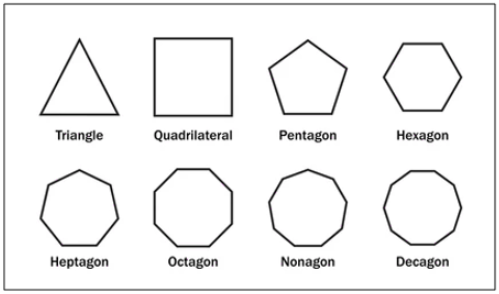
Various types’ regular polygons

Regular polygons get their names from the number of sides they have.

Figure 1: Examples of Regular polygons

Formula

The following formula can be used to compute each angle of a regular polygon

(n-2)×180°/n

where n is the number of sides in the regular polygon.

2. Irregular polygons

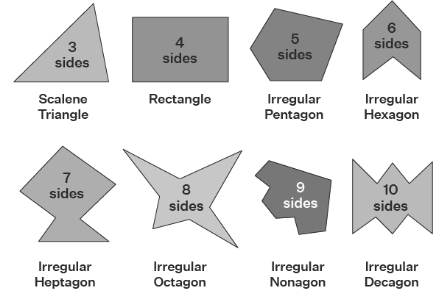
Irregular polygons have sides that are not equal in length and angles that are not equal in measure. As a result, they’re also known as non-regular polygons. In our daily lives, we see irregular polygons in the same way that we see regular polygons. An irregular polygon’s shape may not be as perfect as a regular polygon’s, but it is a closed figure with different side lengths. Scalene triangle, rectangle, kite, and other irregular polygons are examples. These two shapes are considered irregular polygons when the angles and sides of a pentagon and hexagon are not equal. 

Some examples of irregular polygons are shown in the figure below.

Figure 2: Examples of irregular

Formula

Simple formulas can be used to calculate the area and perimeter of irregular polygons.

Figure: 3 

A flat closed shape with irregular sides and angles is known as an irregular polygon. In order to compute the area of irregular polygons, we first divide the irregular polygon into a collection of regular polygons whose area formulas are known. Consider the following scenario.

The ABCD polygon is a skewed polygon. As a result, the polygon ABCD can be divided into two triangles, ABC and ADC. The area of the triangle can be calculated as follows:

Area of polygon ABCD = Area of ∆ABC + Area of ∆ADC

Regular and irregular polygon and their properties 

Regular Polygon Properties

  • A regular polygon’s sides and interior angles are all equal.

  • At the center of a regular polygon, the bisectors of the interior angles meet.

  • The lines connecting a regular polygon’s center to its vertices are all the same length.

  • The center of both the inscribed and circumscribed circles is the center of a regular polygon.

  • A regular polygon is divided into as many equal isosceles triangles as there are sides by straight lines drawn from the center to the vertices.

  • All perpendiculars drawn from a regular polygon’s center to its sides are equal. 

Irregular Polygon Properties

Irregular polygons have a few unique characteristics that set them apart from other polygons. The properties are as follows:

  • An irregular polygon’s sides and angles are not equal, and irregular polygons might be convex or concave in nature.

  • Irregular polygons can be shaped in a number of different ways, both simple and complex.

  • Because their lengths are not equal, irregular polygons have infinitely large sides.

  • Irregular polygons, such as parallelograms, trapeziums, and quadrilaterals, are classed as such because their adjacent sides and angles are not equal.

Conclusion

We study that, Triangles (three sides), quadrilaterals (four sides), and pentagons (five sides) are the simplest polygons. All sides of a regular polygon are the same length, while not all sides of an irregular polygon are the same length. Polygon is a framework for creating block chain networks that are interconnected. It uses a revolutionary side chain solution to overcome some of the major shortcomings, such as low throughput, a poor user experience (slow transactions), and a lack of community governance. Polygons appear in practically every aspect of our lives, from fruits to honeycomb, from floor plans to rectangular or square-shaped structures. We use nut bolts with either a circular or hexagonal top.


faq

Frequently asked questions

Get answers to the most common queries related to the JEE Examination Preparation.

Write down the Difference between a Regular and an Irregular Polygon?

Ans. A regular polygon is one with equal lengths on all sides and identical angles at each vertex, whereas an irregu...Read full

What is the best way to tell if a polygon is regular?

Ans. Any polygon that meets the following three characteristics is a regular p...Read full

Is it True that a Circle Is a Polygon?

Ans. Circle does not contain three or more straight lines or line segments, it is not considered a polygon. It doesn...Read full

What is the Polygon Shape's Perimeter?

Ans. In two -dimensional plane, the perimeter of a polygon is defined as the total length of the polygon’s bou...Read full

How Do You Calculate the Outside Angle of an Irregular Polygon?

Ans. The formula is used to compute the measure of an irregular polygon’s exterior angle,...Read full

Ans. A regular polygon is one with equal lengths on all sides and identical angles at each vertex, whereas an irregular polygon has sides that are not equal and angles that differ from one another. These are the characteristics that distinguish a regular polygon from an irregular polygon.


Ans. Any polygon that meets the following three characteristics is a regular polygon:

  • All of its sides must be the same length.
  • All inside angles must be the same measurement.
  • All of the external angles must be the same measurement.


Ans. Circle does not contain three or more straight lines or line segments, it is not considered a polygon. It doesn’t meet the condition for identifying a polygon because it doesn’t have three or more sides or display any angles. As a result, we can claim that the circle is not a polygon.


Ans. In two -dimensional plane, the perimeter of a polygon is defined as the total length of the polygon’s boundary. The perimeter of a polygon is measured in centimeters, inches, or feet, depending on the unit.

Ans. The formula is used to compute the measure of an irregular polygon’s exterior angle,360°/n, where the number of sides of a polygon is n.


Crack IIT JEE with Unacademy

Get subscription and access unlimited live and recorded courses from India’s best educators

  • Structured syllabus
  • Daily live classes
  • Ask doubts
  • Tests & practice
Learn more

Notifications

Get all the important information related to the JEE Exam including the process of application, important calendar dates, eligibility criteria, exam centers etc.

Allotment of Examination Centre
JEE Advanced Eligibility Criteria
JEE Advanced Exam Dates
JEE Advanced Exam Pattern 2023
JEE Advanced Syllabus
JEE Application Fee
JEE Application Process
JEE Eligibility Criteria 2023
JEE Exam Language and Centres
JEE Exam Pattern – Check JEE Paper Pattern 2024
JEE Examination Scheme
JEE Main 2024 Admit Card (OUT) – Steps to Download Session 1 Hall Ticket
JEE Main Application Form
JEE Main Eligibility Criteria 2024
JEE Main Exam Dates
JEE Main Exam Pattern
JEE Main Highlights
JEE Main Paper Analysis
JEE Main Question Paper with Solutions and Answer Keys
JEE Main Result 2022 (Out)
JEE Main Revised Dates
JEE Marking Scheme
JEE Preparation Books 2024 – JEE Best Books (Mains and Advanced)
Online Applications for JEE (Main)-2022 Session 2
Reserved Seats
See all

Related articles

Learn more topics related to Mathematics
Zero Vector

A zero vector is defined as a line segment coincident with its beginning and ending points. Primary Keyword: Zero Vector

ZERO MATRIX

In this article, we will discuss about the zero matrix and it’s properties.

YARDS TO FEET

In this article we will discuss the conversion of yards into feet and feets to yard.

XVI Roman Numeral

In this article we are going to discuss XVI Roman Numerals and its origin.

See all
Access more than

10,505+ courses for IIT JEE

Get subscription

Trending Topics

  • JEE Main 2024
  • JEE Main Rank Predictor 2024
  • JEE Main Mock Test 2024
  • JEE Main 2024 Admit Card
  • JEE Advanced Syllabus
  • JEE Preparation Books
  • JEE Notes
  • JEE Advanced Toppers
  • JEE Advanced 2022 Question Paper
  • JEE Advanced 2022 Answer Key
  • JEE Main Question Paper
  • JEE Main Answer key 2022
  • JEE Main Paper Analysis 2022
  • JEE Main Result
  • JEE Exam Pattern
  • JEE Main Eligibility
  • JEE College predictor
combat_iitjee

Related links

  • JEE Study Materials
  • CNG Full Form
  • Dimensional Formula of Pressure
  • Reimer Tiemann Reaction
  • Vector Triple Product
  • Swarts Reaction
  • Focal length of Convex Lens
  • Root mean square velocities
  • Fehling’s solution
testseries_iitjee
Predict your JEE Rank
.
Company Logo

Unacademy is India’s largest online learning platform. Download our apps to start learning


Starting your preparation?

Call us and we will answer all your questions about learning on Unacademy

Call +91 8585858585

Company
About usShikshodayaCareers
we're hiring
BlogsPrivacy PolicyTerms and Conditions
Help & support
User GuidelinesSite MapRefund PolicyTakedown PolicyGrievance Redressal
Products
Learner appLearner appEducator appEducator appParent appParent app
Popular goals
IIT JEEUPSCSSCCSIR UGC NETNEET UG
Trending exams
GATECATCANTA UGC NETBank Exams
Study material
UPSC Study MaterialNEET UG Study MaterialCA Foundation Study MaterialJEE Study MaterialSSC Study Material

© 2026 Sorting Hat Technologies Pvt Ltd

Unacademy
  • Goals
    • AFCAT
    • AP EAMCET
    • Bank Exam
    • BPSC
    • CA Foundation
    • CAPF
    • CAT
    • CBSE Class 11
    • CBSE Class 12
    • CDS
    • CLAT
    • CSIR UGC
    • GATE
    • IIT JAM
    • JEE
    • Karnataka CET
    • Karnataka PSC
    • Kerala PSC
    • MHT CET
    • MPPSC
    • NDA
    • NEET PG
    • NEET UG
    • NTA UGC
    • Railway Exam
    • SSC
    • TS EAMCET
    • UPSC
    • WBPSC
    • CFA

Share via

COPY