Access free live classes and tests on the app
Download
+
Unacademy
  • Goals
    • AFCAT
    • AP EAMCET
    • Bank Exam
    • BPSC
    • CA Foundation
    • CAPF
    • CAT
    • CBSE Class 11
    • CBSE Class 12
    • CDS
    • CLAT
    • CSIR UGC
    • GATE
    • IIT JAM
    • JEE
    • Karnataka CET
    • Karnataka PSC
    • Kerala PSC
    • MHT CET
    • MPPSC
    • NDA
    • NEET PG
    • NEET UG
    • NTA UGC
    • Railway Exam
    • SSC
    • TS EAMCET
    • UPSC
    • WBPSC
    • CFA
Login Join for Free
avtar
  • ProfileProfile
  • Settings Settings
  • Refer your friendsRefer your friends
  • Sign outSign out
  • Terms & conditions
  • •
  • Privacy policy
  • About
  • •
  • Careers
  • •
  • Blog

© 2023 Sorting Hat Technologies Pvt Ltd

Watch Free Classes
    • Free courses
    • JEE Main 2024
    • JEE Main 2024 Live Paper Discussion
    • JEE Main Rank Predictor 2024
    • JEE Main College Predictor 2024
    • Stream Predictor
    • JEE Main 2024 Free Mock Test
    • Study Materials
    • Notifications
    • JEE Advanced Syllabus
    • JEE Books
    • JEE Main Question Paper
    • JEE Coaching
    • Downloads
    • JEE Notes & Lectures
    • JEE Daily Videos
    • Difference Between
    • Full Forms
    • Important Formulas
    • Exam Tips
JEE Main 2026 Preparation: Question Papers, Solutions, Mock Tests & Strategy Unacademy » JEE Study Material » Mathematics » Addition of Vectors

Addition of Vectors

There are two laws of addition of vectors, one is the parallelogram law of vector addition and the other is the triangle law of vector addition, both produce the same result but it depends upon the situation to decide which one would be more suitable to use.

Table of Content
  •  

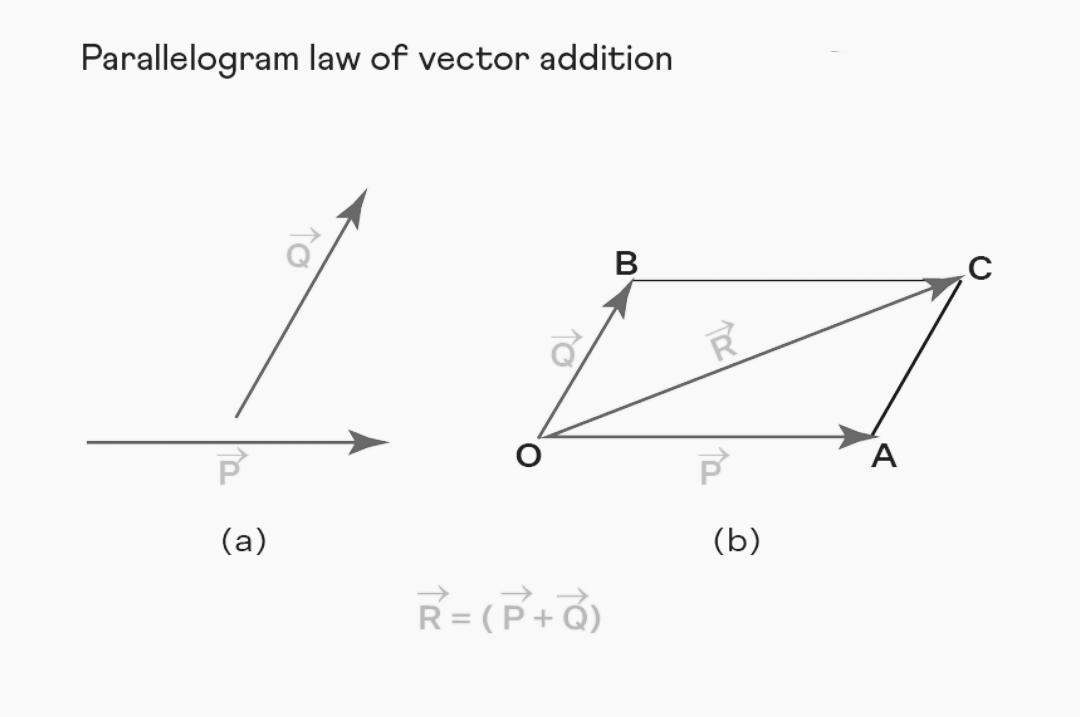
In vector theory, determining the sum of two vectors can be accomplished using a method that is based on the parallelogram law of vector addition. This method is known as the parallelogram law of vector addition. For the purpose of adding two vectors, this law of vector addition is applied when the vectors to be added form two adjacent sides of a parallelogram. The parallelogram is produced by combining the tails of the two vectors to produce the parallelogram itself. In this particular instance, the calculation of the sum of the two vectors makes use of the diagonal of the parallelogram. 

The Triangle Law of Addition to Vectors

Let’s say we have a car that is travelling from point A to point B, as depicted in the diagram on the right. Once it reaches point B, it resumes its journey until it reaches point C. Now, in order to determine the total distance that the car has travelled, we will apply the concept of adding vectors together. The vector AC, which can be calculated by applying the triangle rule of vector addition as demonstrated in the following example, represents the car’s total displacement, which can be expressed as a net value.

AC = AB + BC

In a similar manner, if we have two vectors P and Q, as shown below, and we need to compute the sum of those vectors, we can move the vector Q in such a way that its tail is attached to the head of the vector P without changing the magnitude or direction of the vector Q. This will allow us to find the sum of the two vectors. The following is how we can compute the sum of the vectors P and Q using the triangle law of vector addition:

R = P + Q

Parallelogram Law of Vector Addition

The parallelogram law of vector addition is a law that makes it easier to determine the sum vector that results from an operation known as vector addition, which can be used to determine the sum of two vectors. Assume that a fish is swimming from one side of a river to the other side of the river in the direction of the vector Q, and that the water in the river is flowing in the direction of the vector P, as shown in the image below. This would indicate that the fish is swimming in the direction of the vector Q.

Because there are two velocities at play here, namely the velocity of the fish and the flow of water in the river (which will be a separate velocity), the total of these two velocities is what is meant to be understood as the fish’s “net” velocity. Because of this, the fish will move in a different direction along a vector that has the same length as the sum of the two velocities it is experiencing. It is now possible to calculate the net velocity by thinking of these two vectors as the adjacent sides of a parallelogram and using the parallelogram law of vector addition to determine the total vector that results from adding up all of the vectors in the parallelogram.
Conclusion

Vectors are combinations of direction and magnitude. Using the technique known as vector addition, it is possible to combine two vectors, which are represented by the symbol “a+b,” and the final vector can be expressed as a + b. Only vectors that are of the same type as one another can be combined into a single vector. As an illustration, acceleration ought to be added with just acceleration and not mass as well. Combining vectors and scalars is not something that can be done. If you order the two vectors by attaching the head of one vector to the tail of the other vector, then the vector that sums the two vectors is the vector that unites the free heads and tails of the vectors (by triangle law). If the two vectors are meant to stand in for the two adjacent sides of a parallelogram, then the sum will point to the diagonal vector that can be drawn from the point at which the two vectors intersect, which is also known as the point where the two vectors meet (by parallelogram law).

faq

Frequently asked questions

Get answers to the most common queries related to the JEE Examination Preparation.

What is the commutative property of vector addition?

Ans. The commutative property of vector addition states that for any two vecto...Read full

What is meant by "the parallelogram law of vector addition"?

Ans. According to the Parallelogram law of vector addition, if two vectors a and b represent two parallelogram sides...Read full

Does the Triangle Law of Vector Addition correspond to the Parallelogram Law of Vector Addition, or are these two laws the same thing?

Ans. There are two methods of adding vectors that are comparable to one another. These are the Parallelogram Law of ...Read full

What distinguishes the Triangle Law of Vector Addition from the Parallelogram Law of Vector Addition when it comes to the process of adding vectors?

Ans. The third side of a triangle formed by any two given vectors will be the resultant sum vector for any two given...Read full

Using the Triangle Law for the Addition of Vectors, how do you add vectors using the triangle law?

Ans. When two vectors P and Q are joined together, we add the vectors and use ...Read full

Ans. The commutative property of vector addition states that for any two vectors, a and b, the result of adding them together is always the same.

a+b = b+a

Ans. According to the Parallelogram law of vector addition, if two vectors a and b represent two parallelogram sides in magnitude and direction, then the diagonal of the parallelogram through the point where they both intersect in magnitude and direction is equal to the sum of a and b. This is the case even if a and b do not represent the same magnitude or direction.

Ans. There are two methods of adding vectors that are comparable to one another. These are the Parallelogram Law of Vector Addition and the Triangle Law of Vector Addition. Both rules result in a sum vector that has the same magnitude and direction as the vector that was being summed, to begin with.

Ans. The third side of a triangle formed by any two given vectors will be the resultant sum vector for any two given vectors, as stated by the triangle law of vector addition (also known as the triangle law of vector addition), In contrast, in accordance with the parallelogram law of vector addition, the resultant sum vector is the diagonal of the parallelogram.

Ans. When two vectors P and Q are joined together, we add the vectors and use the following formulas to determine the resultant vector R:

|R| = √(P2 + Q2 + 2PQ cos θ)

ϕ = tan-1[(Q sin θ)/(P + Q cos θ)]

Crack IIT JEE with Unacademy

Get subscription and access unlimited live and recorded courses from India’s best educators

  • Structured syllabus
  • Daily live classes
  • Ask doubts
  • Tests & practice
Learn more

Notifications

Get all the important information related to the JEE Exam including the process of application, important calendar dates, eligibility criteria, exam centers etc.

Allotment of Examination Centre
JEE Advanced Eligibility Criteria
JEE Advanced Exam Dates
JEE Advanced Exam Pattern 2023
JEE Advanced Syllabus
JEE Application Fee
JEE Application Process
JEE Eligibility Criteria 2023
JEE Exam Language and Centres
JEE Exam Pattern – Check JEE Paper Pattern 2024
JEE Examination Scheme
JEE Main 2024 Admit Card (OUT) – Steps to Download Session 1 Hall Ticket
JEE Main Application Form
JEE Main Eligibility Criteria 2024
JEE Main Exam Dates
JEE Main Exam Pattern
JEE Main Highlights
JEE Main Paper Analysis
JEE Main Question Paper with Solutions and Answer Keys
JEE Main Result 2022 (Out)
JEE Main Revised Dates
JEE Marking Scheme
JEE Preparation Books 2024 – JEE Best Books (Mains and Advanced)
Online Applications for JEE (Main)-2022 Session 2
Reserved Seats
See all

Related articles

Learn more topics related to Mathematics
Access more than

10,505+ courses for IIT JEE

Get subscription
Company Logo

Unacademy is India’s largest online learning platform. Download our apps to start learning


Starting your preparation?

Call us and we will answer all your questions about learning on Unacademy

Call +91 8585858585

Company
About usShikshodayaCareers
we're hiring
BlogsPrivacy PolicyTerms and Conditions
Help & support
User GuidelinesSite MapRefund PolicyTakedown PolicyGrievance Redressal
Products
Learner appLearner appEducator appEducator appParent appParent app
Popular goals
IIT JEEUPSCSSCCSIR UGC NETNEET UG
Trending exams
GATECATCANTA UGC NETBank Exams
Study material
UPSC Study MaterialNEET UG Study MaterialCA Foundation Study MaterialJEE Study MaterialSSC Study Material

© 2026 Sorting Hat Technologies Pvt Ltd

Unacademy
  • Goals
    • AFCAT
    • AP EAMCET
    • Bank Exam
    • BPSC
    • CA Foundation
    • CAPF
    • CAT
    • CBSE Class 11
    • CBSE Class 12
    • CDS
    • CLAT
    • CSIR UGC
    • GATE
    • IIT JAM
    • JEE
    • Karnataka CET
    • Karnataka PSC
    • Kerala PSC
    • MHT CET
    • MPPSC
    • NDA
    • NEET PG
    • NEET UG
    • NTA UGC
    • Railway Exam
    • SSC
    • TS EAMCET
    • UPSC
    • WBPSC
    • CFA

Share via

COPY