Access free live classes and tests on the app
Download
+
Unacademy
  • Goals
    • AFCAT
    • AP EAMCET
    • Bank Exam
    • BPSC
    • CA Foundation
    • CAPF
    • CAT
    • CBSE Class 11
    • CBSE Class 12
    • CDS
    • CLAT
    • CSIR UGC
    • GATE
    • IIT JAM
    • JEE
    • Karnataka CET
    • Karnataka PSC
    • Kerala PSC
    • MHT CET
    • MPPSC
    • NDA
    • NEET PG
    • NEET UG
    • NTA UGC
    • Railway Exam
    • SSC
    • TS EAMCET
    • UPSC
    • WBPSC
    • CFA
Login Join for Free
avtar
  • ProfileProfile
  • Settings Settings
  • Refer your friendsRefer your friends
  • Sign outSign out
  • Terms & conditions
  • •
  • Privacy policy
  • About
  • •
  • Careers
  • •
  • Blog

© 2023 Sorting Hat Technologies Pvt Ltd

Watch Free Classes
    • Free courses
    • JEE Main 2024
    • JEE Main 2024 Live Paper Discussion
    • JEE Main Rank Predictor 2024
    • JEE Main College Predictor 2024
    • Stream Predictor
    • JEE Main 2024 Free Mock Test
    • Study Materials
    • Notifications
    • JEE Advanced Syllabus
    • JEE Books
    • JEE Main Question Paper
    • JEE Coaching
    • Downloads
    • JEE Notes & Lectures
    • JEE Daily Videos
    • Difference Between
    • Full Forms
    • Important Formulas
    • Exam Tips
JEE Main 2026 Preparation: Question Papers, Solutions, Mock Tests & Strategy Unacademy » JEE Study Material » Mathematics » A General Study on Addition Theorem

A General Study on Addition Theorem

in this article we will cover probability and addition theorem, example of addition theorem, what is the use of addition theorem in probability. When two outcomes are possible and the occurrence of one does not preclude the occurrence of the other, the addition rule for non-mutually exclusive events is applicable.

Table of Content
  •  

The addition rule for non-mutually exclusive events is applicable when two outcomes are possible and the occurrence of one does not preclude the occurrence of the other. 

This scenario differs from the one depicted in the preceding section due to the probability of overlap, P(A and B), which is supplied. Since the addition rule is used to determine the likelihood that either one or the other event will occur, the likelihood that both events will occur concurrently must be deducted from the outcome.

Probability and Addition Theorem

In probability, addition concepts are crucial. If we are aware of the probabilities of events “A” and “B,” we can use these criteria to determine the likelihood of either happening. The set theory symbol U, which represents the union of two sets, can occasionally be used in place of the word “or.” Whether or not events A and B are mutually exclusive determines which addition rule should be applied.

The probabilities of the two events are simply added together in the first formula. The probability that both occurrences will occur is subtracted from the sum of the probabilities of the two events in the second formula.

If two events A and B are exclusive of one another, then

Theorem:  P(A B)=P(A)+P(B)-P(A∩B)

Where, 

P(A ∪B) = Probability that A or B will occur

P(A)= The probability of Event A

P(B) = The probability of Event B

Proof: 

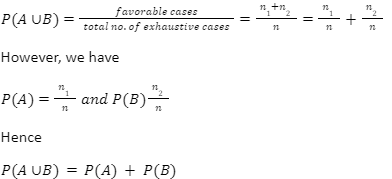
Consider the

n=total number of exhaustive cases

n1=no. of cases favorable to A

n2=no. of cases favorable to B

We currently have two events—A and B—that cannot both occur. Therefore n1+n2 is the number of A or B-favorable cases.

Mutual Exclusivity

A statistical phrase for two or more events that cannot coincide is “mutually exclusive.” It is frequently used to refer to circumstances in which the occurrence of one event takes precedence over the other. Take rolling the dice as a simple illustration. On the same die, you cannot simultaneously roll a three and a five. Additionally, getting a three on the first roll has no bearing on whether a later roll results in a five or not. Every die roll is a distinct occasion.

Addition Rule for Independent Events

When it comes to probability, two occurrences are deemed independent if the occurrence of one has no bearing on the likelihood that the other will happen. Dependent occurrences, on the other hand, are those whose probabilities influence one another.

Example of Addition Theorem

Example

What is the probability that an issue will be solved if two students, Paul and Jimmy, each have a 50% and a 33% chance of doing so?

Solution

Let A and B represent the chances of Paul and Jimmy solving the issue, respectively.Then ,

If the issue is resolved by at least one of them as well, the issue will be resolved.

So, we must locate  P(AUB)

Using the probability addition theorem, we have

P(AUB) = P(A) + P(B)- P(A∩B)

What is the use of the addition theorem in probability?

One must add the odds of each occurrence occurring in the case of mutually excusable events. The probabilities of each event occurring separately must be added, and the probability of the events occurring simultaneously must be subtracted, in the case of non-mutually exclusive events.

The probability that at least one of the events occurs is calculated using the addition rule for probabilities. The area of mathematics known as probability is the study of how certain or uncertain an event or series of events is.

Conclusion

In this article, the scenarios in which the probability of a union of events can be determined by adding probabilities together are given by the probability rule of addition. It is frequently used when two occurrences are mutually exclusive, or when they cannot occur simultaneously.

The probability that at least one of the events occurs is determined using the probabilities addition rule. It is possible to define probability as the area of mathematics that measures how certain or uncertain an event or series of events is.


faq

Frequently asked questions

Get answers to the most common queries related to the JEE Examination Preparation.

How is the probability addition theorem demonstrated?

Answer. Given: A and B are any two events of a random experiment. To support: ...Read full

In probability, what does addition mean?

Answer. The addition rule for probability outlines two formulas, one for the likelihood of either of two events occu...Read full

What is the mutually exclusive events addition rule?

Answer. We can apply the following information to the addition rule P(A∩B) =...Read full

How can you tell whether two probabilities are mutually exclusive?

Answer. If two events can’t happen at the same time, they are said to be mutually exclusive or disjoint in log...Read full

What are the two probability theorems?

Answer. The law of multiplication and addition, which we apply to compute the probabilities of events...Read full

Answer. Given: A and B are any two events of a random experiment. To support: P(A∪B)=P(A)+P(B)-P(A∩B). n(A∪B)=n(A)+n(B)-n(A∩B). As a result, the probability addition theorem stated above is established.

Answer. The addition rule for probability outlines two formulas, one for the likelihood of either of two events occurring that are mutually exclusive and the other for the probability of two events occurring that are not mutually exclusive. The probabilities of the two events are simply added together in the first formula.

Answer. We can apply the following information to the addition rule P(A∩B) = 0. if the events are “mutually exclusive,” or not conceivable to occur simultaneously. The addition rule simply changes to P(A∪B) = P(A) + P(B) in this situation 

Answer. If two events can’t happen at the same time, they are said to be mutually exclusive or disjoint in logic and probability theory. The results of a single coin toss, which can only produce either heads or tails but not both, serve as an obvious illustration.

Answer. The law of multiplication and addition, which we apply to compute the probabilities of events A and B as well as the probabilities of two given events A and B specified on the sample space, are the two fundamental laws of probability.

Crack IIT JEE with Unacademy

Get subscription and access unlimited live and recorded courses from India’s best educators

  • Structured syllabus
  • Daily live classes
  • Ask doubts
  • Tests & practice
Learn more

Notifications

Get all the important information related to the JEE Exam including the process of application, important calendar dates, eligibility criteria, exam centers etc.

Allotment of Examination Centre
JEE Advanced Eligibility Criteria
JEE Advanced Exam Dates
JEE Advanced Exam Pattern 2023
JEE Advanced Syllabus
JEE Application Fee
JEE Application Process
JEE Eligibility Criteria 2023
JEE Exam Language and Centres
JEE Exam Pattern – Check JEE Paper Pattern 2024
JEE Examination Scheme
JEE Main 2024 Admit Card (OUT) – Steps to Download Session 1 Hall Ticket
JEE Main Application Form
JEE Main Eligibility Criteria 2024
JEE Main Exam Dates
JEE Main Exam Pattern
JEE Main Highlights
JEE Main Paper Analysis
JEE Main Question Paper with Solutions and Answer Keys
JEE Main Result 2022 (Out)
JEE Main Revised Dates
JEE Marking Scheme
JEE Preparation Books 2024 – JEE Best Books (Mains and Advanced)
Online Applications for JEE (Main)-2022 Session 2
Reserved Seats
See all

Related articles

Learn more topics related to Mathematics
Zero Vector

A zero vector is defined as a line segment coincident with its beginning and ending points. Primary Keyword: Zero Vector

ZERO MATRIX

In this article, we will discuss about the zero matrix and it’s properties.

YARDS TO FEET

In this article we will discuss the conversion of yards into feet and feets to yard.

XVI Roman Numeral

In this article we are going to discuss XVI Roman Numerals and its origin.

See all
Access more than

10,505+ courses for IIT JEE

Get subscription
Company Logo

Unacademy is India’s largest online learning platform. Download our apps to start learning


Starting your preparation?

Call us and we will answer all your questions about learning on Unacademy

Call +91 8585858585

Company
About usShikshodayaCareers
we're hiring
BlogsPrivacy PolicyTerms and Conditions
Help & support
User GuidelinesSite MapRefund PolicyTakedown PolicyGrievance Redressal
Products
Learner appLearner appEducator appEducator appParent appParent app
Popular goals
IIT JEEUPSCSSCCSIR UGC NETNEET UG
Trending exams
GATECATCANTA UGC NETBank Exams
Study material
UPSC Study MaterialNEET UG Study MaterialCA Foundation Study MaterialJEE Study MaterialSSC Study Material

© 2026 Sorting Hat Technologies Pvt Ltd

Unacademy
  • Goals
    • AFCAT
    • AP EAMCET
    • Bank Exam
    • BPSC
    • CA Foundation
    • CAPF
    • CAT
    • CBSE Class 11
    • CBSE Class 12
    • CDS
    • CLAT
    • CSIR UGC
    • GATE
    • IIT JAM
    • JEE
    • Karnataka CET
    • Karnataka PSC
    • Kerala PSC
    • MHT CET
    • MPPSC
    • NDA
    • NEET PG
    • NEET UG
    • NTA UGC
    • Railway Exam
    • SSC
    • TS EAMCET
    • UPSC
    • WBPSC
    • CFA

Share via

COPY