
Access free live classes and tests on the app
Download
+
Unacademy
  • Goals
    • AFCAT
    • AP EAMCET
    • Bank Exam
    • BPSC
    • CA Foundation
    • CAPF
    • CAT
    • CBSE Class 11
    • CBSE Class 12
    • CDS
    • CLAT
    • CSIR UGC
    • GATE
    • IIT JAM
    • JEE
    • Karnataka CET
    • Karnataka PSC
    • Kerala PSC
    • MHT CET
    • MPPSC
    • NDA
    • NEET PG
    • NEET UG
    • NTA UGC
    • Railway Exam
    • SSC
    • TS EAMCET
    • UPSC
    • WBPSC
    • CFA
Login Join for Free
avtar
  • ProfileProfile
  • Settings Settings
  • Refer your friendsRefer your friends
  • Sign outSign out
  • Terms & conditions
  • •
  • Privacy policy
  • About
  • •
  • Careers
  • •
  • Blog

© 2023 Sorting Hat Technologies Pvt Ltd

JEE Main 2026 Preparation: Question Papers, Solutions, Mock Tests & Strategy Unacademy » JEE Study Material » Chemistry » Pseudo First Order Reaction

Pseudo First Order Reaction

In this article you will be able to grasp a clear concept on pseudo first order reaction, its examples and half-life of pseudo first order reaction.

Table of Content
  •  

The reaction that appears to be an nth order reaction, whereas it belongs to some different order is known as the pseudo order reaction. These are the reactions that are generally not first-order but appear to be first order due to increased concentrations of one or more reactants than the other reactants. For example the pseudo first-order reactions include Acid-catalysed hydrolysis of ethyl acetate, and inversion of sugarcane. As we all know that the order of the reaction can be determined by the rate of reaction’s dependence on the concentration of reactants. The order of the reaction in these cases is zero when the rate is independent of the concentrations of reactants. Similarly, the order of the reaction is the one in which the rate of reaction is proportional to the first power of the reactant concentration. 

Any reaction which is not first-order reaction naturally but it is made first order via increasing or decreasing the concentration of one or the  other reactant is called Pseudo first order reaction. Pseudo refers to ‘fake’. Thus, we get clear information from the name itself that a reaction is not a first-order reaction by nature. The order of reaction is made one by altering certain conditions.  

Examples of Pseudo First Order Reaction

  1. Hydrolysis of an ester: an example of this type of reaction is seen in, ethyl acetate which upon hydrolysis in aqueous solution using a mineral acid as catalyst results in the formation of acetic acid and ethyl alcohol.

ethyl acetate (is formed in excess) acetic acid ethyl alcohol. Here a huge amount of water is used and the rate law can now be written as

The reaction is mainly second-order but in practice it is observed to be first-order. Hence, it represents a pseudo-1st order reaction.

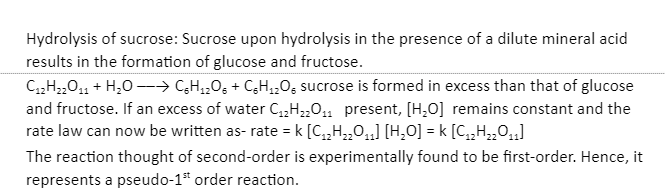
Hydrolysis of sucrose: Sucrose upon hydrolysis in the presence of a dilute mineral acid results in the formation of glucose and fructose.
Pseudo First Order Reaction vs First Order Reaction

The major difference is usually that, in a first order reaction, the order of reaction is one by nature. A pseudo first-order reaction is a second order reaction by nature but it has been altered to make it a first order reaction. The second point of difference is that in a first order reaction, the rate of reaction is based on all the reactants whereas, in a pseudo-first-order reaction, the rate of reaction based only on the isolated reactant as a difference in the concentration of the reactant in excess usually will not affect the reaction.

Half-Life in a Pseudo-1st Order reaction

Half-life is defined as the time needed to decrease the concentration of a reactant by half, so we must solve it for t. Here, [B] represents the reactant in excess, and its concentration will remain constant. [A]o represents the initial concentration of A; so the half-life concentration of A is calculated to be 0.5[A]o. 

The pseudo-1st-order reaction equation is written as:

[A] = [A]oe−[B]kt     or   [A]/[A]o = e−k′t  

By taking natural logs on both sides of the pseudo-1st-order equation, we get: ln([A]/[A]o)=k’t 

 As the concentration of A for a half-life t1/2 is 1/2[A]o : 

ln(1/2[A]o / [A]o)= ln(1/2) = −k’t1/2 

So again recalling that k’ = k[B], [B]≈[B]o and that −ln(1/2)=ln2:  ln(2) = k[B]ot1/2 

                                                                 t1/2 = ln2k[B]o

Conclusion

In this article, we have learned about the pseudo-first-order reaction. With the help of two different examples of pseudo-first-order reactions, we have helped you to know different reactions that are not of first-order reaction but appear to be of first order because of the higher concentration of the reactants. We hope that you were able to grasp a clear concept of pseudo- first order reaction.


faq

Frequently Asked Questions

Get answers to the most common queries related to the JEE Examination Preparation.

For a pseudo first-order reaction, what is the unit of the rate of the reaction?

Ans. The unit of the rate of the reaction (k) is (mol L...Read full

If a 2nd order reaction has the rate equation R = k[A][B], and the rate constant, k, is 3.67 M-1s-1, [A] is 4.5 M and [B] is 99 M, what is the rate constant of its pseudo-1st-order reaction?

Ans.  Because [B] is in excess we multiply 99 M with 3.67 M...Read full

What is the rate law of hydrolysis of CH3COOC2H5 in aqueous solution?

...Read full

For the reaction C2H5COOC2H5 + H2O → C2H5COOH + C2H5OH, find the concentration of [C2H5COOC2H5] if the rate constant k=0.2 and the rate of the reaction.

...Read full

Write one point of difference between a first order and pseudo first order reaction?

Ans. Both first order and pseudo first order reactions follow first or...Read full

Ans.

The unit of the rate of the reaction (k) is (mol L-¹)¹-n s-¹, where n is the order of the reaction. For a pseudo first-order reaction n=1. So, (mol L-¹)1-ns-¹ = (mol L-¹)¹-1s-1 = s-¹ .

Ans.

 Because [B] is in excess we multiply 99 M with 3.67 M-¹s-¹

(99M)(3.67M-¹s-¹) = 363.33s-¹ .

Ans.

Both first order and pseudo first order reactions follow first order kinetics as in the rate of the reaction depends only on one reactant and the unit for rate constant is s-1 but the molecularity in first order reaction should be one where as in pseudo first order reaction the molecularity can be more than one. For example: Inversion of cane sugar.

Company Logo

Unacademy is India’s largest online learning platform. Download our apps to start learning


Starting your preparation?

Call us and we will answer all your questions about learning on Unacademy

Call +91 8585858585

Company
About usShikshodayaCareers
we're hiring
BlogsPrivacy PolicyTerms and Conditions
Help & support
User GuidelinesSite MapRefund PolicyTakedown PolicyGrievance Redressal
Products
Learner appLearner appEducator appEducator appParent appParent app
Popular goals
IIT JEEUPSCSSCCSIR UGC NETNEET UG
Trending exams
GATECATCANTA UGC NETBank Exams
Study material
UPSC Study MaterialNEET UG Study MaterialCA Foundation Study MaterialJEE Study MaterialSSC Study Material

© 2026 Sorting Hat Technologies Pvt Ltd

Unacademy
  • Goals
    • AFCAT
    • AP EAMCET
    • Bank Exam
    • BPSC
    • CA Foundation
    • CAPF
    • CAT
    • CBSE Class 11
    • CBSE Class 12
    • CDS
    • CLAT
    • CSIR UGC
    • GATE
    • IIT JAM
    • JEE
    • Karnataka CET
    • Karnataka PSC
    • Kerala PSC
    • MHT CET
    • MPPSC
    • NDA
    • NEET PG
    • NEET UG
    • NTA UGC
    • Railway Exam
    • SSC
    • TS EAMCET
    • UPSC
    • WBPSC
    • CFA

Share via

COPY
