
Access free live classes and tests on the app
Download
+
Unacademy
  • Goals
    • AFCAT
    • AP EAMCET
    • Bank Exam
    • BPSC
    • CA Foundation
    • CAPF
    • CAT
    • CBSE Class 11
    • CBSE Class 12
    • CDS
    • CLAT
    • CSIR UGC
    • GATE
    • IIT JAM
    • JEE
    • Karnataka CET
    • Karnataka PSC
    • Kerala PSC
    • MHT CET
    • MPPSC
    • NDA
    • NEET PG
    • NEET UG
    • NTA UGC
    • Railway Exam
    • SSC
    • TS EAMCET
    • UPSC
    • WBPSC
    • CFA
Login Join for Free
avtar
  • ProfileProfile
  • Settings Settings
  • Refer your friendsRefer your friends
  • Sign outSign out
  • Terms & conditions
  • •
  • Privacy policy
  • About
  • •
  • Careers
  • •
  • Blog

© 2023 Sorting Hat Technologies Pvt Ltd

Watch Free Classes
    • Free courses
    • JEE Main 2024
    • JEE Main 2024 Live Paper Discussion
    • JEE Main Rank Predictor 2024
    • JEE Main College Predictor 2024
    • Stream Predictor
    • JEE Main 2024 Free Mock Test
    • Study Materials
    • Notifications
    • JEE Advanced Syllabus
    • JEE Books
    • JEE Main Question Paper
    • JEE Coaching
    • Downloads
    • JEE Notes & Lectures
    • JEE Daily Videos
    • Difference Between
    • Full Forms
    • Important Formulas
    • Exam Tips
JEE Main 2026 Preparation: Question Papers, Solutions, Mock Tests & Strategy Unacademy » JEE Study Material » Chemistry » Electric Field

Electric Field

The properties of electric fields are associated with different forms of charges. Its magnitude and direction are in the form of electric field strength. It can be understood by Coulomb’s law.

Table of Content
  •  

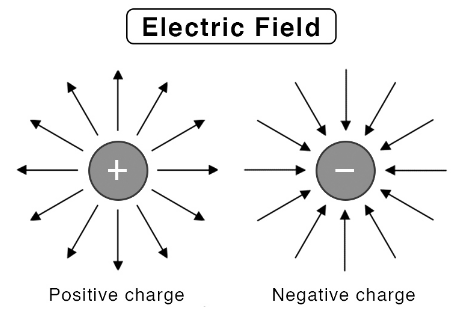
An electric field is a physical field associated with each point present in the space and surrounds the charges that may be present in any form. An electric field has the ability to exert force either by repulsion or by attraction on all the surrounding charged particles. The magnitude as well as the direction of the electric field can be expressed by electric field strength, which is denoted by the symbol E. The electric field strength can also be called electric field intensity or electric field. This can be understood by the following given electric field example in the form of a diagram.
ef1

Electric charge

Electric field is a vector quantity having both magnitudes and direction. It is basically the force experienced by every point carrying a positive charge. Thus, electric force is the result of a phenomenon called electric charge. Electric charges produce a region in space around electrically charged particles, where differently charged particles may feel the force. In an electric field, a charge is considered the source of an electric field when it extends in an outward manner into the surrounding space. The force exerted by the first particle over the second particle in this region may be defined as a direct interaction between the second charge as well as the electric field. 

Mathematically, the electric field is expressed in the form of the equation,

E=F/Q 

Where,

E = Electric field, 

F = Force 

Q = Charge 

What are the dimensions of an electric field?

We can see in the electric field notes that the electric field is expressed in force per unit charge. In the SI system, the units are expressed in Newtons per Coulomb, which is almost equivalent to Volts per meter. In the CGS system, the units are expressed in Dynes per Electrostatic Unit, which is equivalent to Statvolts per centimeter. 

Being a vector quantity, the electric field is assigned arrows going towards and away from charges. Electric field acts in the same way as a gravitational field between two masses. Thus, in the electric field notes, we can see that the electric field obeys the inverse square law with the distance. It can be understood efficiently through Coulomb’s Law. 

Coulomb’s Law

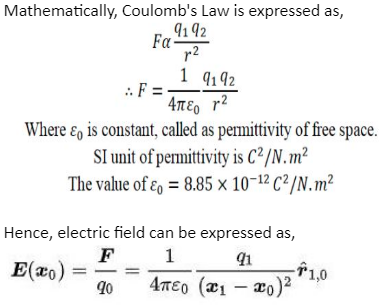
Coulomb’s Law states that the magnitude of the force between two point charges is directly proportional to the charge magnitude and inversely proportional to the distance between the two charges. It can be understood clearly by the following statement: if the source charge is doubled, the electric field would be doubled; and if we move away from a source, the electric field would have an extremely low strength, which is only about one-quarter of its strength with respect to the original.
ef2

The direction of an electric field

The directions of an electric field exerted by positive and negative charges are opposite to each other. The direction of a positive charge is chosen as the direction of the electric field. Since like charges repel each other, the electric field surrounding an isolated positive charge is outwardly radiated. If the electric field is expressed in the form of field lines or lines of force, it is considered as starting on positive charge and ending on negatively charged species. The line tangent to the electric field is used to express the direction of the electric field at a particular point. 

Strength of an electric field

The region where field lines are in close contact with each other experiences a strong electric field as compared to the region where these field lines are far apart. 

Electric field examples

Capacitors and cells of batteries generate electric fields due to their charges and their configurations. Radio waves, light, x-rays, etc., contain components related to the electric field.

Types of electric field

  • Electrostatic Fields
  • Uniform Fields
  • Electrodynamics Fields
  • Electric displacement Field

Electrostatic Fields: These fields do not change with respect to time. They can be seen when there are no changes in the system of charged matter, and they remain stationary. 

Uniform Fields: As the name suggests, they are constant at each point. Its approximation is usually achieved by the placement of conducting plates in parallel manner and maintaining a proper voltage between them. 

Electrodynamics Fields: An electrodynamic field is an electric field example which has a tendency to change with time when the charges remain in motion.

Electric Displacement Field: Electric Displacement Field is also referred to as electric induction. It is a type of vector field that can be found in the Maxwell’s equation section of electric field notes. It is expressed by the symbol D, which corresponds to the term displacement. It accounts for the effects shown by charges that may remain free or may be bound within materials.

Expression of electric field with respect to different point charges

Electric field near an isolated point charge

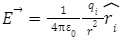
The electric field near an isolated point charge can be expressed by the equation,
ef3

The direction of the electric field points away from the positive charge and towards the negative charge. It can be seen that the magnitude of the electric field falls at a rate of 1r2 as we move away from the point charge. 

Expression of an electric field towards multiple point charges

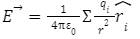
This electric field can be expressed by the summation of the fields from each point charge. The type of summation is a vector sum. 
ef4

Expression of an electric field towards distributed charges

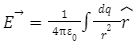
If the charges are expressed as continuous distribution, then the summation is to be taken as an integral.
ef5

Here, r is the distance between dq and the region of utmost interest, while r is the direction of force in a linear way between dq and the region of interest.

Conclusion 

Electric field is a force experienced by a point charge in the surrounding space. It is a vector quantity having both direction and magnitude. It is expressed in Newtons per Coulomb. Mathematically, electric field is expressed in the form of the equation E=F/Q, where E stands for electric field, F stands for force and Q stands for charge. Electric field is expressed by Coulomb’s law.

faq

Frequently Asked Questions

Get answers to the most common queries related to the IIT JEE Examination Preparation.

Where can we locate the strongest electric field?

Ans. The region where the field lines are crowded is considered to be the strongest since the field lines are den...Read full

What does 1 Coulomb mean?

Ans: Coulomb is the SI unit of electric charge. One coulomb is equal to the amount of electric charge ...Read full

What is the expression of electric field?

Ans. Electric field is mathematically expressed in the form of the equation, ...Read full

What is Coulomb’s Law?

Ans. According to Coulomb’s Law, the force of attraction and repulsion between any two charged particles i...Read full

What are the applications of Coulomb’s Law in daily life?

Ans. While mixing subst...Read full

Ans. The region where the field lines are crowded is considered to be the strongest since the field lines are densely located. It means that field lines are in close contact with each other without any form of overlap over one another.

Ans:

Coulomb is the SI unit of electric charge. One coulomb is equal to the amount of electric charge from a current, which has a value of one ampere, flowing at an interval of one second. Thus, mathematically we can express one coulomb as,1 Coulomb =1 Ampere 1 second. It is almost equal to the charge on 6.2411018protons. 


Ans. Electric field is mathematically expressed in the form of the equation, E=F/Q where E is the electric field, F is the force and Q is the electric charge.

Ans. According to Coulomb’s Law, the force of attraction and repulsion between any two charged particles is directly proportional to the product of the magnitude of the charges and inversely proportional to the square of the distance. 


Ans.

  1. While mixing substances in water, polarity plays a major role. An electrostatic interaction exists between the two components i.e. solute and solvent. Thus, Coulomb’s law can be easily applied in this case. 
  2. When we rub a glass rod over a silk or woollen fabric, the glass rod gets charged. The glass rod exerts attraction and repulsion forces onto its neighbouring objects, which proves Coulomb’s law.

Crack IIT JEE with Unacademy

Get subscription and access unlimited live and recorded courses from India’s best educators

  • Structured syllabus
  • Daily live classes
  • Ask doubts
  • Tests & practice
Learn more

Notifications

Get all the important information related to the JEE Exam including the process of application, important calendar dates, eligibility criteria, exam centers etc.

Allotment of Examination Centre
JEE Advanced Eligibility Criteria
JEE Advanced Exam Dates
JEE Advanced Exam Pattern 2023
JEE Advanced Syllabus
JEE Application Fee
JEE Application Process
JEE Eligibility Criteria 2023
JEE Exam Language and Centres
JEE Exam Pattern – Check JEE Paper Pattern 2024
JEE Examination Scheme
JEE Main 2024 Admit Card (OUT) – Steps to Download Session 1 Hall Ticket
JEE Main Application Form
JEE Main Eligibility Criteria 2024
JEE Main Exam Dates
JEE Main Exam Pattern
JEE Main Highlights
JEE Main Paper Analysis
JEE Main Question Paper with Solutions and Answer Keys
JEE Main Result 2022 (Out)
JEE Main Revised Dates
JEE Marking Scheme
JEE Preparation Books 2024 – JEE Best Books (Mains and Advanced)
Online Applications for JEE (Main)-2022 Session 2
Reserved Seats
See all

Related articles

Learn more topics related to Chemistry
Zeolites

Aluminium silicate zeolites are microporous three-dimensional crystalline solids. Zeolites have small, fixed-size openings that allow small molecules to pass through easily but not larger molecules; this is why they are sometimes referred to as molecular sieves.

XeF6 Molecular Geometry and Bond Angles

In this article, we will learn about the XeF6 Molecular Geometry And Bond Angles in detail. We also learn the importance of XeF6 molecular geometry and bond angles importance and much more about the topic in detail.

XeF4 Molecular Geometry and Bond Angeles

A general overview of Lewis Structure, XeF4 Molecular Geometry and bond Angles meaning, valuable XeF4 Molecular Geometry and bond angle questions.

XeF2 Molecular Geometry and Bond Angles

Let us learn about the molecule XeF2, its molecular geometry and bond examples, and XeF2 Lewis structure.

See all
Access more than

10,505+ courses for IIT JEE

Get subscription
Challenge Yourself Everyday
Attempt 2023’s and previous year’s JEE Main
Download Important Formulas pdf
Attempt Free Test Series for JEE Main 2023

Trending Topics

  • JEE Main 2024
  • JEE Main Rank Predictor 2024
  • JEE Main Mock Test 2024
  • JEE Main 2024 Admit Card
  • JEE Advanced Syllabus
  • JEE Preparation Books
  • JEE Notes
  • JEE Advanced Toppers
  • JEE Advanced 2022 Question Paper
  • JEE Advanced 2022 Answer Key
  • JEE Main Question Paper
  • JEE Main Answer key 2022
  • JEE Main Paper Analysis 2022
  • JEE Main Result
  • JEE Exam Pattern
  • JEE Main Eligibility
  • JEE College predictor

JEE Coaching Centres

  • JEE Coaching in Nagpur
  • JEE Coaching in Ranchi
  • JEE Coaching in Gorakhpur
  • JEE Coaching in Bhubaneswar
  • JEE Coaching in Vijayawada
  • JEE Coaching in Dehradun
  • JEE Coaching in Indore
  • JEE Coaching in Gurugram
  • JEE Coaching in Muzaffarpur
  • JEE Coaching in Varanasi
  • JEE Coaching in Jammu
  • JEE Coaching in Kolhapur
  • JEE Coaching in Bikaner
  • JEE Coaching in Delhi Lajpat Nagar
Predict your JEE Rank
.
Company Logo

Unacademy is India’s largest online learning platform. Download our apps to start learning


Starting your preparation?

Call us and we will answer all your questions about learning on Unacademy

Call +91 8585858585

Company
About usShikshodayaCareers
we're hiring
BlogsPrivacy PolicyTerms and Conditions
Help & support
User GuidelinesSite MapRefund PolicyTakedown PolicyGrievance Redressal
Products
Learner appLearner appEducator appEducator appParent appParent app
Popular goals
IIT JEEUPSCSSCCSIR UGC NETNEET UG
Trending exams
GATECATCANTA UGC NETBank Exams
Study material
UPSC Study MaterialNEET UG Study MaterialCA Foundation Study MaterialJEE Study MaterialSSC Study Material

© 2026 Sorting Hat Technologies Pvt Ltd

Unacademy
  • Goals
    • AFCAT
    • AP EAMCET
    • Bank Exam
    • BPSC
    • CA Foundation
    • CAPF
    • CAT
    • CBSE Class 11
    • CBSE Class 12
    • CDS
    • CLAT
    • CSIR UGC
    • GATE
    • IIT JAM
    • JEE
    • Karnataka CET
    • Karnataka PSC
    • Kerala PSC
    • MHT CET
    • MPPSC
    • NDA
    • NEET PG
    • NEET UG
    • NTA UGC
    • Railway Exam
    • SSC
    • TS EAMCET
    • UPSC
    • WBPSC
    • CFA

Share via

COPY