Access free live classes and tests on the app
Download
+
Unacademy
  • Goals
    • AFCAT
    • AP EAMCET
    • Bank Exam
    • BPSC
    • CA Foundation
    • CAPF
    • CAT
    • CBSE Class 11
    • CBSE Class 12
    • CDS
    • CLAT
    • CSIR UGC
    • GATE
    • IIT JAM
    • JEE
    • Karnataka CET
    • Karnataka PSC
    • Kerala PSC
    • MHT CET
    • MPPSC
    • NDA
    • NEET PG
    • NEET UG
    • NTA UGC
    • Railway Exam
    • SSC
    • TS EAMCET
    • UPSC
    • WBPSC
    • CFA
Login Join for Free
avtar
  • ProfileProfile
  • Settings Settings
  • Refer your friendsRefer your friends
  • Sign outSign out
  • Terms & conditions
  • •
  • Privacy policy
  • About
  • •
  • Careers
  • •
  • Blog

© 2023 Sorting Hat Technologies Pvt Ltd

Watch Free Classes
    • Free courses
    • JEE Main 2024
    • JEE Main 2024 Live Paper Discussion
    • JEE Main Rank Predictor 2024
    • JEE Main College Predictor 2024
    • Stream Predictor
    • JEE Main 2024 Free Mock Test
    • Study Materials
    • Notifications
    • JEE Advanced Syllabus
    • JEE Books
    • JEE Main Question Paper
    • JEE Coaching
    • Downloads
    • JEE Notes & Lectures
    • JEE Daily Videos
    • Difference Between
    • Full Forms
    • Important Formulas
    • Exam Tips
JEE Main 2026 Preparation: Question Papers, Solutions, Mock Tests & Strategy Unacademy » JEE Study Material » Chemistry » Aluminium Oxide

Aluminium Oxide

In this topic, we will know the introduction to aluminium oxide, its preparation, its structure, its physical and chemical properties, and its uses.

Table of Content
  •  

Aluminium oxide is also known as alumina, and its chemical formula is Al2O3. It is sometimes also known as alundum, aloxide, or aloxite. It is an amorphous material, has no odour, appears white, and is inert. This compound is insoluble in water and thermally unstable. Also, it reacts with both acid and bases alike; therefore, it is amphoteric. In nature, alumina can be found naturally in corundum, sapphire, emerald, and ruby. An everyday use of alumina is its applications in industrial ceramics. Also, it is used in cutting tools and as an abrasive due to its hardness. 

Preparation of aluminium oxide

Bayer’s process is used to produce alumina. This process involves the following steps:

  • Digestion – The bauxite ore (Al2O3.2H2O) is crushed and heated with caustic soda (NaOH). This solution is heated for 2-8 hours at 140-150C under high pressure. The tank in which it is heated is termed a digester. Since alumina is amphoteric in nature, it reacts with the aqueous NaOH solution to form sodium aluminate. The reaction for this step can be illustrated as follows:
al1
  • Filtration – Bauxite includes other components apart from alumina, which does not dissolve in caustic acid. The undissolved components settle down at the bottom of the digester as red mud. This mud is removed through filtration.
  • Precipitation – Aluminium hydroxide is obtained as a precipitate when the sodium aluminate solution (NaAlO2) is diluted with water, and the mixture is then cooled to 50C. The reaction for this step can be illustrated as follows:
al2
  • Calcination – The aluminium hydroxide obtained from the previous step is filtered, washed, dried, and then heated at 1010-1260C in calciners. This gives aluminium oxide. The reaction for this step can be illustrated as follows:
al3

Structure

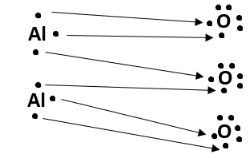
The structure of alumina consists of two aluminium atoms and three oxygen atoms. Each aluminium atom loses three electrons to gain a positive charge of +3, and each oxygen atom gains two electrons to acquire a negative charge of -2. This forms an ionic compound, since a metal (aluminium) loses electrons to a non-metal (oxygen). The dot structure of Al2O3 can be illustrated as follows:

al4

Physical properties 

The physical properties of aluminium oxide are as follows:

  • It has a molar mass of 101.96 g·mol−1
  • It has a boiling point of 2,977 °C.
  • It has a density of 3.95–4.1 g/cm3.
  • It is a hard material.
  • It is resistant to electricity.
  • It has low thermal expansion.
  • It has corrosion endurance.

Chemical properties

  • Reaction with water – The oxide ions in Al2O3 are held strongly and therefore do not react with water. This makes Al2O3 insoluble in water.
  • Reaction with acids – Al2O3 reacts with acids due to the presence of oxide ions. For example, when it reacts with dilute hydrochloric acid, it gives aluminium chloride and water. When reacting with an acid, it acts as a base.
al5
  • Reaction with bases – Al2O3 also reacts with bases. When reacting with bases, it acts as an acid. For example, when it reacts with sodium hydroxide, it forms sodium aluminate and water.
al6

Uses 

Alumina is used in the following fields:

  • Medical industry – In medicine, alumina is used as a material for hip replacement bearings, in tissue reinforcement, as prostheses, in bionic implants, in dental implants, in lab equipment like furnaces and crucibles, etc. The reason for the use of alumina in the medical industry is its hardness and bio-inertness. 
  • Military and protective equipment – Alumina is used in some military equipment, like body armour. It is also used in protective equipment like aircraft armour, vehicle armour, and bulletproof windows. This is due to its lightweight qualities and strength. 
  • Electronics industry – Alumina is used to manufacture electrical insulators and furnace insulation. This is because of its high melting and boiling points. It is also used in the microchip industry in the form of alumina films. Some other applications of alumina in the electronic industry include insulating heatsinks, spark plug insulators, and micro-electric substrates.
  • Gem industry – The crystalline form of alumina, corundum is the base element for rubies and sapphires. Both rubies and sapphires are precious gems. They get their colour from trace impurities. Rubies get their colour from chromium while sapphires get their colour from iron and titanium. 
  • Industrial applications – Alumina is used as an abrasive for sandpaper owing to its strength. It is also used as a filler in bricks, clayware and plastics due to its inert nature. It is also a substitute for diamond as a more economical option. It can be an ingredient in toothpaste and sunscreen. 

Conclusion 

Aluminium oxide is also known as alumina, and its chemical formula is Al2O3. Its structure consists of two aluminium atoms and three oxygen atoms. Each aluminium atom loses three electrons, thereby gaining a +3 charge, and each oxygen atom gains two electrons, thereby gaining a -2 charge.

Alumina can be prepared through Bayer’s process. In this process, bauxite (ore of aluminium) is heated with caustic soda (NaOH). Sodium aluminate (NaAlO2) is obtained in this process, which, when diluted with water, gives aluminium hydroxide (Al(OH)3). When aluminium hydroxide is heated, aluminium oxide and water vapour are obtained.

Alumina has a high melting and boiling point, is resistant to electricity, and is insoluble in water. It is amphoteric in nature, i.e. it reacts with acids and bases alike. It is used in the medical industry, the electronic industry, the gem industry, the manufacture of protective equipment, etc.


faq

Frequently asked questions

Get answers to the most common queries related to the ITT JEE Examination Preparation.

Does aluminium oxide react with water?

Ans. No, alumina does not react with water, or, in other words, it is insoluble in water. This is b...Read full

Where is aluminium oxide found?

Ans. Aluminium oxide can be found in nature in its crystalline form, called corundum. It can also be obtaine...Read full

What kind of oxide is aluminium oxide?

Ans. Aluminium oxide reacts with acids and bases alike; therefore, it can be termed an amphoteric oxide. Whe...Read full

Who invented Bayer’s process?

Ans. Bayer’s process was invented by Carl Josef Bayer. This is an industrial process used to obtain alumin...Read full

Ans. No, alumina does not react with water, or, in other words, it is insoluble in water. This is because it has a low heat of hydration and high lattice energy.

Ans. Aluminium oxide can be found in nature in its crystalline form, called corundum. It can also be obtained from bauxite, the ore of aluminium. Bayer’s process is used to obtain alumina from bauxite.

Ans. Aluminium oxide reacts with acids and bases alike; therefore, it can be termed an amphoteric oxide. When reacting with acids, it acts as a base. Similarly, when reacting with a base, it acts as an acid.

Ans. Bayer’s process was invented by Carl Josef Bayer. This is an industrial process used to obtain alumina from bauxite.

Crack IIT JEE with Unacademy

Get subscription and access unlimited live and recorded courses from India’s best educators

  • Structured syllabus
  • Daily live classes
  • Ask doubts
  • Tests & practice
Learn more

Notifications

Get all the important information related to the JEE Exam including the process of application, important calendar dates, eligibility criteria, exam centers etc.

Allotment of Examination Centre
JEE Advanced Eligibility Criteria
JEE Advanced Exam Dates
JEE Advanced Exam Pattern 2023
JEE Advanced Syllabus
JEE Application Fee
JEE Application Process
JEE Eligibility Criteria 2023
JEE Exam Language and Centres
JEE Exam Pattern – Check JEE Paper Pattern 2024
JEE Examination Scheme
JEE Main 2024 Admit Card (OUT) – Steps to Download Session 1 Hall Ticket
JEE Main Application Form
JEE Main Eligibility Criteria 2024
JEE Main Exam Dates
JEE Main Exam Pattern
JEE Main Highlights
JEE Main Paper Analysis
JEE Main Question Paper with Solutions and Answer Keys
JEE Main Result 2022 (Out)
JEE Main Revised Dates
JEE Marking Scheme
JEE Preparation Books 2024 – JEE Best Books (Mains and Advanced)
Online Applications for JEE (Main)-2022 Session 2
Reserved Seats
See all

Related articles

Learn more topics related to Chemistry
Zeolites

Aluminium silicate zeolites are microporous three-dimensional crystalline solids. Zeolites have small, fixed-size openings that allow small molecules to pass through easily but not larger molecules; this is why they are sometimes referred to as molecular sieves.

XeF6 Molecular Geometry and Bond Angles

In this article, we will learn about the XeF6 Molecular Geometry And Bond Angles in detail. We also learn the importance of XeF6 molecular geometry and bond angles importance and much more about the topic in detail.

XeF4 Molecular Geometry and Bond Angeles

A general overview of Lewis Structure, XeF4 Molecular Geometry and bond Angles meaning, valuable XeF4 Molecular Geometry and bond angle questions.

XeF2 Molecular Geometry and Bond Angles

Let us learn about the molecule XeF2, its molecular geometry and bond examples, and XeF2 Lewis structure.

See all
Access more than

10,505+ courses for IIT JEE

Get subscription
Challenge Yourself Everyday
Attempt 2023’s and previous year’s JEE Main
Download Important Formulas pdf
Attempt Free Test Series for JEE Main 2023

Trending Topics

  • JEE Main 2024
  • JEE Main Rank Predictor 2024
  • JEE Main Mock Test 2024
  • JEE Main 2024 Admit Card
  • JEE Advanced Syllabus
  • JEE Preparation Books
  • JEE Notes
  • JEE Advanced Toppers
  • JEE Advanced 2022 Question Paper
  • JEE Advanced 2022 Answer Key
  • JEE Main Question Paper
  • JEE Main Answer key 2022
  • JEE Main Paper Analysis 2022
  • JEE Main Result
  • JEE Exam Pattern
  • JEE Main Eligibility
  • JEE College predictor

JEE Coaching Centres

  • JEE Coaching in Nagpur
  • JEE Coaching in Ranchi
  • JEE Coaching in Gorakhpur
  • JEE Coaching in Bhubaneswar
  • JEE Coaching in Vijayawada
  • JEE Coaching in Dehradun
  • JEE Coaching in Indore
  • JEE Coaching in Gurugram
  • JEE Coaching in Muzaffarpur
  • JEE Coaching in Varanasi
  • JEE Coaching in Jammu
  • JEE Coaching in Kolhapur
  • JEE Coaching in Bikaner
  • JEE Coaching in Delhi Lajpat Nagar
Predict your JEE Rank
.
Company Logo

Unacademy is India’s largest online learning platform. Download our apps to start learning


Starting your preparation?

Call us and we will answer all your questions about learning on Unacademy

Call +91 8585858585

Company
About usShikshodayaCareers
we're hiring
BlogsPrivacy PolicyTerms and Conditions
Help & support
User GuidelinesSite MapRefund PolicyTakedown PolicyGrievance Redressal
Products
Learner appLearner appEducator appEducator appParent appParent app
Popular goals
IIT JEEUPSCSSCCSIR UGC NETNEET UG
Trending exams
GATECATCANTA UGC NETBank Exams
Study material
UPSC Study MaterialNEET UG Study MaterialCA Foundation Study MaterialJEE Study MaterialSSC Study Material

© 2026 Sorting Hat Technologies Pvt Ltd

Unacademy
  • Goals
    • AFCAT
    • AP EAMCET
    • Bank Exam
    • BPSC
    • CA Foundation
    • CAPF
    • CAT
    • CBSE Class 11
    • CBSE Class 12
    • CDS
    • CLAT
    • CSIR UGC
    • GATE
    • IIT JAM
    • JEE
    • Karnataka CET
    • Karnataka PSC
    • Kerala PSC
    • MHT CET
    • MPPSC
    • NDA
    • NEET PG
    • NEET UG
    • NTA UGC
    • Railway Exam
    • SSC
    • TS EAMCET
    • UPSC
    • WBPSC
    • CFA

Share via

COPY