Access free live classes and tests on the app
Download
+
Unacademy
  • Goals
    • AFCAT
    • AP EAMCET
    • Bank Exam
    • BPSC
    • CA Foundation
    • CAPF
    • CAT
    • CBSE Class 11
    • CBSE Class 12
    • CDS
    • CLAT
    • CSIR UGC
    • GATE
    • IIT JAM
    • JEE
    • Karnataka CET
    • Karnataka PSC
    • Kerala PSC
    • MHT CET
    • MPPSC
    • NDA
    • NEET PG
    • NEET UG
    • NTA UGC
    • Railway Exam
    • SSC
    • TS EAMCET
    • UPSC
    • WBPSC
    • CFA
Login Join for Free
avtar
  • ProfileProfile
  • Settings Settings
  • Refer your friendsRefer your friends
  • Sign outSign out
  • Terms & conditions
  • •
  • Privacy policy
  • About
  • •
  • Careers
  • •
  • Blog

© 2023 Sorting Hat Technologies Pvt Ltd

Watch Free Classes
    • Free courses
    • JEE Main 2024
    • JEE Main 2024 Live Paper Discussion
    • JEE Main Rank Predictor 2024
    • JEE Main College Predictor 2024
    • Stream Predictor
    • JEE Main 2024 Free Mock Test
    • Study Materials
    • Notifications
    • JEE Advanced Syllabus
    • JEE Books
    • JEE Main Question Paper
    • JEE Coaching
    • Downloads
    • JEE Notes & Lectures
    • JEE Daily Videos
    • Difference Between
    • Full Forms
    • Important Formulas
    • Exam Tips
JEE Main 2026 Preparation: Question Papers, Solutions, Mock Tests & Strategy Unacademy » JEE Study Material » Physics » Angular momentum of a satellite

Angular momentum of a satellite

The momentum becomes angular momentum when the object is moving on or around a fixed axis.

Table of Content
  •  

As we know, the mass times the velocity of a moving object is known as momentum. Any object which has mass can produce momentum while moving. The difference between momentum and angular momentum is if an object is moving on or around a fixed axis, then it will create angular momentum.

Let’s take an example: Have you ever tried to balance your bicycle or motorcycle while still in a place? If you did, then you know that it’s not possible for more than a few seconds. 

Then how does a bicycle balance when we ride it? The key to the balancing of a bike while riding is angular momentum. When you start your bike and accelerate it to produce motion, then the wheels of the bike start rotating on a fixed axis. The rotation of the wheels on that fixed axis creates the angular momentum. Moreover, this angular momentum helps the bike to balance by resisting any change to the balance. 

Definition of Angular Momentum

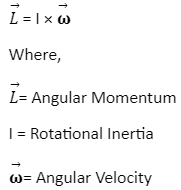
Angular momentum is the virtue of an object rotating on a fixed axis. The angular momentum is the result of the product of the angular velocity of the object and the moment of inertia.

Angular momentum has direction as well as magnitude. Hence, angular momentum is a vector quantity. The notation of the angular velocity is a vector on L. 

The SI unit of angular momentum is Kg.m².1/s. Hence, the Dimensional formula of the Angular Momentum is [L]²[T]–¹.

The formula of Angular Momentum

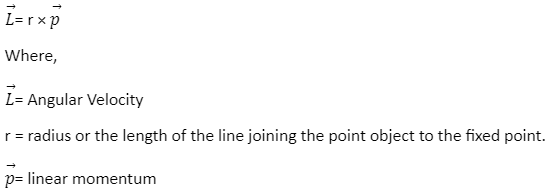
Point object: A point object rotating around a fixed point on a fixed axis. Example: a planet revolving around the sun.

Extended object: An object rotating on a fixed point on a fixed axis. Example: Tire of a bicycle rotating on its axis.

Right Hand Rule

The right-hand rule to identify the direction of the angular momentum is very similar to the rule which we use to get the direction of the magnetic fields in an electromagnet. 

The rule states that if you curl the fingers of your right hand in the direction of rotation. And open your thumb perpendicular to your fingers. Then, your thumb will show the direction of the angular momentum.

Angular Momentum of a Satellite Meaning

According to the motion of a Satellite, it falls in the group of the angular momentum by a point object around a fixed point. 

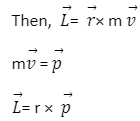
To derive a formula to calculate the angular momentum of a Satellite.

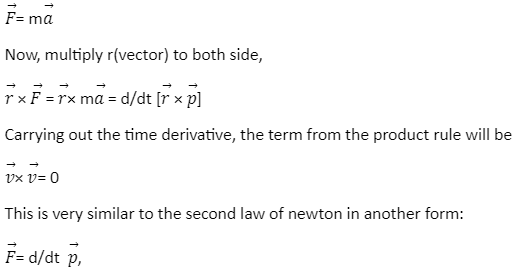
According to the second law of Newton,

We can say the application of a force around the axis generates a rate of change of momentum. Besides, we can also say that the left side of the equation is torque. Also, the quantity which is on the right of the equation is angular momentum.

Solved Angular Momentum of a Satellite questions

Q. If L is the angular momentum of a satellite revolving around the earth in a circular orbit of radius r with speed V, then L is directly proportional to it?

L=r×p

In circular orbit,

  r×p = rp = mvr

∴L=√GmMr

or, L∝√r

Q. A satellite of mass m is revolving around the earth in a fixed circular orbit of radius r. Derive an expression for angular momentum.

The orbital speed of a satellite revolving around the earth in a circular orbit of radius r is,

v⁰ = √GM/r

Therefore the angular momentum of satellite,

L= mv⁰r =mr × √GM/r

=√GMm³r

Q. The orbital angular momentum of a satellite revolving at a distance r from the centre is L. If the distance increases to 16r, then new angular momentum will be.

Angular momentum 

L = √m²GMr

∴L ∝√r 

Then, 

L²/L¹ = √r²/r¹ = √16r/r =4

L² = 4L¹ = 4L

Conclusion

This was a brief introduction to the angular momentum of a satellite. Basically, it concludes that the angular momentum of a Satellite can be derived from the second law of Newton. Moreover, the angular momentum of the satellite is the same as the angular momentum of a point object revolving around a fixed point. As we learnt today, angular momentum is a vector quantity which means it contains both direction and magnitude. So you can easily find the direction of angular momentum of an object rotating on its own axis with the help of the right-hand rule given above. Best of luck, keep preparing.


faq

Frequently Asked Questions

Get answers to the most common queries related to the JEE Examination Preparation.

What is angular momentum?

Ans. Angular momentum is the virtue of an object rotating on a fixed axis. The...Read full

What is the formula of angular momentum?

Ans.  ...Read full

How is the right-hand rule useful in calculating the angular momentum of a satellite?

Ans. The right-hand rule to identify the direction of the angular momentum is ...Read full

What is the angular momentum of a satellite?

Ans. According to the motion of a Satellite, it falls in the group of the angular momentum by a point object around ...Read full

Ans. Angular momentum is the virtue of an object rotating on a fixed axis. The angular momentum is the result of the product of the angular velocity of the object and the moment of inertia.

Angular momentum has direction as well as magnitude. Hence, Angular Momentum is a vector quantity. The notation of the angular velocity is a vector on L. 

The SI Unit of Angular Momentum is Kg.m².1/s¹. Hence, the Dimensional formula of the Angular Momentum is [L]²[T]–¹.

Ans. 

Ans. The right-hand rule to identify the direction of the angular momentum is very similar to the rule which we use to get the direction of the magnetic fields in an electromagnet. 

The rule states that if you curl the fingers of your right hand in the direction of rotation. And open your thumb perpendicular to your fingers. Then, your thumb will show the direction of the angular momentum.

Ans. According to the motion of a Satellite, it falls in the group of the angular momentum by a point object around a fixed point. 

To derive a formula to calculate the angular momentum of a Satellite.

According to the second law of Newton,

Crack IIT JEE with Unacademy

Get subscription and access unlimited live and recorded courses from India’s best educators

  • Structured syllabus
  • Daily live classes
  • Ask doubts
  • Tests & practice
Learn more

Notifications

Get all the important information related to the JEE Exam including the process of application, important calendar dates, eligibility criteria, exam centers etc.

Allotment of Examination Centre
JEE Advanced Eligibility Criteria
JEE Advanced Exam Dates
JEE Advanced Exam Pattern 2023
JEE Advanced Syllabus
JEE Application Fee
JEE Application Process
JEE Eligibility Criteria 2023
JEE Exam Language and Centres
JEE Exam Pattern – Check JEE Paper Pattern 2024
JEE Examination Scheme
JEE Main 2024 Admit Card (OUT) – Steps to Download Session 1 Hall Ticket
JEE Main Application Form
JEE Main Eligibility Criteria 2024
JEE Main Exam Dates
JEE Main Exam Pattern
JEE Main Highlights
JEE Main Paper Analysis
JEE Main Question Paper with Solutions and Answer Keys
JEE Main Result 2022 (Out)
JEE Main Revised Dates
JEE Marking Scheme
JEE Preparation Books 2024 – JEE Best Books (Mains and Advanced)
Online Applications for JEE (Main)-2022 Session 2
Reserved Seats
See all

Related articles

Learn more topics related to Physics
Zinc-Carbon Cell

The battery you use every day in your TV remote or torch is made up of cells and is also known as a zinc-carbon cell. Read on to know more.

ZEROTH LAW OF THERMODYNAMICS

Read about the Zeroth law of thermodynamics. Learn about the zeroth law definitions and their examples.

Zener Diode As A Voltage Regulator

Understand the concepts of Zener diodes. Also, learn about the efficiency and limitations of Zener Diode as a Voltage Regulator.

Zener diode as a voltage regulator

zener diode is a very versatile semiconductor that is used for a variety of industrial processes and allows the flow of current in both directions.It can be used as a voltage regulator.

See all
Access more than

10,505+ courses for IIT JEE

Get subscription
Company Logo

Unacademy is India’s largest online learning platform. Download our apps to start learning


Starting your preparation?

Call us and we will answer all your questions about learning on Unacademy

Call +91 8585858585

Company
About usShikshodayaCareers
we're hiring
BlogsPrivacy PolicyTerms and Conditions
Help & support
User GuidelinesSite MapRefund PolicyTakedown PolicyGrievance Redressal
Products
Learner appLearner appEducator appEducator appParent appParent app
Popular goals
IIT JEEUPSCSSCCSIR UGC NETNEET UG
Trending exams
GATECATCANTA UGC NETBank Exams
Study material
UPSC Study MaterialNEET UG Study MaterialCA Foundation Study MaterialJEE Study MaterialSSC Study Material

© 2026 Sorting Hat Technologies Pvt Ltd

Unacademy
  • Goals
    • AFCAT
    • AP EAMCET
    • Bank Exam
    • BPSC
    • CA Foundation
    • CAPF
    • CAT
    • CBSE Class 11
    • CBSE Class 12
    • CDS
    • CLAT
    • CSIR UGC
    • GATE
    • IIT JAM
    • JEE
    • Karnataka CET
    • Karnataka PSC
    • Kerala PSC
    • MHT CET
    • MPPSC
    • NDA
    • NEET PG
    • NEET UG
    • NTA UGC
    • Railway Exam
    • SSC
    • TS EAMCET
    • UPSC
    • WBPSC
    • CFA

Share via

COPY