Gauss law is one of the fundamentals of physics. It is regarding the production of electric fields by the distribution of charges over the region.
Gauss’s law states that the flux coming out of the surface equals 1 /ϵ0 of the charge enclosed by the surface. Gauss theorem has various applications.
In this study material notes, we learn about the differential form of Gauss’s theorem.
Integral equation of Gauss’s law:
∫E⋅dA = Q/ε0
Where,
E is the electric field vector
Q is the enclosed electric charge
ε0 is the electric permittivity of free space
A is the outward pointing normal area vector
Flux is a measure of the strength of a field passing through a surface. Electric flux is expressed as:
Φ = ∫E⋅dA
Flux is a scalar quantity.
Electric flux is defined as the measure of the number of electric field lines crossing an area.
The SI unit of electric flux is Nm2/C.
ΦE = E⋅S = EScosθ
Another statement of Gauss’s law states that the net flux of an electric field of a given surface divided enclosed charge should be equal to a constant.
According to Gauss’s theorem, electric flux in a closed surface is equal to 1/ϵ0 times of charge enclosed in the surface.
Gauss law is represented by-.
Where ‘q’ represents the total charge of the surface, and ‘∈0’ represents the permittivity of free space.
Gauss theorem has different applications.
The equation gives the electric field intensity of an infinitely long charged wire
E = λ/2π∈0r
where,
E = Electric field
λ = Linear charge density
∈0 = Permittivity of free space
Where λ = q/l (where λ denotes Linear charge density, q denotes the total charge of the selected piece, and L denotes the total length of the selected piece).
The equation gives the electric field intensity due to an infinite plane sheet of charge:
E = σ/2∈0
Where,
E = Electric Field
σ = Surface charge density
∈0 = Permitivity in free space.
Where, σ = q/A (where, σ denotes surface charge density, q denotes total charge of sheet, A denotes area of sheet).
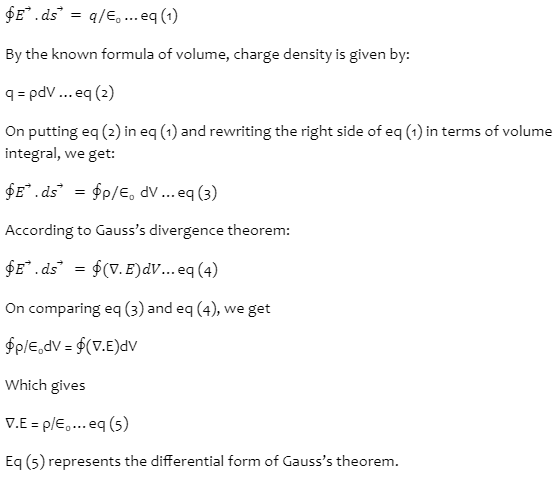
According to the differential form of Gauss’s law, the divergence of the electric field at any point in space is equal to 1/∈0 times the volume charge density ‘ρ’ at that point.
Gauss divergence theorem is represented by
Gauss law derives the relationship between the charge enclosed and the electric flux. Like Newton’s law, it is also a universal law. But it is useful under certain conditions that it is applicable to closed surfaces, the standard shape of Gaussian surfaces (spherical, cylindrical, or plane symmetry). The change distribution should be symmetric. It is not applicable for open surfaces. Gauss law is also applied to non-uniform surfaces.



 Profile
 Settings
 Refer your friends
 Sign out