
Unacademy's Blog!
Login Join for Free
avtar
  • ProfileProfile
  • Settings Settings
  • Refer your friendsRefer your friends
  • Sign outSign out
  • Terms & conditions
  • •
  • Privacy policy
  • About
  • •
  • Careers
  • •
  • Blog

© 2023 Sorting Hat Technologies Pvt Ltd

Watch Free Classes
    • Free courses
    • JEE Main 2024
    • JEE Main 2024 Live Paper Discussion
    • JEE Main Rank Predictor 2024
    • JEE Main College Predictor 2024
    • Stream Predictor
    • JEE Main 2024 Free Mock Test
    • Study Materials
    • Notifications
    • JEE Advanced Syllabus
    • JEE Books
    • JEE Main Question Paper
    • JEE Coaching
    • Downloads
    • JEE Notes & Lectures
    • JEE Daily Videos
    • Difference Between
    • Full Forms
    • Important Formulas
    • Exam Tips
JEE Main 2026 Preparation: Question Papers, Solutions, Mock Tests & Strategy Unacademy » JEE Study Material » Chemistry » Variation of Probability Density

Variation of Probability Density

Table of Content
  •  

Atomic orbitals are mathematical functions that describe the wave nature of electrons (or electron pairs) in an atom. They are also known as atomic orbitals.

In addition, they provide a method for calculating the probability of finding an electron in a specified region around the nucleus of an element’s nucleus.

Chemistry of Orbitals

It is possible to have four different kinds of orbitals, each with a different shape. These are denoted by the letters s,p,d, and f. The s and p orbitals are the only ones taken into consideration because they are the most common in organic and biological chemistry, respectively. It is spherical in shape with the nucleus at its centre, whereas a p-orbital is dumbbell-shaped, and four of the five d orbitals are cloverleaf in shape. d orbitals are shaped like an elongated dumbbell with a doughnut in the middle, and the fifth d orbital is no exception. The orbitals in an atom are organised into different layers or electron shells, which are referred to as electron shells.

Shape of s Orbital:
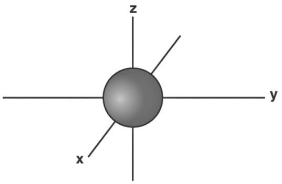
The boundary surface diagram for the s orbital has the shape of a sphere with the nucleus at its centre, which can be visualised as a circle in two dimensions when viewed from above.

In this way, we can say that s-orbitals are spherically symmetric, with the probability of finding the electron at a given distance equal in all directions regardless of the direction of the electron’s motion.

It is also discovered that the size of the s orbital increases with the increase in the value of the principal quantum number (n), with 4s > 3s > 2s > 1s being the largest.
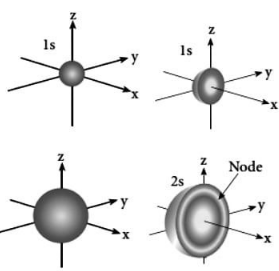
1s orbital:

The 1s orbital is the orbital that is closest to the nucleus in terms of distance. It has the least amount of energy compared to the other orbitals. It also has the distinction of being the smallest spherical shape. As a result, the radius of the s orbital is relatively small. In the s orbital, there can only be two electrons at a time. If there is only one electron in the s orbital, the electron configuration can be written as 1s1, which means there is only one electron in the s orbital. It can, however, be written as 1s2 if there are two electrons in the system. The two electrons in the s orbital then move in opposite directions as a result of the repulsion that occurs as a result of the same electrical charges carried by the two electrons in the s orbital. It is referred to as paramagnetic when there is an unpaired electron present. This is due to the fact that it can be attracted by a magnet. However, if the orbital is completely filled and there is a pair of electrons present, the electrons will not be attracted by a magnet; this is referred to as diamagnetic behaviour.

2s orbital:

The 2s orbital is larger than the 1s orbital. As a result, its radius is greater than that of the 1s orbital. It is the orbital that is closest to the nucleus after the 1s orbital. Its energy is higher than that of the 1s orbital, but it is lower than that of the other orbitals in an atom. The 2s orbital can also only be filled with one or two electrons. However, the 2s orbital is only filled with electrons after the 1s orbital has been completed. This is referred to as the Aufbau principle, and it indicates the order in which electrons fill sub-orbitals.

Conclusion:

It is possible for an atom to have many different numbers of orbitals, according to the quantum atomic theory. The sizes, shapes, and orientations of these orbitals can all be classified as well. With a smaller-sized orbital, there is a greater likelihood of attracting the attention of an electron close to the nucleus. When it comes to representing the coordinates of an electron, the orbital wave function, also known as,ϕ is used. The square of the orbital wave function,demonstrate the probability of finding an electron in the nucleus.

When drawing boundary surface diagrams, this wave function is also useful. The shape of orbitals can be better understood using boundary surface diagrams of the constant probability density for various orbitals.

Crack IIT JEE with Unacademy

Get subscription and access unlimited live and recorded courses from India’s best educators

  • Structured syllabus
  • Daily live classes
  • Ask doubts
  • Tests & practice
Learn more

Notifications

Get all the important information related to the JEE Exam including the process of application, important calendar dates, eligibility criteria, exam centers etc.

Allotment of Examination Centre
JEE Advanced Eligibility Criteria
JEE Advanced Exam Dates
JEE Advanced Exam Pattern 2023
JEE Advanced Syllabus
JEE Application Fee
JEE Application Process
JEE Eligibility Criteria 2023
JEE Exam Language and Centres
JEE Exam Pattern – Check JEE Paper Pattern 2024
JEE Examination Scheme
JEE Main 2024 Admit Card (OUT) – Steps to Download Session 1 Hall Ticket
JEE Main Application Form
JEE Main Eligibility Criteria 2024
JEE Main Exam Dates
JEE Main Exam Pattern
JEE Main Highlights
JEE Main Paper Analysis
JEE Main Question Paper with Solutions and Answer Keys
JEE Main Result 2022 (Out)
JEE Main Revised Dates
JEE Marking Scheme
JEE Preparation Books 2024 – JEE Best Books (Mains and Advanced)
Online Applications for JEE (Main)-2022 Session 2
Reserved Seats
See all

Related articles

Learn more topics related to Chemistry
Zeolites

Aluminium silicate zeolites are microporous three-dimensional crystalline solids. Zeolites have small, fixed-size openings that allow small molecules to pass through easily but not larger molecules; this is why they are sometimes referred to as molecular sieves.

XeF6 Molecular Geometry and Bond Angles

In this article, we will learn about the XeF6 Molecular Geometry And Bond Angles in detail. We also learn the importance of XeF6 molecular geometry and bond angles importance and much more about the topic in detail.

XeF4 Molecular Geometry and Bond Angeles

A general overview of Lewis Structure, XeF4 Molecular Geometry and bond Angles meaning, valuable XeF4 Molecular Geometry and bond angle questions.

XeF2 Molecular Geometry and Bond Angles

Let us learn about the molecule XeF2, its molecular geometry and bond examples, and XeF2 Lewis structure.

See all
Access more than

10,505+ courses for IIT JEE

Get subscription
Challenge Yourself Everyday
Attempt 2023’s and previous year’s JEE Main
Download Important Formulas pdf
Attempt Free Test Series for JEE Main 2023

Trending Topics

  • JEE Main 2024
  • JEE Main Rank Predictor 2024
  • JEE Main Mock Test 2024
  • JEE Main 2024 Admit Card
  • JEE Advanced Syllabus
  • JEE Preparation Books
  • JEE Notes
  • JEE Advanced Toppers
  • JEE Advanced 2022 Question Paper
  • JEE Advanced 2022 Answer Key
  • JEE Main Question Paper
  • JEE Main Answer key 2022
  • JEE Main Paper Analysis 2022
  • JEE Main Result
  • JEE Exam Pattern
  • JEE Main Eligibility
  • JEE College predictor

JEE Coaching Centres

  • JEE Coaching in Nagpur
  • JEE Coaching in Ranchi
  • JEE Coaching in Gorakhpur
  • JEE Coaching in Bhubaneswar
  • JEE Coaching in Vijayawada
  • JEE Coaching in Dehradun
  • JEE Coaching in Indore
  • JEE Coaching in Gurugram
  • JEE Coaching in Muzaffarpur
  • JEE Coaching in Varanasi
  • JEE Coaching in Jammu
  • JEE Coaching in Kolhapur
  • JEE Coaching in Bikaner
  • JEE Coaching in Delhi Lajpat Nagar
Predict your JEE Rank
.
Company Logo

Unacademy is India’s largest online learning platform. Download our apps to start learning


Starting your preparation?

Call us and we will answer all your questions about learning on Unacademy

Call +91 8585858585

Company
About usShikshodayaCareers
we're hiring
BlogsPrivacy PolicyTerms and Conditions
Help & support
User GuidelinesSite MapRefund PolicyTakedown PolicyGrievance Redressal
Products
Learner appLearner appEducator appEducator appParent appParent app
Popular goals
IIT JEEUPSCSSCCSIR UGC NETNEET UG
Trending exams
GATECATCANTA UGC NETBank Exams
Study material
UPSC Study MaterialNEET UG Study MaterialCA Foundation Study MaterialJEE Study MaterialSSC Study Material

© 2026 Sorting Hat Technologies Pvt Ltd

Unacademy's Blog!

Share via

COPY