Access free live classes and tests on the app
Download
+
Unacademy
  • Goals
    • AFCAT
    • AP EAMCET
    • Bank Exam
    • BPSC
    • CA Foundation
    • CAPF
    • CAT
    • CBSE Class 11
    • CBSE Class 12
    • CDS
    • CLAT
    • CSIR UGC
    • GATE
    • IIT JAM
    • JEE
    • Karnataka CET
    • Karnataka PSC
    • Kerala PSC
    • MHT CET
    • MPPSC
    • NDA
    • NEET PG
    • NEET UG
    • NTA UGC
    • Railway Exam
    • SSC
    • TS EAMCET
    • UPSC
    • WBPSC
    • CFA
Login Join for Free
avtar
  • ProfileProfile
  • Settings Settings
  • Refer your friendsRefer your friends
  • Sign outSign out
  • Terms & conditions
  • •
  • Privacy policy
  • About
  • •
  • Careers
  • •
  • Blog

© 2023 Sorting Hat Technologies Pvt Ltd

    • Free courses
    • JEE Main 2024
    • JEE Main 2024 Live Paper Discussion
    • JEE Main Rank Predictor 2024
    • JEE Main College Predictor 2024
    • Stream Predictor
    • JEE Main 2024 Free Mock Test
    • Study Materials
    • Notifications
    • JEE Advanced Syllabus
    • JEE Books
    • JEE Main Question Paper
    • JEE Coaching
    • Downloads
    • JEE Notes & Lectures
    • JEE Daily Videos
    • Difference Between
    • Full Forms
    • Important Formulas
    • Exam Tips
JEE Main 2026 Preparation: Question Papers, Solutions, Mock Tests & Strategy Unacademy » JEE Study Material » Physics » Potential Energy Spring

Potential Energy Spring

In this article we are going to learn about potential energy spring, spring-mass potential energy equation, gravitational potential energy spring work, Hooke’s law, potential energy and many more.

Table of Content
  •  

Whenever we compress or lengthen a stretched spring, we experience a force equivalent to the force we apply in the opposite direction. However, as soon as the stress is relieved, the spring returns to its original shape. The spring potential energy is what it’s called.

Potential Energy of a Spring

A spring can be found in practically every mechanical part of our lives, from automotive shock absorbers to kitchen gas lighting. Spring is used since of its ability to deform and then return to their original state. When a spring is stretched or compressed, it produces a force in the opposite direction. Whenever a spring differs from its mean position, it seeks to return to that point. Hooke’s law determines this force, which aids in the analysis of the energy stored in the spring.

Hooke’s law

An elastic object, including a metal spring or rope, requires force to stretch. If an elastic object is stretched or squeezed, it is said to be elastic. It tries to resist the change in shape by exerting power. Hooke’s law provides this force. The spring’s force is known as restoring force since it always acts in the opposite direction of the deformation.

According to Hooke’s law,

For short ranges, the force required to stretch an elastic object including a metal spring is precisely proportional to the spring’s extension. A negative sign is employed since the restorative force is in the opposite direction.

Where x is the displacement of the spring in relation to its unpadded length and F is the force it exerts. Then,

F=-Kx

The spring constant k, is used here.

Potential Energy

The energy possessed by an item as a result of its relative immovable location in space, tension, or electric charge is referred to as potential energy. Potential energy is one of the two basic forms of energy, whereas kinetic energy is the other.

Potential energy is the energy that an object retains as a consequence of its stationary location. Potential energy is the intrinsic energy of the body in its static position.

The two types of potential energy are elastic potential energy and gravitational potential energy.

Elastic Potential Energy

Elastic potential energy is the energy stored in materials which can be stretched or extended, including trampolines, rubber bands, and bungee cords. An object’s ability to expand is proportional to its elastic potential energy. Many objects, such as the twisted rubber band which propels a toy plane or the Coil spring in a wind-up clock, are designed to store elastic potential energy.

The elastic potential energy is calculated using the following formula:

 U=1/2kx²

Here,

Where,

U is the elastic potential energy.

K is the constant of spring force.

X is the length of the string when stretched in metres.

Gravitational Potential Energy

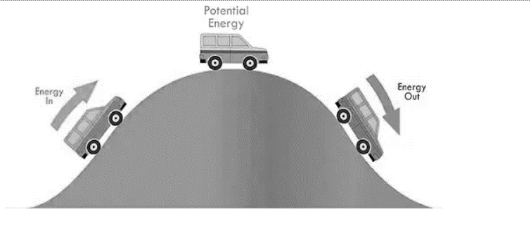
As a consequence of a shift in its position, an object in a gravitational field obtains gravitational potential energy. Gravitational potential energy is an energy which is linked to gravity or gravitational force in simple words.

The gravitational potential energy is calculated using the following equation:

GPE=m×g×h

m refers to mass in kg.

The letter g stands for gravitational acceleration.

h denotes height.

Concept of Spring Potential Energy

Spring is a standard tool, and due to its small mass, their inertia is commonly disregarded. It’s a common occurrence whenever a spring is strained, it will deform owing to compression. As a consequence, when a spring compresses or extends a body, it exerts an equal and opposite force. 

It’s the stored energy in a compressible or stretchable substance, such as a spring, rubber band, or molecule. It’s the force multiplied by the movement’s distance.

There is no energy in the spring when it is in its normal position, that is not strained. This is caused by the deformation of a certain elastic object, such as a spring. It also refers to the process of stretching the spring. 

Spring Potential Energy Formula

Whenever an object repeats its motion in a predetermined cycle, it is said to be in periodic motion. Oscillation is another term for this type of motion. Spring and pendulum movement are simple instances, but there are numerous additional situations in which oscillations occur. One of the most significant characteristics of periodic motion is that the item maintains a stable equilibrium position.

A restoring force also works for string, which means that string has potential energy.

Potential Energy of a Spring Formula

String potential energy=force×distance or displacement

In consequence, the force is equal to the displacement of the spring constant.

A spring’s potential energy is:

P.E=1 ⁄ 2k×x²

 Gravitational potential energy spring work

Since the spring is stretched to its full extension, its potential energy is at its highest. Because the mass is elevated the least amount above earth, the potential energy owing to gravity is at a minimum.

Spring-mass potential energy equation

String potential energy=force×distance or displacement

Conclusion

A spring can be found in practically every mechanical part of our lives, from automotive shock absorbers to kitchen gas lighting. Spring is used since of its ability to deform and then return to their original state.

Potential Energy of a Spring Formula

String potential energy=force× distance of displacement

A spring’s potential energy is:

P.E=1 ⁄ 2k×x²

faq

Frequently Asked Questions

Get answers to the most common queries related to the JEE Examination Preparation.

What are some other types of potential energy besides gravitational energy?

Ans. An electron has potential energy based on its shell displacement from the atomic nucleus. ...Read full

What is the potential energy Meaning?

Ans. Potential energy is the energy that is stored in a system and is governed by the relative positions of differen...Read full

Is gravitational potential energy equal to work?

Ans. The work done against gravity to move a mass to a particular position in space is the general term for gravitat...Read full

Write Potential Spring energy formula?

Potential Spring energy formula is given as: P.E=...Read full

Ans. An electron has potential energy based on its shell displacement from the atomic nucleus.

    A completely wound spring watch includes potential energy stored in the spring. This energy is released as kinetic energy in order to make the watch balance disc run.

Ans. Potential energy is the energy that is stored in a system and is governed by the relative positions of different portions of the system. Whenever a spring is compressed or stretched, it has more potential energy.

Ans. The work done against gravity to move a mass to a particular position in space is the general term for gravitational potential energy, which comes from the law of gravity.

Potential Spring energy formula is given as:

P.E=1 ⁄ 2k×x²

Trending Topics

  • JEE Main 2024
  • JEE Main Rank Predictor 2024
  • JEE Main Mock Test 2024
  • JEE Main 2024 Admit Card
  • JEE Advanced Syllabus
  • JEE Preparation Books
  • JEE Notes
  • JEE Advanced Toppers
  • JEE Advanced 2022 Question Paper
  • JEE Advanced 2022 Answer Key
  • JEE Main Question Paper
  • JEE Main Answer key 2022
  • JEE Main Paper Analysis 2022
  • JEE Main Result
  • JEE Exam Pattern
  • JEE Main Eligibility
  • JEE College predictor
combat_iitjee

Related links

  • JEE Study Materials
  • CNG Full Form
  • Dimensional Formula of Pressure
  • Reimer Tiemann Reaction
  • Vector Triple Product
  • Swarts Reaction
  • Focal length of Convex Lens
  • Root mean square velocities
  • Fehling’s solution
testseries_iitjee
Subscribe Now
. document.querySelector('.targetTopBtn').onClick = topFunction; function topFunction() { window.scrollTo({ top: 0, behavior: 'smooth' }) }
Company Logo

Unacademy is India’s largest online learning platform. Download our apps to start learning


Starting your preparation?

Call us and we will answer all your questions about learning on Unacademy

Call +91 8585858585

Company
About usShikshodayaCareers
we're hiring
BlogsPrivacy PolicyTerms and Conditions
Help & support
User GuidelinesSite MapRefund PolicyTakedown PolicyGrievance Redressal
Products
Learner appLearner appEducator appEducator appParent appParent app
Popular goals
IIT JEEUPSCSSCCSIR UGC NETNEET UG
Trending exams
GATECATCANTA UGC NETBank Exams
Study material
UPSC Study MaterialNEET UG Study MaterialCA Foundation Study MaterialJEE Study MaterialSSC Study Material

© 2026 Sorting Hat Technologies Pvt Ltd

Unacademy
  • Goals
    • AFCAT
    • AP EAMCET
    • Bank Exam
    • BPSC
    • CA Foundation
    • CAPF
    • CAT
    • CBSE Class 11
    • CBSE Class 12
    • CDS
    • CLAT
    • CSIR UGC
    • GATE
    • IIT JAM
    • JEE
    • Karnataka CET
    • Karnataka PSC
    • Kerala PSC
    • MHT CET
    • MPPSC
    • NDA
    • NEET PG
    • NEET UG
    • NTA UGC
    • Railway Exam
    • SSC
    • TS EAMCET
    • UPSC
    • WBPSC
    • CFA

Share via

COPY