Access free live classes and tests on the app
Download
+
Unacademy
  • Goals
    • AFCAT
    • AP EAMCET
    • Bank Exam
    • BPSC
    • CA Foundation
    • CAPF
    • CAT
    • CBSE Class 11
    • CBSE Class 12
    • CDS
    • CLAT
    • CSIR UGC
    • GATE
    • IIT JAM
    • JEE
    • Karnataka CET
    • Karnataka PSC
    • Kerala PSC
    • MHT CET
    • MPPSC
    • NDA
    • NEET PG
    • NEET UG
    • NTA UGC
    • Railway Exam
    • SSC
    • TS EAMCET
    • UPSC
    • WBPSC
    • CFA
Login Join for Free
avtar
  • ProfileProfile
  • Settings Settings
  • Refer your friendsRefer your friends
  • Sign outSign out
  • Terms & conditions
  • •
  • Privacy policy
  • About
  • •
  • Careers
  • •
  • Blog

© 2023 Sorting Hat Technologies Pvt Ltd

Watch Free Classes
    • Free courses
    • JEE Main 2024
    • JEE Main 2024 Live Paper Discussion
    • JEE Main Rank Predictor 2024
    • JEE Main College Predictor 2024
    • Stream Predictor
    • JEE Main 2024 Free Mock Test
    • Study Materials
    • Notifications
    • JEE Advanced Syllabus
    • JEE Books
    • JEE Main Question Paper
    • JEE Coaching
    • Downloads
    • JEE Notes & Lectures
    • JEE Daily Videos
    • Difference Between
    • Full Forms
    • Important Formulas
    • Exam Tips
JEE Main 2026 Preparation: Question Papers, Solutions, Mock Tests & Strategy Unacademy » JEE Study Material » Physics » Basic Concepts of Rotational Motion

Basic Concepts of Rotational Motion

In this article, we will discuss rotational motion, what rotational motion is, analogue of rotational motion is and more. Rotational motion is a very important topic in physics.

Table of Content
  •  

In the case of rotational motion or movement, we know that the particles of the body follow a circular path during the movement. Each particle in the rigid body moves in a circular path along a plane normal to the axis and centred on the same axis. There can be two rotary motions, one about the fixed axis and the second about a non-fixed axis. Examples of rotation about a fixed axis are the fan, while for the non-fixed axis the spinning top is a best example.

Rotational Motion

Pure Rotational motion is defined as the motion of an object about a fixed axis. When a rigid body is moved in such that all the particles constituting it experiences circular motion about a common axis then the motion is known as rotational motion.

The rotational motion of a rigid body around a defined axis is a special case of rotational movement. During the rotational motion or movement there is also the possibility that the axis changes its orientation. We cannot explain the concepts of oscillation or precession using the fixed axis hypothesis for rotational motion.

Rigid Body

A rigid body is a body which has a perfectly defined and unchanging shape, no matter how the body moves, the distance between any of the two particles inside the body will remain fixed. Although the way we define a rigid body provides the definition of an idealised rigid body and real materials always deform under the action of force, this assumption of an idealised rigid body can be freely used for substances where the deformation is insignificantly small and can also be neglected.

In general, the motion of a rigid body can be viewed as consisting of a translation of the body’s centre of mass plus a rotation of the body about an axis through the centre of mass.

Moment of Inertia

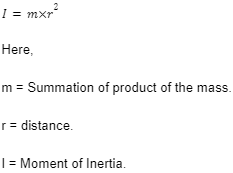
The moment of inertia is defined as the quantity expressed by the body resisting angular acceleration, which is the sum of the product of the mass of each particle and the square of it’s distance from the axis of rotation of an object. Or, more simply put, it can be described as a quantity that determines the amount of torque required for a given angular acceleration on an axis of rotation. The SI unit is kg.m2.

Analogue of mass in rotational motion is moment of inertia.

The moment of inertia is

Angular Velocity

The angular velocity is the rate at which an object or a particle rotates about a centre or a certain point in a specified period of time. Angular Velocity is also termed as rotational velocity and it’s unit is radian per second.

Angular velocity plays a prominent role in the rotational motion of a body. We already know that all particles of a body that exhibit rotational motion move in a circular path. The linear velocity of each particle involved is directly related to the angular velocity of the entire object.

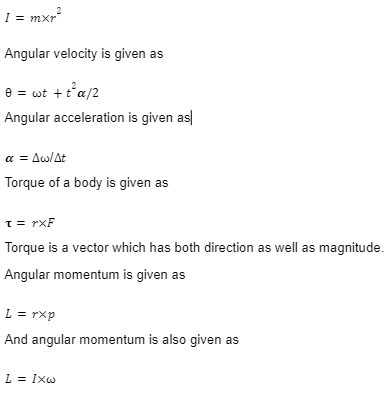
Angular velocity is given as

θ=⍵t+t2𝜶/2      

Here,

⍵= angular velocity

Δθ= angular displacement

Δt= time interval

Angular Acceleration

Angular acceleration is defined as the rate of change of angular velocity. Angular acceleration is the same as linear acceleration.

Angular acceleration is given as

 𝜶= Δ⍵/Δt             

Here,

𝜶= angular acceleration

Torque

Torque is the measure of the force which causes an object to rotate about an axis. Force is that which causes a body to accelerate in linear kinematics. In the same way, torque causes angular acceleration. Therefore, torque is defined as the rotational equivalent of linear force. The point at which the body rotates is called the axis of rotation. In physics, torque is the tendency of a force to twist or turn. Various terminologies like moment or moment of force are used interchangeably to define torque.

Torque of a body is given as

𝛕=r×F            

Torque is a vector which has both direction as well as magnitude.

Angular Momentum

Angular momentum is the property of a rotating object that results from the product of moment of inertia and angular velocity of the rotating body. Angular momentum is a vector quantity which has both direction as well as magnitude.

Angular momentum is given as

L=r×p

And angular momentum is also given as

L=I×⍵   

Here,

L= angular momentum

⍵= angular velocity

I = rotational inertia

p = linear momentum

Angular Displacement

Angular displacement is the shortest angle between the starting and ending positions of a given body which have a circular motion about a fixed point. Here the angular displacement is a vector quantity.

Therefore, angular displacement will have both magnitude and direction. The direction is expressed by a circular arrow which points from the start position to the end position. It can be clockwise or counter-clockwise in direction

The angular displacement is given by

𝛉=s/r          

And also, angular displacement is given as

θ=⍵t+t2𝜶/2      

Here,

θ= angular displacement

⍵= angular velocity

𝜶= angular acceleration

t = time

Conclusion

Pure Rotational motion is defined as the motion of an object about a fixed axis.

A rigid body is a body which has a perfectly defined and unchanging shape, no matter how the body moves, the distance between any of the two particles inside the body will remain fixed.

The moment of inertia is

faq

Frequently asked questions

Get answers to the most common queries related to the JEE Examination Preparation.

What is rotational motion?

Ans. Pure Rotational motion is defined as the motion of an object about a fixe...Read full

What is torque?

Ans. Torque is the measure of the force which causes an object to rotate about...Read full

What is inertia?

Ans. Inertia is the resistance of a physical body/object to a change in its...Read full

Ans. Pure Rotational motion is defined as the motion of an object about a fixed axis. When a rigid body is moved in such that all the particles constituting it experiences circular motion about a common axis then the motion is known as rotational motion.

Ans. Torque is the measure of the force which causes an object to rotate about an axis. Force is that which causes a body to accelerate in linear kinematics. In same way, torque causes angular acceleration. Therefore, torque is defined as the rotational equivalent of linear force. The point at which the body rotates is called the axis of rotation.

Torque of a body is given as

𝛕=r×F

Ans. Inertia is the resistance of a physical body/object to a change in its velocity. This includes the changes to the object’s speed, or in the direction of motion of the body. One aspect of this property is the tendency of objects to move in a straight line at constant speed when no force is acting on them.

Crack IIT JEE with Unacademy

Get subscription and access unlimited live and recorded courses from India’s best educators

  • Structured syllabus
  • Daily live classes
  • Ask doubts
  • Tests & practice
Learn more

Notifications

Get all the important information related to the JEE Exam including the process of application, important calendar dates, eligibility criteria, exam centers etc.

Allotment of Examination Centre
JEE Advanced Eligibility Criteria
JEE Advanced Exam Dates
JEE Advanced Exam Pattern 2023
JEE Advanced Syllabus
JEE Application Fee
JEE Application Process
JEE Eligibility Criteria 2023
JEE Exam Language and Centres
JEE Exam Pattern – Check JEE Paper Pattern 2024
JEE Examination Scheme
JEE Main 2024 Admit Card (OUT) – Steps to Download Session 1 Hall Ticket
JEE Main Application Form
JEE Main Eligibility Criteria 2024
JEE Main Exam Dates
JEE Main Exam Pattern
JEE Main Highlights
JEE Main Paper Analysis
JEE Main Question Paper with Solutions and Answer Keys
JEE Main Result 2022 (Out)
JEE Main Revised Dates
JEE Marking Scheme
JEE Preparation Books 2024 – JEE Best Books (Mains and Advanced)
Online Applications for JEE (Main)-2022 Session 2
Reserved Seats
See all

Related articles

Learn more topics related to Physics
Zinc-Carbon Cell

The battery you use every day in your TV remote or torch is made up of cells and is also known as a zinc-carbon cell. Read on to know more.

ZEROTH LAW OF THERMODYNAMICS

Read about the Zeroth law of thermodynamics. Learn about the zeroth law definitions and their examples.

Zener Diode As A Voltage Regulator

Understand the concepts of Zener diodes. Also, learn about the efficiency and limitations of Zener Diode as a Voltage Regulator.

Zener diode as a voltage regulator

zener diode is a very versatile semiconductor that is used for a variety of industrial processes and allows the flow of current in both directions.It can be used as a voltage regulator.

See all
Access more than

10,505+ courses for IIT JEE

Get subscription
Company Logo

Unacademy is India’s largest online learning platform. Download our apps to start learning


Starting your preparation?

Call us and we will answer all your questions about learning on Unacademy

Call +91 8585858585

Company
About usShikshodayaCareers
we're hiring
BlogsPrivacy PolicyTerms and Conditions
Help & support
User GuidelinesSite MapRefund PolicyTakedown PolicyGrievance Redressal
Products
Learner appLearner appEducator appEducator appParent appParent app
Popular goals
IIT JEEUPSCSSCCSIR UGC NETNEET UG
Trending exams
GATECATCANTA UGC NETBank Exams
Study material
UPSC Study MaterialNEET UG Study MaterialCA Foundation Study MaterialJEE Study MaterialSSC Study Material

© 2026 Sorting Hat Technologies Pvt Ltd

Unacademy
  • Goals
    • AFCAT
    • AP EAMCET
    • Bank Exam
    • BPSC
    • CA Foundation
    • CAPF
    • CAT
    • CBSE Class 11
    • CBSE Class 12
    • CDS
    • CLAT
    • CSIR UGC
    • GATE
    • IIT JAM
    • JEE
    • Karnataka CET
    • Karnataka PSC
    • Kerala PSC
    • MHT CET
    • MPPSC
    • NDA
    • NEET PG
    • NEET UG
    • NTA UGC
    • Railway Exam
    • SSC
    • TS EAMCET
    • UPSC
    • WBPSC
    • CFA

Share via

COPY