Access free live classes and tests on the app
Download
+
Unacademy
  • Goals
    • AFCAT
    • AP EAMCET
    • Bank Exam
    • BPSC
    • CA Foundation
    • CAPF
    • CAT
    • CBSE Class 11
    • CBSE Class 12
    • CDS
    • CLAT
    • CSIR UGC
    • GATE
    • IIT JAM
    • JEE
    • Karnataka CET
    • Karnataka PSC
    • Kerala PSC
    • MHT CET
    • MPPSC
    • NDA
    • NEET PG
    • NEET UG
    • NTA UGC
    • Railway Exam
    • SSC
    • TS EAMCET
    • UPSC
    • WBPSC
    • CFA
Login Join for Free
avtar
  • ProfileProfile
  • Settings Settings
  • Refer your friendsRefer your friends
  • Sign outSign out
  • Terms & conditions
  • •
  • Privacy policy
  • About
  • •
  • Careers
  • •
  • Blog

© 2023 Sorting Hat Technologies Pvt Ltd

  • CA Foundation Syllabus
  • CA Foundation Question Papers
  • CA Foundation Books
  • Video Lectures
  • CA Foundation Study Material
  • CA Foundation Preparation Strategy
  • MCQs
CA Foundation Exam June 2023 » CA Foundation Study Material » Business Mathematics » Determinants and Matrices
testseries_cafoundation

Determinants and Matrices

The sole motto of this article is to make matrices and determinant-based problem solutions easy and less time-consuming. Read more and understand about it.

Table of Content
  •  

Matrices

A matrix is a rectangular or square arrangement of numbers, alphabets, or any kind of element in specific columns and rows. This arrangement of elements in rows and columns is enclosed by a box bracket on either side, left and right.

The denotation of a matrix is done usually by an alphabet in upper case. For example, a capital ‘A’, ‘M’, ‘I’, etc.

Types of Matrices

There are various types of Matrices in the mathematical world, the name of some are-

  • Square Matrix
  • Rectangular Matrix
  • Row Matrix
  • Column Matrix
  • Diagonal Matrix 
  • Scalar Matrix 
  • Null Matrix 
  • Triangular Matrix 
  • Unit Matrix or Identity Matrix
  • Upper and lower triangular Matrix

As we know, a matrix consists of rows and columns. The count of rows and columns in a matrix is called ‘the order of a matrix’, it is also sometimes mentioned as ‘the dimensions of a matrix’. 

Following the rules of matrices, while finding the order of a matrix, the number of rows is written first followed by the columns.

For example-

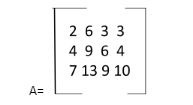
We now have a matrix above, named ‘A’. If we want to find out the order/dimensions of matrix ‘A’ we need to count the number of rows in the matrix ‘A’ first and then the number of columns in it.

The number of rows in matrix ‘A’ is 3 and the number of columns in the above- given matrix is 4. 

Thus, the required order of matrix ‘A’ is written by – 3 x 4.

Determinant 

Every square matrix has an association with a scalar, this is called a determinant. 

A determinant is denoted by writing det(A) or I A I.

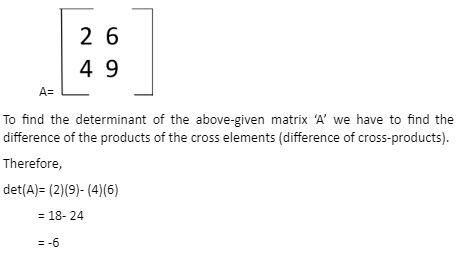
Note: The determinant value of a matrix with order 1 is its scalar value. But, the determinant of a matrix with order 2 x 2 is the difference of its cross products. 

For example-

Some Important Properties Of Determinants-

  1. If the columns and rows of a given determinant are interchanged, then the value of the determinant remains unchanged.
  2. In case, 2 rows in a determinant are interchanged then the value of the determinant becomes negative (-ve).
  3. If all the elements of a specific row or column are multiplied by a number (a non-zero number) then the value of the given determinant automatically changes to the multiplied number multiplied by the old determinant value.

For an instant, if every element in row 1 of a given determinant is multiplied by 2 then the new value of the determinant becomes 2 multiplied by the original value

  1. If any two columns or rows of a given determinant are similar then the value of the determinant is supposed to be zero.
  2. If all the elements in a specific row or column are zeros then the determinant value is 0. 

Equality of Matrices

If the order or dimensions of two given matrices and also the corresponding elements are equal then the two matrices are said to be equal.

For an instance if matrix ‘A’ has order 2 x 4 and matrix ‘B’ also has order 2 x 4

Then, matrix ‘A’ and matrix ‘B’ is said to be equal and we write them as-

A = B.

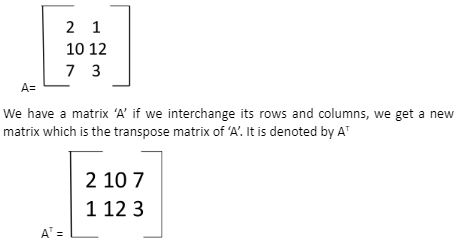
Transpose of Matrix

If the corresponding rows of a given matrix are flipped and converted into its columns then the newly formed matrix is called the transpose of the earlier matrix.

Conclusion

Matrices provide us with a lot of help and shows us an extremely linear and easy path for solving hectic equations in day to day life, especially in algebra.

The laws and solutions of matrices as well as determinants are used for plotting graphs, statistical studies and also to do research and scientific studies in different fields. Matrices can also be used to generate and show us data of the world in real life like the population of people, infant mortality rate, population per square meter, deaths per year, etc. They are the best representation methods for plotting and performing surveys.

Crack CA Foundation with Unacademy

Get subscription and access unlimited live and recorded courses from India’s best educators

  • Structured syllabus
  • Daily live classes
  • Ask doubts
  • Tests & practice
Learn more

Notifications

Get all the important information related to the CA Foundation Exam including the process of application, important calendar dates, eligibility criteria, exam centers etc.

Application Process
CA Foundation Exam Pattern 2024
CA Foundation Results(Out) – Result Link at icai.nic.in
CA Foundation Syllabus 2023 – (New & Old)
CA Intermediate Results
Eligibility
Examination Centres
Last Year’s Papers for CA Foundation
Registration Fee for CA Foundation Course
See all

Related articles

Learn more topics related to Business Mathematics
Union, intersection and complement of sets

Are you keen to know about sets? If yes, then explore in detail the intersection of sets, the union of sets and get an answer to what is the complement of a set.

Types of Matrices

In this article different types of matrices which are important parts of the business and mathematics have been discussed with an explanation.

Triangle inequality

The Triangle Inequality states that the sum of lengths of two different sides of a triangle is larger than the third side for any given triangle.

Time value of Money

The time value of money concept tells that, in the current day the value of a given sum of money is more than the value of money in the future.

See all
Access more than

1,470+ courses for CA Foundation

Get subscription

Trending Topics

  • Nature of Employment
  • Fixed Capital and Working Capital
  • Demographic Environment
  • Chapter wise Free MCQ test Series
freeliveclasses_ca

Related links

  • CA Intermediate Subscription
  • CA Intermediate Free Trial
  • CA Intermediate AIMT
  • Demo Lectures for Yoddha Warm-up Batch
  • CA Intermediate Store
  • CA Foundation Study Materials
  • CA Intermediate Batches
testseries_ca
Subscribe Now
.
Company Logo

Unacademy is India’s largest online learning platform. Download our apps to start learning


Starting your preparation?

Call us and we will answer all your questions about learning on Unacademy

Call +91 8585858585

Company
About usShikshodayaCareers
we're hiring
BlogsPrivacy PolicyTerms and Conditions
Help & support
User GuidelinesSite MapRefund PolicyTakedown PolicyGrievance Redressal
Products
Learner appLearner appEducator appEducator appParent appParent app
Popular goals
IIT JEEUPSCSSCCSIR UGC NETNEET UG
Trending exams
GATECATCANTA UGC NETBank Exams
Study material
UPSC Study MaterialNEET UG Study MaterialCA Foundation Study MaterialJEE Study MaterialSSC Study Material

© 2025 Sorting Hat Technologies Pvt Ltd

Unacademy
  • Goals
    • AFCAT
    • AP EAMCET
    • Bank Exam
    • BPSC
    • CA Foundation
    • CAPF
    • CAT
    • CBSE Class 11
    • CBSE Class 12
    • CDS
    • CLAT
    • CSIR UGC
    • GATE
    • IIT JAM
    • JEE
    • Karnataka CET
    • Karnataka PSC
    • Kerala PSC
    • MHT CET
    • MPPSC
    • NDA
    • NEET PG
    • NEET UG
    • NTA UGC
    • Railway Exam
    • SSC
    • TS EAMCET
    • UPSC
    • WBPSC
    • CFA

Share via

COPY