Access free live classes and tests on the app
Download
+
Unacademy
  • Goals
    • AFCAT
    • AP EAMCET
    • Bank Exam
    • BPSC
    • CA Foundation
    • CAPF
    • CAT
    • CBSE Class 11
    • CBSE Class 12
    • CDS
    • CLAT
    • CSIR UGC
    • GATE
    • IIT JAM
    • JEE
    • Karnataka CET
    • Karnataka PSC
    • Kerala PSC
    • MHT CET
    • MPPSC
    • NDA
    • NEET PG
    • NEET UG
    • NTA UGC
    • Railway Exam
    • SSC
    • TS EAMCET
    • UPSC
    • WBPSC
    • CFA
Login Join for Free
avtar
  • ProfileProfile
  • Settings Settings
  • Refer your friendsRefer your friends
  • Sign outSign out
  • Terms & conditions
  • •
  • Privacy policy
  • About
  • •
  • Careers
  • •
  • Blog

© 2023 Sorting Hat Technologies Pvt Ltd

Watch Free Classes
    • Free courses
    • JEE Main 2024
    • JEE Main 2024 Live Paper Discussion
    • JEE Main Rank Predictor 2024
    • JEE Main College Predictor 2024
    • Stream Predictor
    • JEE Main 2024 Free Mock Test
    • Study Materials
    • Notifications
    • JEE Advanced Syllabus
    • JEE Books
    • JEE Main Question Paper
    • JEE Coaching
    • Downloads
    • JEE Notes & Lectures
    • JEE Daily Videos
    • Difference Between
    • Full Forms
    • Important Formulas
    • Exam Tips
JEE Main 2026 Preparation: Question Papers, Solutions, Mock Tests & Strategy Unacademy » JEE Study Material » Mathematics » Graphs of Trigonometric Functions

Graphs of Trigonometric Functions

The graph-based approach of a trigonometric function helps correlate the value of angle and its trigonometric factor.

Table of Content
  •  

A trigonometric function is a part of mathematics that helps calculate functions that give a relationship between a triangle’s side and angle. For example, functions like Sine(sin), Cosine(cos), Tangent(tan), Cotangent(cot), Secant(sec), and Cosecant (cosec) help you to give a correlation between the sides and angle of a triangle. Along with that, a trigonometric ratio can also prove helpful in finding the missing parts of the triangle, which can include different sides and angles.

Trigonometric functions are one of the most important topics in which learning graphical representation is as vital as learning the theory. It is because many of the theoretical formulas are dependent on Graphical properties. For example, as per the definition of trigonometry ratios, each value of a graph differs from the other in many ways, like trigonometrical value, sign property, formulas and functions. 

Based on the area of functions, a trigonometric graph can be plotted so that the X-axis contains the angle of the triangle and the vertical moving line, i.e. Y-axis contains the value of the trigonometric ratio for the respective function. To catch a strong grip on the graphical representation, continue reading as we move ahead in our study material notes on graphs of trigonometric functions.

Concept Of Trigonometry In Quadrants

Quadrants are the sections created after dividing a graph into four parts.

  •  If the angle is acute, i.e. less than 90° (θ < 90°), it lies in the first quadrant with both the coordinates, i.e. X and Y being positive. 
  • If the angle is obtuse, it is considered in the second quadrant, with the Y coordinate being positive and the X-coordinate being negative. 
  • If the angle is more than 180° and less than 270°, then the ratio lies in the third quadrant with both the axes coordinates being negative. 
  • Finally, if the coordinate lies in the fourth quadrant, which is only possible if the angle is more than 270° and less than 360°, then the x-coordinate is considered positive and Y-coordinate as negative.

The relationships between the ratios and quadrants could be seen in the graph, with the first quadrant being positive for all trigonometric ratios and the second being positive for only sin and cosec and negative for the rest of the ratios. Similarly, in the third quadrant, the gates of being positive are only open for tangent(tan) and cotangent(cot) trigonometric values and make the other remaining ratios lying in this quadrant appear with a negative sign. Finally, in the fourth quadrant, cos and sec can be only positive and make other ratios negative. 

Graph of Trigonometric Functions

1.Sine Graph

In this graph, the function is considered as y=sin x. As you can see, the graph meets the X-axis only at the angles of 180° and 360°, multiples of π. It means that the graph of sin x passes through the X-axis with the value as sin x =0. Hence the period of the sine function is said to be 2π. Also, as you can see, the maximum value of the graph is at π/2, which is one, and the minimum value is -1 at (3π/2).

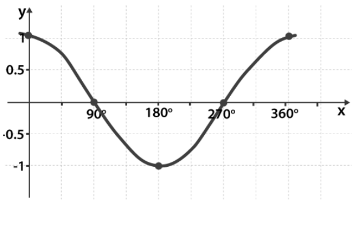
2.Cosine Graph

In this graph, the function is considered as y=sin x. As you can see, the graph meets the X-axis only at the angles of 180° and 360°, multiples of π. It means that the graph of cos x passes through the X-axis with the value as cos x =1. Hence the period of the cos function is said to be 2π. Also, as you can see, the maximum value of the graph is at π,4π, which is one, and the minimum value is -1 at (2π).

3.Tangent Graph

The tan function is different from sin and cos. It is the only function that goes between positive and negative infinity, crossing through the x-axis over the intervals of 180°. As a result, the amplitude of a tangent graph is undefined as the curves on the graph go to infinity.

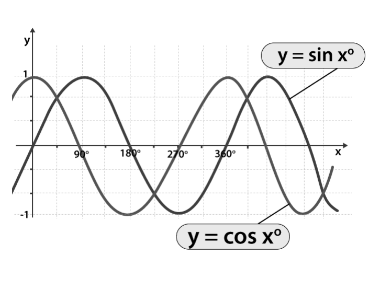
4.The similarity between sin and cos graphs


Most of the properties in sin and cos are similar to each other. But due to the difference 

in angles, they become varying. Here are some similarities which we see between sin and cos.

  • Both of these trigonometric ratios have the curve meeting along the X-axis only.
  • They both have an amplitude of 1 and a minimum value of -1.
  • They have possessed the same period, 360° or 2π radians.

Steps to Draw a Graph of Trigonometric Function

While drawing a sine function graph, convert the given function to the general form using the formula,

sin (bx – c) + d 

This is used to find the different parameters such as, |a| = Amplitude, c/b = Phase shift, d = Vertical shift, 2π/|b| = Period.

The same case is used for the cosine function using the formula: 

 cos (bx – c) + d

Graphical representations of sin(x), cos(x), tan(x), csc(x), sec(x), cot(x):

Conclusion

The concept of graphs of trigonometric functions is very crucial to learn. It helps solve any mathematical idea with ease and at a faster pace. Also, graphs of trigonometry could be a valuable tool to simplify the problem and make its solving process more efficient. 

Therefore, these graphs of trigonometric functions study material provided above could help you understand the topic more quickly and efficiently. Furthermore, studying all issues from the study material notes on graphs of trigonometric functions can help you achieve the milestone of tackling challenging problems in mathematics.


faq

Frequently asked questions

Get answers to the most common queries related to the IIT JEE Examination Preparation.

What do you mean by amplitude?

Ans : The curve’s height from the X-axis to the peak point is known as its amplitude. It is the maximum value obtained by su...Read full

What is a Period?

Ans : The time the curve takes to reach the next matching point from any point is called a period. It is measured in seconds....Read full

What is a Phase?

Ans : The distance covered by the function horizontally is called a Phase. It is used to calculate the maximum and minimum turning...Read full

What are the complementary trigonometric functions for the angle (90° - θ)?

Ans :  The complementary trigonometric functions for the angle (90° – θ) is given as: sin(90°−θ) ...Read full

What do you mean by the term domain and range of a trigonometric function?

Ans:The value of the angle in the trigonometric function is called a domain. At the same time, the range is the final value of the...Read full

Ans : The curve’s height from the X-axis to the peak point is known as its amplitude. It is the maximum value obtained by substituting the angle on the trigonometric function.

Ans : The time the curve takes to reach the next matching point from any point is called a period. It is measured in seconds.

Ans : The distance covered by the function horizontally is called a Phase. It is used to calculate the maximum and minimum turning points.

Ans : 

The complementary trigonometric functions for the angle (90° – θ) is given as:

  • sin(90°−θ) = cos θ
  • cos(90°−θ) = sin θ
  • tan(90°−θ) = cot θ
  • cot(90°−θ) = tan θ
  • sec(90°−θ) = cosec θ
  • cosec(90°−θ) = sec θ

Ans:The value of the angle in the trigonometric function is called a domain. At the same time, the range is the final value of the trigonometric function. The highest range is for sin θ and varies from [-1, 1], for sinθ and cosθ, and the lowest value is (-∞, +∞) for tanθ, cotθ.

Crack IIT JEE with Unacademy

Get subscription and access unlimited live and recorded courses from India’s best educators

  • Structured syllabus
  • Daily live classes
  • Ask doubts
  • Tests & practice
Learn more

Notifications

Get all the important information related to the JEE Exam including the process of application, important calendar dates, eligibility criteria, exam centers etc.

Allotment of Examination Centre
JEE Advanced Eligibility Criteria
JEE Advanced Exam Dates
JEE Advanced Exam Pattern 2023
JEE Advanced Syllabus
JEE Application Fee
JEE Application Process
JEE Eligibility Criteria 2023
JEE Exam Language and Centres
JEE Exam Pattern – Check JEE Paper Pattern 2024
JEE Examination Scheme
JEE Main 2024 Admit Card (OUT) – Steps to Download Session 1 Hall Ticket
JEE Main Application Form
JEE Main Eligibility Criteria 2024
JEE Main Exam Dates
JEE Main Exam Pattern
JEE Main Highlights
JEE Main Paper Analysis
JEE Main Question Paper with Solutions and Answer Keys
JEE Main Result 2022 (Out)
JEE Main Revised Dates
JEE Marking Scheme
JEE Preparation Books 2024 – JEE Best Books (Mains and Advanced)
Online Applications for JEE (Main)-2022 Session 2
Reserved Seats
See all

Related articles

Learn more topics related to Mathematics
Zero Vector

A zero vector is defined as a line segment coincident with its beginning and ending points. Primary Keyword: Zero Vector

ZERO MATRIX

In this article, we will discuss about the zero matrix and it’s properties.

YARDS TO FEET

In this article we will discuss the conversion of yards into feet and feets to yard.

XVI Roman Numeral

In this article we are going to discuss XVI Roman Numerals and its origin.

See all
Access more than

10,505+ courses for IIT JEE

Get subscription

Trending Topics

  • JEE Main 2024
  • JEE Main Rank Predictor 2024
  • JEE Main Mock Test 2024
  • JEE Main 2024 Admit Card
  • JEE Advanced Syllabus
  • JEE Preparation Books
  • JEE Notes
  • JEE Advanced Toppers
  • JEE Advanced 2022 Question Paper
  • JEE Advanced 2022 Answer Key
  • JEE Main Question Paper
  • JEE Main Answer key 2022
  • JEE Main Paper Analysis 2022
  • JEE Main Result
  • JEE Exam Pattern
  • JEE Main Eligibility
  • JEE College predictor
combat_iitjee

Related links

  • JEE Study Materials
  • CNG Full Form
  • Dimensional Formula of Pressure
  • Reimer Tiemann Reaction
  • Vector Triple Product
  • Swarts Reaction
  • Focal length of Convex Lens
  • Root mean square velocities
  • Fehling’s solution
testseries_iitjee
Predict your JEE Rank
.
Company Logo

Unacademy is India’s largest online learning platform. Download our apps to start learning


Starting your preparation?

Call us and we will answer all your questions about learning on Unacademy

Call +91 8585858585

Company
About usShikshodayaCareers
we're hiring
BlogsPrivacy PolicyTerms and Conditions
Help & support
User GuidelinesSite MapRefund PolicyTakedown PolicyGrievance Redressal
Products
Learner appLearner appEducator appEducator appParent appParent app
Popular goals
IIT JEEUPSCSSCCSIR UGC NETNEET UG
Trending exams
GATECATCANTA UGC NETBank Exams
Study material
UPSC Study MaterialNEET UG Study MaterialCA Foundation Study MaterialJEE Study MaterialSSC Study Material

© 2026 Sorting Hat Technologies Pvt Ltd

Unacademy
  • Goals
    • AFCAT
    • AP EAMCET
    • Bank Exam
    • BPSC
    • CA Foundation
    • CAPF
    • CAT
    • CBSE Class 11
    • CBSE Class 12
    • CDS
    • CLAT
    • CSIR UGC
    • GATE
    • IIT JAM
    • JEE
    • Karnataka CET
    • Karnataka PSC
    • Kerala PSC
    • MHT CET
    • MPPSC
    • NDA
    • NEET PG
    • NEET UG
    • NTA UGC
    • Railway Exam
    • SSC
    • TS EAMCET
    • UPSC
    • WBPSC
    • CFA

Share via

COPY