
Access free live classes and tests on the app
Download
+
Unacademy's Blog!
Login Join for Free
avtar
  • ProfileProfile
  • Settings Settings
  • Refer your friendsRefer your friends
  • Sign outSign out
  • Terms & conditions
  • •
  • Privacy policy
  • About
  • •
  • Careers
  • •
  • Blog

© 2023 Sorting Hat Technologies Pvt Ltd

Challenge Yourself Everyday Attempt 2023’s and previous year’s JEE Main Download Important Formulas pdf Attempt Free Test Series for JEE Main 2023

Trending Topics

  • JEE Main 2024
  • JEE Main Rank Predictor 2024
  • JEE Main Mock Test 2024
  • JEE Main 2024 Admit Card
  • JEE Advanced Syllabus
  • JEE Preparation Books
  • JEE Notes
  • JEE Advanced Toppers
  • JEE Advanced 2022 Question Paper
  • JEE Advanced 2022 Answer Key
  • JEE Main Question Paper
  • JEE Main Answer key 2022
  • JEE Main Paper Analysis 2022
  • JEE Main Result
  • JEE Exam Pattern
  • JEE Main Eligibility
  • JEE College predictor
[wp_login_wall media_id="424566" text_before_login="Download JEE Main PYQs" text_after_login="Download JEE Main 2022 Question Papers"]

JEE Coaching Centres

  • JEE Coaching in Nagpur
  • JEE Coaching in Ranchi
  • JEE Coaching in Gorakhpur
  • JEE Coaching in Bhubaneswar
  • JEE Coaching in Vijayawada
  • JEE Coaching in Dehradun
  • JEE Coaching in Indore
  • JEE Coaching in Gurugram
  • JEE Coaching in Muzaffarpur
  • JEE Coaching in Varanasi
  • JEE Coaching in Jammu
  • JEE Coaching in Kolhapur
  • JEE Coaching in Bikaner
  • JEE Coaching in Delhi Lajpat Nagar
Predict your JEE Rank . [wp_custom_style style=".side-btn-second{margin: 1px 0px;}"][wp_custom_script script="document.querySelector('.targetTopBtn').onClick = topFunction; function topFunction() { window.scrollTo({ top: 0, behavior: 'smooth' }) }"][wp_custom_style style=".side-btn-second{margin: 1px 0px;} .elementor-element.elementor-element-dcb2b31{display: none !important;}"]
Challenge Yourself Everyday Attempt 2023’s and previous year’s JEE Main Download Important Formulas pdf Attempt Free Test Series for JEE Main 2023

Trending Topics

  • JEE Main 2024
  • JEE Main Rank Predictor 2024
  • JEE Main Mock Test 2024
  • JEE Main 2024 Admit Card
  • JEE Advanced Syllabus
  • JEE Preparation Books
  • JEE Notes
  • JEE Advanced Toppers
  • JEE Advanced 2022 Question Paper
  • JEE Advanced 2022 Answer Key
  • JEE Main Question Paper
  • JEE Main Answer key 2022
  • JEE Main Paper Analysis 2022
  • JEE Main Result
  • JEE Exam Pattern
  • JEE Main Eligibility
  • JEE College predictor
[wp_login_wall media_id="424566" text_before_login="Download JEE Main PYQs" text_after_login="Download JEE Main 2022 Question Papers"]

JEE Coaching Centres

  • JEE Coaching in Nagpur
  • JEE Coaching in Ranchi
  • JEE Coaching in Gorakhpur
  • JEE Coaching in Bhubaneswar
  • JEE Coaching in Vijayawada
  • JEE Coaching in Dehradun
  • JEE Coaching in Indore
  • JEE Coaching in Gurugram
  • JEE Coaching in Muzaffarpur
  • JEE Coaching in Varanasi
  • JEE Coaching in Jammu
  • JEE Coaching in Kolhapur
  • JEE Coaching in Bikaner
  • JEE Coaching in Delhi Lajpat Nagar
Predict your JEE Rank . [wp_custom_style style=".side-btn-second{margin: 1px 0px;}"][wp_custom_script script="document.querySelector('.targetTopBtn').onClick = topFunction; function topFunction() { window.scrollTo({ top: 0, behavior: 'smooth' }) }"][wp_custom_style style=".side-btn-second{margin: 1px 0px;} .elementor-element.elementor-element-dcb2b31{display: none !important;}"]
JEE Main 2026 Preparation: Question Papers, Solutions, Mock Tests & Strategy Unacademy » JEE Study Material » Chemistry » Various Types of Chemical Equilibrium
Challenge Yourself Everyday Attempt 2023’s and previous year’s JEE Main Download Important Formulas pdf Attempt Free Test Series for JEE Main 2023

Trending Topics

  • JEE Main 2024
  • JEE Main Rank Predictor 2024
  • JEE Main Mock Test 2024
  • JEE Main 2024 Admit Card
  • JEE Advanced Syllabus
  • JEE Preparation Books
  • JEE Notes
  • JEE Advanced Toppers
  • JEE Advanced 2022 Question Paper
  • JEE Advanced 2022 Answer Key
  • JEE Main Question Paper
  • JEE Main Answer key 2022
  • JEE Main Paper Analysis 2022
  • JEE Main Result
  • JEE Exam Pattern
  • JEE Main Eligibility
  • JEE College predictor
[wp_login_wall media_id="424566" text_before_login="Download JEE Main PYQs" text_after_login="Download JEE Main 2022 Question Papers"]

JEE Coaching Centres

  • JEE Coaching in Nagpur
  • JEE Coaching in Ranchi
  • JEE Coaching in Gorakhpur
  • JEE Coaching in Bhubaneswar
  • JEE Coaching in Vijayawada
  • JEE Coaching in Dehradun
  • JEE Coaching in Indore
  • JEE Coaching in Gurugram
  • JEE Coaching in Muzaffarpur
  • JEE Coaching in Varanasi
  • JEE Coaching in Jammu
  • JEE Coaching in Kolhapur
  • JEE Coaching in Bikaner
  • JEE Coaching in Delhi Lajpat Nagar
Predict your JEE Rank . [wp_custom_style style=".side-btn-second{margin: 1px 0px;}"][wp_custom_script script="document.querySelector('.targetTopBtn').onClick = topFunction; function topFunction() { window.scrollTo({ top: 0, behavior: 'smooth' }) }"][wp_custom_style style=".side-btn-second{margin: 1px 0px;} .elementor-element.elementor-element-dcb2b31{display: none !important;}"]

Various Types of Chemical Equilibrium

There are two types of chemical equilibrium- homogeneous and heterogeneous, depending on the phases present in the reaction. If one phase is present, it is homogeneous, otherwise heterogeneous.

Table of Content
  •  

Let us consider an example of chemical equilibrium:

2NO2 (g)→ N2O4 (g)

NO2 is reddish-brown coloured, while N2O4 is colourless. If NO2 is kept in a sealed, evacuated glass vessel at 25℃, it starts getting converted to colourless N2O4. However, after a while, it can be seen that the intensity of the brown colour gets constant, signifying that the concentration of NO2 is no longer changing. When such a stage is reached, we can say that a state of equilibrium has been reached.

Chemical equilibrium in a reversible reaction can be defined as the state at which two opposing reactions occur at the same speed. The reaction doesn’t stop.

If the reaction is of type: jA + kB ⇌ lC +mD

The law of mass action can be represented by the equilibrium expression given below:

 K = [C]l [D]m∕ [A]j [B]k

Here, K is the equilibrium constant.

Types and examples of chemical equilibrium

 There are two types of chemical equilibria: (i) Homogeneous and (ii) Heterogeneous.

Homogeneous equilibrium

The reversible reactions in which all the reactants and products are present in the same state, i.e., only one phase is present, are homogeneous reactions. When equilibrium is achieved in such chemical reactions, it is known as homogeneous equilibrium.

Homogeneous reactions can be further classified into three types:

First type: Number of molecules are not changed in a reaction. Examples include:

(a)   H2 (g) + I2 (g) ⇌ 2HI (g)

(b)   CH3COOH(l) + CH3CH2OH (l) ⇌ CH3COOCH2CH3 (l) + H2O (l)

Second type: There is an increase in the number of molecules in a reaction. Examples include:

(a)   PCl5 (g)⇌ PCl3 (g) + Cl2 (g)

(b)    2NH3 (g) ⇌ N2(g) + 3H2(g)

Third type: There is a decrease in the number of molecules in a reaction. Examples include:

(a)    N2(g) + 3H2(g) ⇌ 2NH3 (g)

(b)   2SO2 (g) + O2 (g) ⇌ 2SO3 (g)

The value of the equilibrium constant is also dependent on certain factors in these reactions.

  • The mode of representation of the reaction: Concentrations of products are kept at the numerator, whereas the concentrations of reactants are kept at the denominator.

A + B ⇌ C+ D

Here, equilibrium constant K can be written as

K= [C][D]/[A][B]

However, if we consider the reverse reaction,

C + D⇌ A+ B

Now, K’ = [A][B]/[C][D] = 1/ K

  • Stoichiometric representation: When a reversible reaction can be written in the form of 2 or more stoichiometric equations, the value of K will differ in each case. In general, if we multiply a balanced equation with any value n, the new equilibrium constant will be now equal to Kn.

A+ B⇌ C+ D,  K= [C][D]/[A][B]

nA +nB ⇌ nC + nD,  K’ = [C]n[D]n/ [A]n[B]n = Kn

  • Use of partial pressures in place of concentrations: When the reaction takes place in the gaseous phase, partial pressure can be used instead of concentration as the partial pressure of a substance is proportional to its concentration in the gas phase.

From the ideal gas equation, PV= nRT

Or P= (n/V) RT = CRT

Where C is the number of moles of gas per unit volume

For the general reaction 

jA + kB⇌ lC + mD

Let the partial pressures be PA , PB, PC and PD, respectively at equilibrium.

So,, Kp = (Pcl)(PDl) / ( PAj)( PBk)

           = ( CC× RT)l ( CD RT)m / (CA RT)j ( CBRT)k

                 = [C]l[D]m/[A]j[B]k ×(RT)(l+m)-(j+k) = K (RT)∆n

Where ∆n = difference in the sums of coefficients for gaseous reactants and products.

Units of Equilibrium Constant

 K has no unit for a reaction where the reactants and products are equimolar.

In general, unit of K = [M]∆n

Where M = mol litre-1 and ∆n= number of moles of gaseous products- number of moles of gaseous reactants.

Similarly, the unit of Kp = [atm]∆n

Heterogeneous equilibrium

The reversible reactions where the components occur in more than one phase are known as heterogeneous reactions. The equilibrium achieved in heterogeneous reactions is called heterogeneous equilibrium.

Examples include:

(a)    CaCO3 (s) ⇌ CaO (s) + CO2 (g)

(b)   H2O (g) + C (s) ⇌ H2 (g) + CO (g)

If we consider the example of decomposition of calcium carbonate and try to derive its equilibrium expression, we get

K’ = [CO2][ CaO]/ [CaCO3]

However, it has been determined experimentally that the concentrations of pure solid and pure liquid phases don’t appear in the expression of the equilibrium constant for a heterogeneous reaction. Here CaCO3 is a pure solid, and its activity is taken as unity. Similarly, the activity of CaO is also unity as the reference states are pure CaCO3 and pure CaO, respectively.

So, the equilibrium expression can be written as

K= [CO2](1)/ (1) = [CO2]

And Kp = PCO2 (1) / (1) = PCO2

To generalise, we can say that in the case of a pure solid or a pure liquid, activity is always 1.

Conclusion

In summary, we can say that there are two types of chemical reactions, i.e., reversible and irreversible reactions. Chemical equilibrium is a characteristic property of a reversible reaction. The equilibrium state is the state where the rate of the forward reaction and backward or reverse reaction are equal.

However, the reaction doesn’t actually stop, so it is dynamic in nature.

There are two types of chemical equilibrium- heterogeneous and homogeneous.

The equilibrium taking place in a reaction where every component is in the phase is called homogeneous equilibrium, whereas, if two or more phases are present, the equilibrium is heterogeneous.
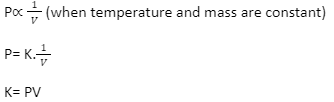
pv1

where k is a constant whose value is determined by the volume of the gas V and its temperature P.

According to Boyle’s law, the product of the volume and pressure of a given amount of gas at a certain temperature is constant based on the preceding equation.

Let T be the temperature and P2 be the pressure of a particular quantity of gas. Now, if the gas’s pressure at temperature T is increased to V2, resulting in a volume V2, according to Boyle’s law, the gas’s volume will be V2.

P1 V1 = P2V2

They are constants, when mass and temperature are constant.

pv2

P1= Initial pressure exerted by the gas

P2= Final pressure exerted by the gas

V1= Initial volume occupied by the gas

V2= Final volume occupied by the gas

Examples of Boyle’s law

Respiration: Our lungs use Boyle’s law during respiration. When you breathe in, your lungs expand because they are filled with air. As the volume increases, the pressure level decreases. Similarly, when air is deflated, the lungs contract, reducing volume and increasing pressure. The change in pressure and volume is both instantaneous and periodic.

Soda bottle: One of the best examples of Boyle’s law is a soda bottle filled with a mixture of carbon dioxide and water. It is difficult to squeeze a sealed beverage can or container. This is because the air molecules inside the container are tightly packed and have little room to move. When you open a can or bottle, some air molecules leave the container, allowing room for more air molecules to move in and squeeze the bottle. The change in pressure as a function of the volume can be clearly seen in this example.

Scuba diving: When diving underwater, it is important to ensure that the volume and pressure ratios are balanced to avoid illness or injury. You feel great pressure when entering or approaching the depth of the body of water. The solubility of gases in the human blood increases with high pressure. As it rises or moves up, the pressure in the blood begins to drop, and the gases in the blood begin to expand. As a result, the diver must ascend slowly to avoid damage. Boyle’s law is based on the relationship between pressure and volume.

Graphical representation of Boyle’s law

A direct line going via the starting place for a plot of P vs 1/V at a steady temperature for a fixed quantity of fuel line might be a graphical illustration of Boyle’s Law.

A rectangular hyperbola is a plot of P vs V at constant temperature for a specific mass of gas.

A straight line parallel to the PV axis is used to plot P (or V) versus PV at constant temperature for a specific mass of a gas.

Conclusion

Boyle’s law regulation is very important as it explains how gases behave. It proves past a shadow of a doubt that fuel line strain and quantity are inversely proportional. When you press down on a fuel line, the quantity shrinks, and the strain rises.

faq

Frequently asked questions

Get answers to the most common queries related to the IIT JEE Examination Preparation.

Explain the difference between K and Kp.

Ans. K is the equilibrium constant in terms of concentration, whereas K...Read full

What is chemical equilibrium?

Ans. The state of reaction where the rate of forward reaction becomes equal to the rate of backward reaction...Read full

What are homogeneous and heterogeneous equilibria?

Ans. When equilibrium occurs in a reaction in which the reac...Read full

For which reactions are K and Kp equal?

Ans.According to the relation: Kp = K (RT)∆n , when ∆n=0, i.e., gaseous reactants and products are equimolar, K and Kp become ...Read full

Is the chemical equilibrium static or dynamic in nature?

Ans. Chemical equilibrium is dynamic in nature because the reaction doesn’t stop. In fact, the forward and...Read full

Can an equilibrium state be attained from both sides of a chemical reaction?

Ans. Yes, we can attain equilibrium from either side of a chemical reaction. It depends on the initial conce...Read full

Ans. K is the equilibrium constant in terms of concentration, whereas Kp is the equilibrium constant in terms of partial pressure. K is given as the ratio between the concentration of reactants and products. Kp gives a ratio between partial pressures of products and reactants.

Ans. The state of reaction where the rate of forward reaction becomes equal to the rate of backward reaction is known as a chemical equilibrium. In other words, we can say that the condition where no net change occurs in the amounts of reactants and products.

Ans. When equilibrium occurs in a reaction in which the reactants and products are in the same phase, it is known as homogeneous equilibrium. Example: 

 H2 (g) + I2 (g) ⇌ 2HI (g)

However, when two or more phases are present, the equilibrium is heterogeneous.  

Example: CaCO3 (s) ⇌ CaO (s) + CO2 (g)

Ans.According to the relation: Kp = K (RT)∆n , when ∆n=0, i.e., gaseous reactants and products are equimolar, K and Kp become equal.

Ans. Chemical equilibrium is dynamic in nature because the reaction doesn’t stop. In fact, the forward and backward reactions occur at the same rate even after attaining equilibrium.

Ans. Yes, we can attain equilibrium from either side of a chemical reaction. It depends on the initial concentration. If the initial concentration of reactants is higher than that of products, the rate of forward reaction will be more. However, if the initial concentration of products is higher, then the rate of reverse reaction will be high till equilibrium is reached.

Challenge Yourself Everyday
Attempt 2023’s and previous year’s JEE Main
Download Important Formulas pdf
Attempt Free Test Series for JEE Main 2023

Trending Topics

  • JEE Main 2024
  • JEE Main Rank Predictor 2024
  • JEE Main Mock Test 2024
  • JEE Main 2024 Admit Card
  • JEE Advanced Syllabus
  • JEE Preparation Books
  • JEE Notes
  • JEE Advanced Toppers
  • JEE Advanced 2022 Question Paper
  • JEE Advanced 2022 Answer Key
  • JEE Main Question Paper
  • JEE Main Answer key 2022
  • JEE Main Paper Analysis 2022
  • JEE Main Result
  • JEE Exam Pattern
  • JEE Main Eligibility
  • JEE College predictor

JEE Coaching Centres

  • JEE Coaching in Nagpur
  • JEE Coaching in Ranchi
  • JEE Coaching in Gorakhpur
  • JEE Coaching in Bhubaneswar
  • JEE Coaching in Vijayawada
  • JEE Coaching in Dehradun
  • JEE Coaching in Indore
  • JEE Coaching in Gurugram
  • JEE Coaching in Muzaffarpur
  • JEE Coaching in Varanasi
  • JEE Coaching in Jammu
  • JEE Coaching in Kolhapur
  • JEE Coaching in Bikaner
  • JEE Coaching in Delhi Lajpat Nagar
Predict your JEE Rank
.
Challenge Yourself Everyday
Attempt 2023’s and previous year’s JEE Main
Download Important Formulas pdf
Attempt Free Test Series for JEE Main 2023

Trending Topics

  • JEE Main 2024
  • JEE Main Rank Predictor 2024
  • JEE Main Mock Test 2024
  • JEE Main 2024 Admit Card
  • JEE Advanced Syllabus
  • JEE Preparation Books
  • JEE Notes
  • JEE Advanced Toppers
  • JEE Advanced 2022 Question Paper
  • JEE Advanced 2022 Answer Key
  • JEE Main Question Paper
  • JEE Main Answer key 2022
  • JEE Main Paper Analysis 2022
  • JEE Main Result
  • JEE Exam Pattern
  • JEE Main Eligibility
  • JEE College predictor

JEE Coaching Centres

  • JEE Coaching in Nagpur
  • JEE Coaching in Ranchi
  • JEE Coaching in Gorakhpur
  • JEE Coaching in Bhubaneswar
  • JEE Coaching in Vijayawada
  • JEE Coaching in Dehradun
  • JEE Coaching in Indore
  • JEE Coaching in Gurugram
  • JEE Coaching in Muzaffarpur
  • JEE Coaching in Varanasi
  • JEE Coaching in Jammu
  • JEE Coaching in Kolhapur
  • JEE Coaching in Bikaner
  • JEE Coaching in Delhi Lajpat Nagar
Predict your JEE Rank
.
Company Logo

Unacademy is India’s largest online learning platform. Download our apps to start learning


Starting your preparation?

Call us and we will answer all your questions about learning on Unacademy

Call +91 8585858585

Company
About usShikshodayaCareers
we're hiring
BlogsPrivacy PolicyTerms and Conditions
Help & support
User GuidelinesSite MapRefund PolicyTakedown PolicyGrievance Redressal
Products
Learner appLearner appEducator appEducator appParent appParent app
Popular goals
IIT JEEUPSCSSCCSIR UGC NETNEET UG
Trending exams
GATECATCANTA UGC NETBank Exams
Study material
UPSC Study MaterialNEET UG Study MaterialCA Foundation Study MaterialJEE Study MaterialSSC Study Material

© 2026 Sorting Hat Technologies Pvt Ltd

Unacademy's Blog!

Share via

COPY