


 Profile
 Settings
 Refer your friends
 Sign out




What Is Gross National Income (GNI) per Capita?
- Gross National Income (GNI) refers to the total income earned by the residents of a country during a specific period.
- It is calculated by taking the Gross Domestic Product (GDP), subtracting the income paid to non-residents, and adding the income received by residents from abroad.
- In other words, GNI = GDP – income paid to foreign entities + income earned from abroad.
- GNI is calculated in local currency and then converted to US dollars using exchange rates.
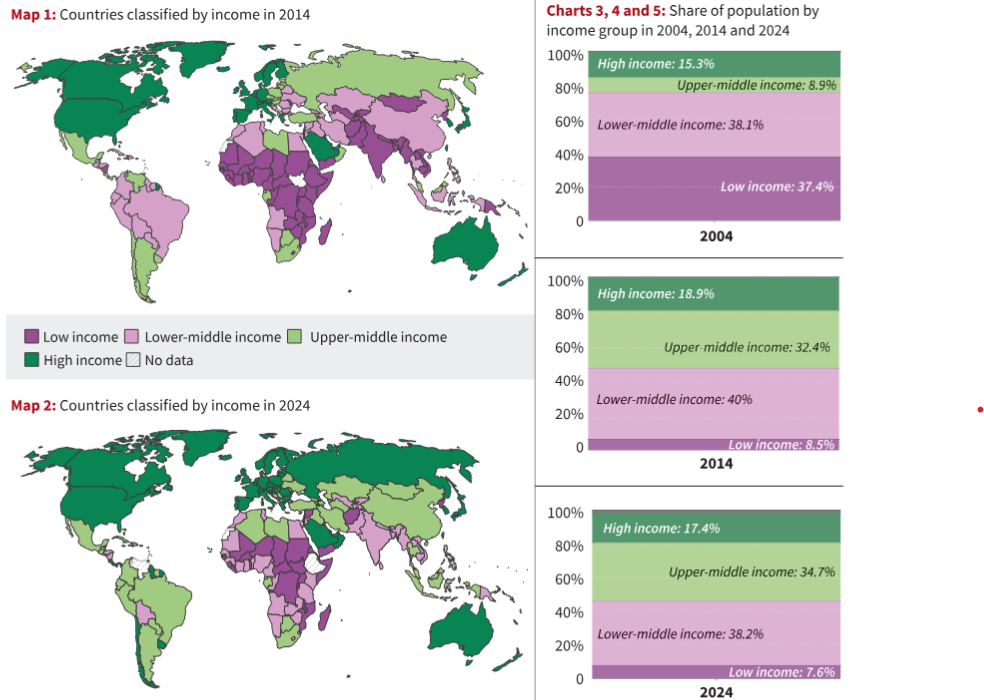
World Bank’s Four Income Groups (2024)
| Income Group | GNI per Capita (in USD) |
| Low-income | $1,135 or less |
| Lower-middle income | $1,136 – $4,495 |
| Upper-middle income | $4,496 – $13,935 |
| High-income | More than $13,935 |
Key Features of the Classification:
- Absolute system: Based on fixed thresholds, not relative to other countries.
- Updated yearly: Adjusted for global inflation.
- A country may move up or down based on:
- Actual income change
- Currency exchange rate
- Population data updates
- The World Bank’s 2024–25 update of its income classification system shows how countries are grouped based on Gross National Income (GNI) per capita, helping compare their economic status over time.
