


 Profile
 Settings
 Refer your friends
 Sign out




Current Situation:
![]() Geographical Factors:
Geographical Factors:
- Punjab is facing one of its worst floods in recent memory.
- All 23 districts declared flood-hit.
- 1,902 villages inundated; 3.8 lakh people affected.
- 11.7 lakh hectares of farmland destroyed; at least 43 deaths.
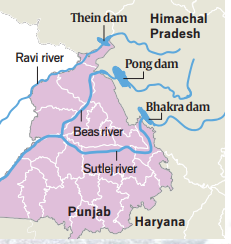
- Punjab, “land of five rivers,” is naturally flood-prone.
- Major rivers: Ravi, Beas, Sutlej (perennial) + Ghaggar and several smaller tributaries and hill streams, known locally as choes (seasonal).
- Fertile alluvial plains → Punjab produces 20% of India’s wheat & 12% of rice despite only 1.5% landmass.
- Floods recur in major years: 1955, 1988, 1993, 2019, 2023, 2025.
- Exceptionally heavy rainfall in Himachal & J&K → inflows exceeded carrying capacity.
- IMD: Punjab, Himachal & J&K saw >45% excess rainfall this monsoon.
- Bhakra (Sutlej), Pong (Beas), Thein/Ranjit Sagar (Ravi) play key roles.
- When reservoirs fill, water release is necessary to prevent overtopping.
- Controlled releases still caused downstream flooding.
- BBMB (Bhakra Beas Management Board) accused of:
- Keeping reservoir levels too high in July–Aug (to secure water/power).
- Giving delayed warnings.
- Focusing on irrigation & power, not flood control.
- Centre’s 2022 amendment allowing all-India officers in BBMB further alienated Punjab.
- Example: Madhopur barrage gates destroyed after sudden release from Thein dam (Aug 26).
- Experts cite poor coordination between upstream & downstream authorities.
- No consistent “flood cushion” maintained in reservoirs.
- Delayed warnings worsened flood impacts.
- Dhussi bundhs (earthen embankments) weakened by illegal mining.
- Drainage Department estimates: ₹4,000–5,000 crore needed for embankment strengthening & river desilting — cheaper than repeated flood losses.
- Punjab’s devastating floods in 2025 highlight the double burden of natural excess rainfall and human mismanagement — poor dam operations and weakened embankments.
