Profile
 Settings
 Refer your friends
 Sign out




Why in News?
- A new study published in Nature Physics explains how malaria parasites use helical motion and “coloured noise” to move efficiently inside the human body, offering new insights for biology and medical micro-robot design.
Helical Motion in Microorganisms
- Many microorganisms, including malaria parasites, move in spiral or corkscrew (helical) paths instead of straight lines.
- This motion helps parasites travel through soft tissues and reach blood vessels after a mosquito bite.
- The study found that malaria parasites move mainly in right-handed helices.
The Problem of Noise in Microscopic Movement
- At microscopic scales, movement is disturbed by random molecular collisions, called noise.
- This noise can make organisms lose their direction within seconds.
- Despite this, malaria parasites stay on track for tens of seconds, which was previously unexplained.
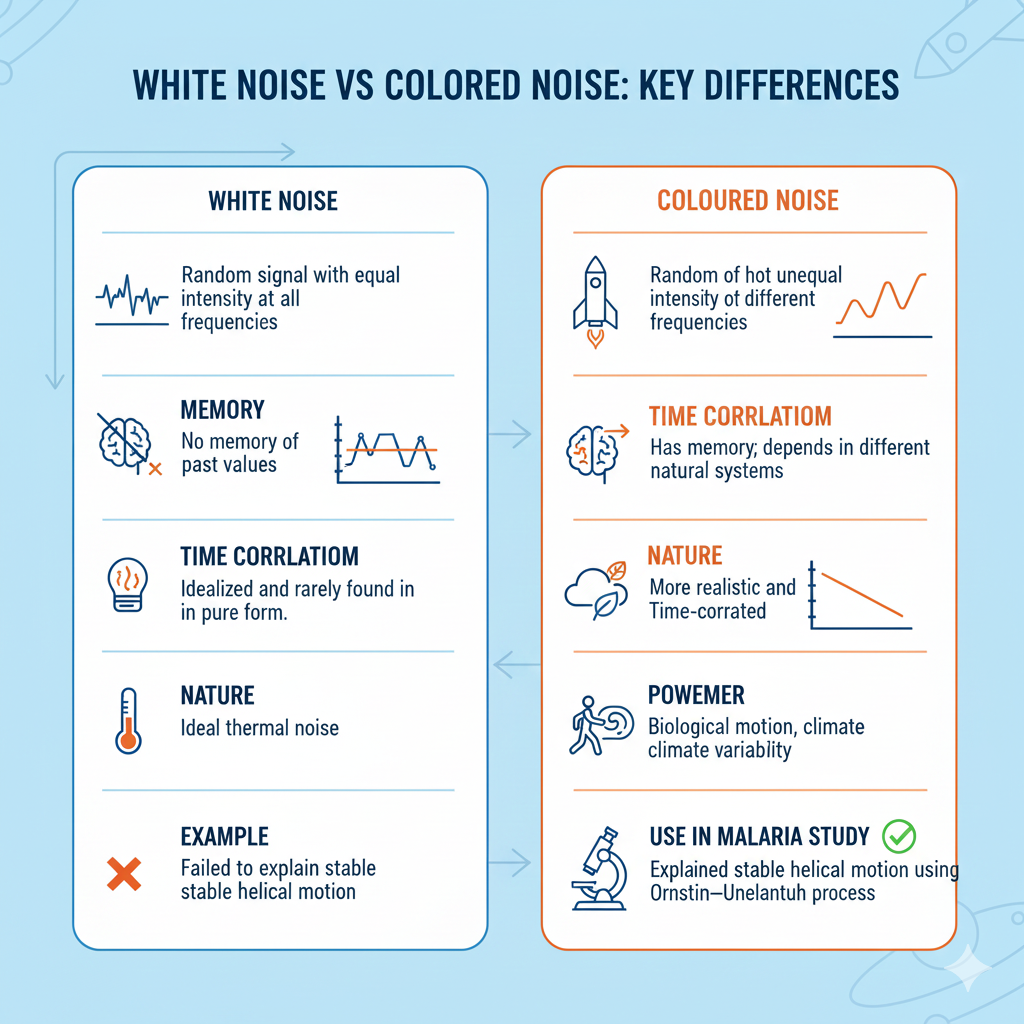
White Noise
- White noise is completely random and memory-less disturbance.
- Its present value does not depend on past values.
- Earlier models used white noise to explain microorganism movement.
- These models failed to explain stable 3D helical movement over long time periods.
Coloured Noise
- Coloured noise has memory and time correlation.
- Its present value depends partly on its recent past.
- The study used an Ornstein-Uhlenbeck process to model coloured noise.
- This better represents the slow internal force fluctuations inside parasites.
Why Coloured Noise is Better for Movement
- With coloured noise, the parasite’s movement becomes more stable over time.
- The internal fluctuations average out instead of destabilizing the motion.
- This allows the parasite to maintain direction for nearly 100 seconds.
- As a result, the parasite travels farther than one moving in a straight line at the same speed.