


 Profile
 Settings
 Refer your friends
 Sign out




Why in News?
- The Union government is set to introduce the Viksit Bharat -Guarantee for Rozgar and Ajeevika Mission (Gramin) Bill, 2025 in the Lok Sabha, proposing to replace the MGNREGA, 2005, triggering strong political and policy debate.
Background: From MGNREGA to VB-G RAM G
- The Mahatma Gandhi National Rural Employment Guarantee Act (MGNREGA), 2005 is a rights-based, demand-driven employment programme.
- It legally guarantees 100 days of wage employment to rural households on demand.
- The new Bill proposes to repeal MGNREGA and replace it with a supply-driven framework.
- This marks a fundamental shift in the philosophy of rural employment support.
Key Features of the Proposed VB-G RAM G Bill
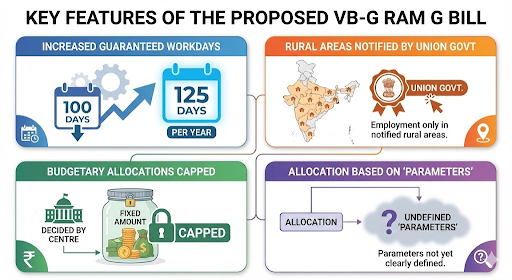
- The scheme increases guaranteed workdays from 100 to 125 days per year.
- Employment will be provided only in rural areas notified by the Union government.
- Budgetary allocations will be capped at a fixed amount, decided by the Centre.
- The allocation will be based on “parameters” that are not yet clearly defined.
Shift from Demand-Driven to Supply-Driven Model
- Under MGNREGA, employment is provided whenever workers demand work.
- The new Bill removes this legal entitlement and replaces it with administrative allocation of work.
- This weakens the rights-based nature of rural employment guarantees.
- Critics argue this reduces accountability and responsiveness to rural distress.
Increased Financial Burden on States
- Under MGNREGA, States currently bear about 10% of the total expenditure.
- The proposed Bill increases the States’ contribution to 40% of total expenditure.
- This may strain the finances of poorer States with high rural unemployment.
- States fear reduced flexibility and increased dependence on Central notifications.
- Opposition parties have criticised the Bill as an attempt to dismantle a landmark welfare law.
- Critics argued that none of the recommendations of the Parliamentary Standing Committee were incorporated.
- Several leaders have objected to the removal of Mahatma Gandhi’s name, calling it unnecessary and symbolic.
- The scheme is being portrayed by critics as a dilution rather than reform.
Concerns Over Rights-Based Framework
- MGNREGA is credited with providing a social safety net during crises, including the COVID-19 pandemic.
- The new Bill is seen as shifting from a legal right to discretionary welfare.
- Experts fear exclusion errors due to selective notification of rural areas.
- The removal of guaranteed demand-based employment may weaken rural bargaining power.
Implications for Rural Livelihoods
- Rural employment schemes are crucial for income security, food security, and asset creation.
- Reduced certainty of employment may increase seasonal migration and rural distress.
- Higher State costs may lead to uneven implementation across regions.
- The long-term impact on rural poverty reduction remains uncertain.
Way Forward and Policy Debate
- The government argues the new scheme aligns with the vision of Viksit Bharat and improved efficiency.
- Critics demand wider consultation and parliamentary scrutiny before repealing MGNREGA.
- Clear guidelines on budget parameters and area notification are essential.
- The debate highlights the tension between fiscal control and social welfare rights.
