


 Profile
 Settings
 Refer your friends
 Sign out




Why in News?
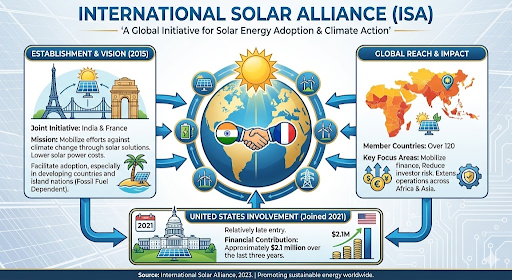
- On January 7, the U.S. government announced its withdrawal from 66 international organizations, including the India-led International Solar Alliance (ISA), stating that these bodies no longer served American interests.
Financial and Operational Impact of US Exit
- The withdrawal is expected to have minimal financial impact on the ISA as the US contribution constituted only about 1% of the alliance’s total funds.
- Indian officials have confirmed that the day-to-day operations and ongoing programs of the alliance will continue without disruption.
- Key activities such as training and capacity-building efforts remain in place despite the loss of American partnership.
- However, the exit may affect global investor confidence more than actual budgets, potentially creating ripple effects in international climate cooperation.
Resilience of India’s Solar Industry
- India’s domestic solar sector is largely insulated from this decision as it does not rely on the US for solar panels or key manufacturing equipment.
- The country has built significant self-reliance with a solar module manufacturing capacity of nearly 144 gigawatts as of late 2025.
- India continues to depend on China for high-efficiency solar components, importing $1.7 billion worth of PV modules in FY25, rather than the US.
- Consequently, electricity tariffs and project costs for Indian consumers remain unaffected by the US policy shift.
Impact on Investments and Employment
- Investment flows into Indian solar projects are unlikely to slow down as they are driven primarily by domestic demand and long-term contracts with state utilities.
- Funding sources remain diverse, relying on Indian banks and global development institutions rather than US government financing.
- Employment in the sector is secure since solar jobs are generated mainly through local manufacturing and installation, which are independent of US climate policy.
- Indian manufacturers might find new export opportunities if the US seeks non-Chinese sources for clean energy equipment amid ongoing trade tensions.
Global Implications and India’s Leadership
- The primary risk lies in poorer developing nations in Africa and elsewhere that rely on international cooperation and cheap loans for solar projects.
- A US withdrawal from climate engagement may cause global lenders to become cautious, potentially slowing down green energy transitions in the Global South.
- The ISA remains a crucial instrument for India’s climate diplomacy, helping to build influence and open markets for Indian companies overseas.
- While the exit removes an influential partner, India’s leadership role in the alliance remains unchallenged but now comes with increased responsibility to sustain momentum.
