


 Profile
 Settings
 Refer your friends
 Sign out




Background
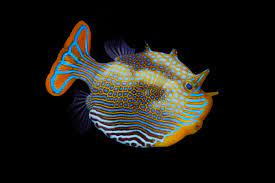
- Researchers at the University of Colorado Boulder have developed a mathematical model that successfully reproduces the complex skin patterns of the ornate boxfish, extending a theory first proposed by Alan Turing in 1952.
What are Turing Patterns?
- In 1952, Alan Turing proposed that interactions between chemical reactions and diffusion in biological systems can spontaneously create stripes, spots, and repeating natural patterns.
- These patterns are widely observed in animal skins, shells, and plant surfaces.
Potential Applications
- Making bio-mimetic camouflage materials.
- In adaptive design technologies.
Ornate Boxfish
|
Why in News?
- Recent research successfully reproduced the ornate boxfish’s skin patterns using an advanced mathematical model based on Turing’s theory of biological pattern formation.
