


 Profile
 Settings
 Refer your friends
 Sign out




Why in News?
- The Right to Disconnect Bill, 2025 was introduced in the Lok Sabha as a Private Member’s Bill to legally protect employees from work-related digital communication beyond working hours.
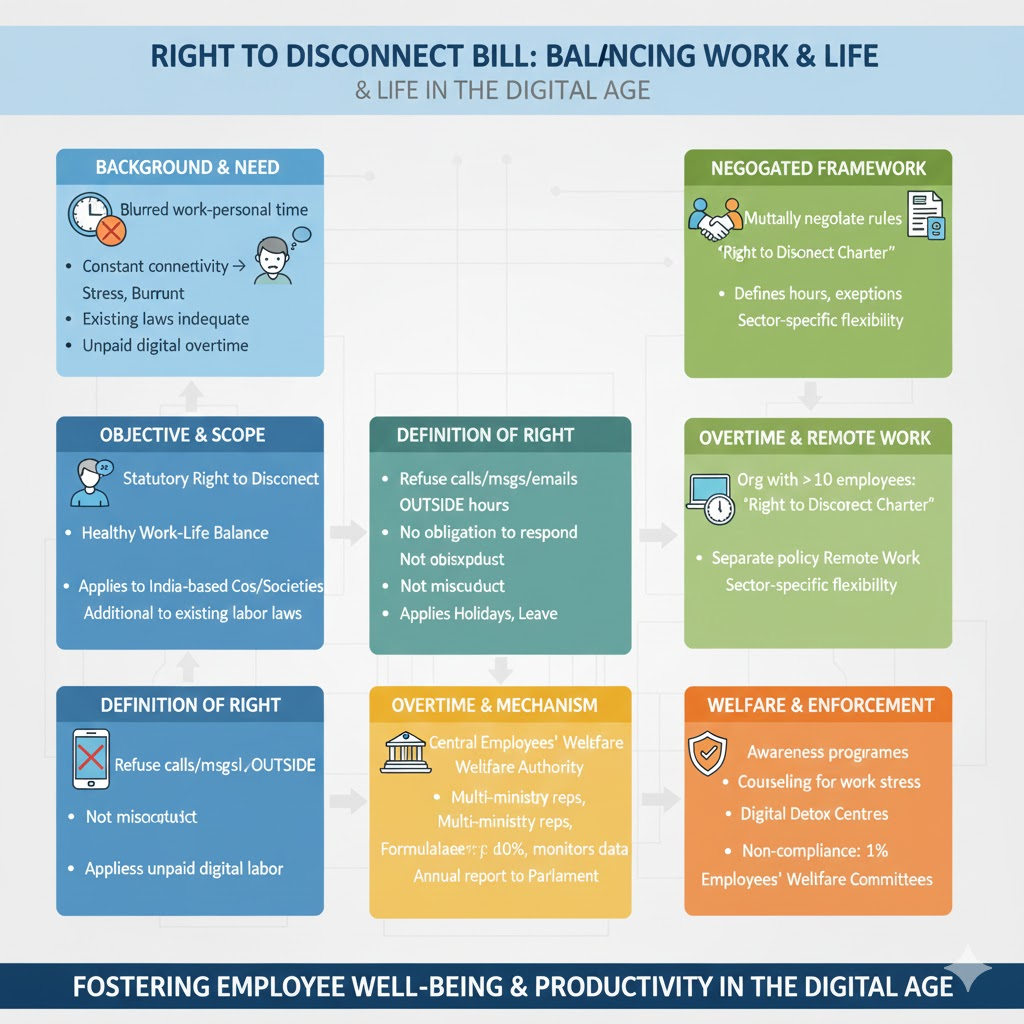
Background and Need for the Bill
- Digital technologies have blurred the boundary between working hours and personal time.
- Employees are often expected to respond to emails, messages and calls outside office hours.
- This constant connectivity has led to stress, burnout, mental health issues and unpaid digital overtime.
- Existing labour laws do not clearly address after-hours digital work obligations.
Objective and Scope of the Bill
- The Bill aims to statutorily recognise employees’ right to disconnect from work-related communication.
- It seeks to ensure a healthy work–life balance without harming productivity.
- The Act applies to companies and societies operating in India.
- The rights under the Bill are in addition to existing labour welfare laws.
Definition of the Right to Disconnect
- Employees have the right to refuse calls, messages or emails outside agreed working hours.
- Employers may contact employees after work hours, but employees are not obligated to respond.
- Refusal to respond cannot be treated as misconduct or indiscipline.
- The right applies to non-working hours, holidays and leave periods.
Negotiated and Charter-Based Framework
- Employers and employees must mutually negotiate rules on after-hours communication.
- Every organisation with more than ten employees must prepare a Right to Disconnect Charter.
- The Charter defines work hours, emergency exceptions and communication protocols.
- This ensures sector-specific flexibility rather than a rigid one-size-fits-all approach.
Overtime, Remote Work and Special Situations
- Employees who voluntarily work beyond working hours are entitled to overtime wages.
- Employers must create a separate policy for remote work, teleworking and work during travel.
- In the absence of agreement, employees retain the right to disconnect or claim overtime pay.
- This addresses the issue of unpaid digital labour in flexible work arrangements.
Institutional Mechanism: Employees’ Welfare Authority
- The Bill provides for a Central Employees’ Welfare Authority.
- The Authority includes representatives from Labour, IT, Communications and Statistics ministries.
- It formulates guidelines, monitors implementation and collects data on workplace practices.
- The Authority submits an annual report to Parliament, ensuring accountability.
Welfare Measures and Digital Well-being
- The Bill mandates awareness programmes on responsible digital communication.
- Governments are required to provide counselling services for work-related stress.
- It proposes setting up Digital Detox Centres for citizens.
- These provisions recognise the mental health dimension of hyper-connectivity.
Enforcement, Penalties and Compliance
- Non-compliance attracts a penalty of 1% of total employee remuneration.
- Penalties apply if employers fail to define or respect out-of-work communication rules.
- Employees’ Welfare Committees at organisational level assist in negotiations and complaints.
- The Central Government is empowered to make rules and remove implementation difficulties.
Financial and Administrative Implications
- The Bill estimates recurring expenditure of around ₹500 crore annually.
- A one-time non-recurring expenditure of about ₹100 crore is projected.
- Expenditure is met from the Consolidated Fund of India.
- Delegated legislation is limited to procedural and operational matters.
