Profile
 Settings
 Refer your friends
 Sign out




Why in News?
![]()
- The long-standing freeze on the reallocation of Lok Sabha seats is set to expire with the first census conducted after 2026 (likely Census 2027), triggering a mandatory but politically sensitive redrawing of India’s electoral boundaries.
Overview of the Delimitation Process
- Definition and Purpose: Delimitation is the act of redrawing boundaries of Lok Sabha and State Assembly seats to reflect population changes, ensuring the democratic principle of One Citizen-One Vote-One Value.
- Constitutional Mandate: Under Article 82, Parliament enacts a Delimitation Act after every Census, while Article 170 provides for the division of States into territorial constituencies.
- The Historical Freeze: The inter-state distribution of seats has been frozen since 1976 (based on the 1971 Census) via the 42nd and 84th Amendments to prevent penalizing states that successfully implemented population control.
- Role of the Commission: The process is conducted by an independent Delimitation Commission, whose orders have the force of law and cannot be challenged in any court.
Key Challenges of the Post-2027 Exercise
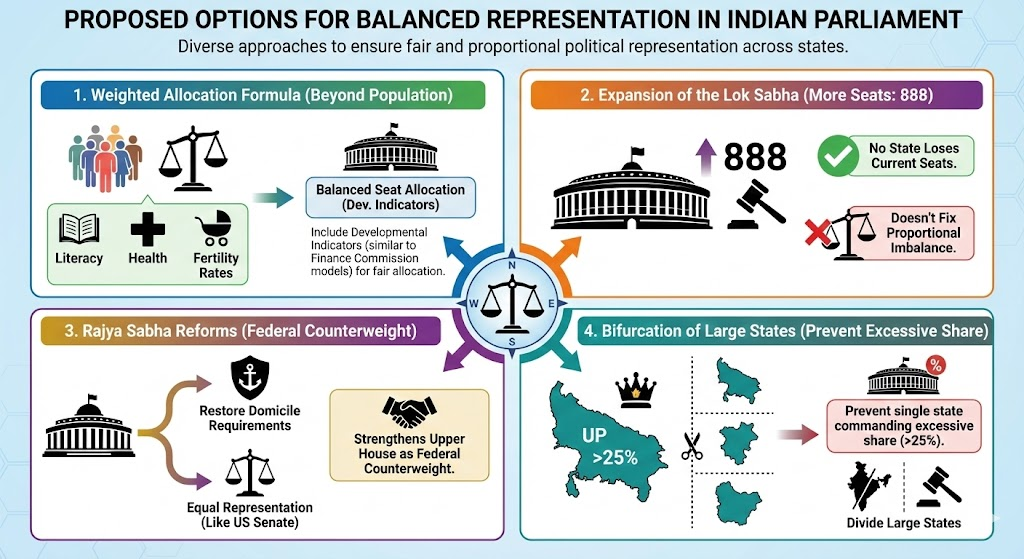
- The North-South Divide: Projections suggest northern states like Uttar Pradesh and Bihar could gain significantly (up to 151 and 82 seats respectively), while southern states would see their relative political weight diminish.
- Penalty for Good Governance: Southern states argue that their success in Family Planning and social development is being treated as a political liability, leading to a loss of parliamentary influence.
- Violation of Federal Spirit: A shift in power toward the “Hindi Heartland” may alienate regional voices, potentially making it possible for a party to form a national government without representation from the South.
- Impact on Women’s Reservation: The implementation of the Nari Shakti Vandan Adhiniyam (2023), which mandates a 33% quota for women, is legally tied to the completion of this delimitation exercise.