Profile
 Settings
 Refer your friends
 Sign out




Why in News?
-
Recent physiological research published in July 2025 suggests that yawning is a complex “brain-cooling” mechanism, debunking the older theory that its primary function is to increase oxygen intake.
Mechanism: Why Eyes Water During Yawning
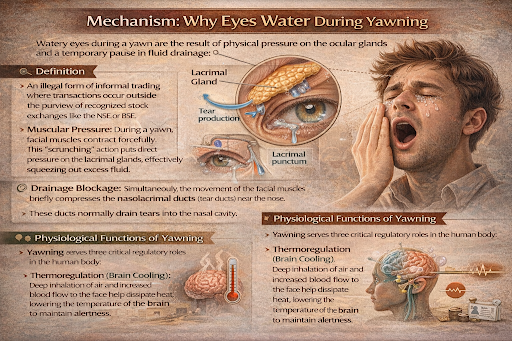
Watery eyes during a yawn are the result of physical pressure on the ocular glands and a temporary pause in fluid drainage:- The Lacrimal Gland: Located above each eye, these exocrine glands produce the aqueous (watery) layer of the tear film.
- Muscular Pressure: During a yawn, facial muscles contract forcefully. This “scrunching” action puts direct pressure on the lacrimal glands, effectively squeezing out excess fluid.
- Drainage Blockage: Simultaneously, the movement of the facial muscles briefly compresses the nasolacrimal ducts (tear ducts) near the nose. These ducts normally drain tears into the nasal cavity.
- Tear Pooling: Because the drainage is blocked while production is forced, tears collect on the eye surface and “overflow” when the eyes are opened.
Physiological Functions of Yawning
Yawning serves three critical regulatory roles in the human body:- Thermoregulation (Brain Cooling): Deep inhalation of air and increased blood flow to the face help dissipate heat, lowering the temperature of the brain to maintain alertness.
- Pressure Equalization: Yawning opens the Eustachian tubes, balancing air pressure between the middle ear and the atmosphere (critical during rapid altitude changes).
- Alertness Boost: The physical stretch increases heart rate and blood flow, acting as a “reset” for the brain to transition between different states of consciousness.