Profile
 Settings
 Refer your friends
 Sign out




Why in News?
- On December 29, 2025, Union Minister Shri Jyotiraditya M. Scindia announced a series of major strategic reforms by the Department of Telecommunications (DoT) to bolster India’s telecom security while slashing compliance burdens for the year 2026.
Extension of the Pro Tem Security Certification Scheme
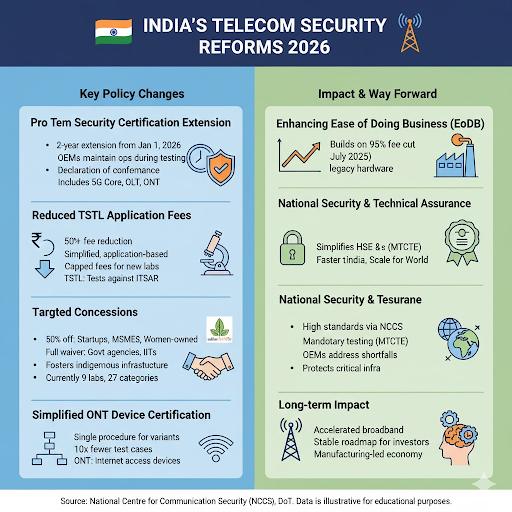
- The DoT has extended the Pro Tem Security Certification Scheme for an additional two years, effective from January 1, 2026.
- This scheme allows Original Equipment Manufacturers (OEMs) to continue business operations for products like IP Routers and Wi-Fi CPE while full security testing is underway.
- The extension empowers manufacturers to maintain product line continuity for up to two years based on a declaration of conformance and a commitment to fix identified gaps.
- Its scope has been expanded to include critical future technologies such as 5G Core SMF, Optical Line Terminals, and Optical Networking Terminals.
Drastic Reduction in TSTL Application Fees
- To expand the testing ecosystem, the National Centre for Communication Security (NCCS) has reduced the application fees for Telecom Security Testing Laboratories (TSTL) by over 50%.
- The previous complex fee slabs have been replaced with a simplified, application-based structure to encourage wider participation from private and academic sectors.
- First-time TSTL designation application fees are now capped at significantly lower levels, reducing the entry barrier for new laboratories.
- These labs are essential as they test telecom equipment against the Indian Telecommunication Security Assurance Requirements (ITSAR) and specific test procedures.
Targeted Concessions for Startups and Government Agencies
- In a push for inclusivity, Indian Startups, MSMEs, and Women-owned enterprises will benefit from a 50% reduction in TSTL designation fees.
- A complete fee waiver has been granted to Central and State Government testing agencies, IITs, and other autonomous government institutions.
- These concessions are designed to foster indigenous telecom security infrastructure in line with the Atmanirbhar Bharat vision.
- By lowering the cost of entry, the government aims to increase the number of designated TSTLs, which currently stands at nine facilities covering 27 equipment categories.
Simplification of ONT Device Certification
- The certification process for Optical Network Terminator (ONT) devices has been simplified to provide substantial financial relief to the industry.
- Previously, slight software variations necessitated separate certifications for each variant; now, customized variants can be tested under a single procedure.
- This reform is expected to reduce the total number of required testing cases by 10 times, drastically cutting compliance costs.
- Security certification for ONT devices, which provide internet access at customer premises, will become mandatory starting January 1, 2026.
Enhancing the Ease of Doing Business (EoDB)
- These 2026 reforms build upon the 95% reduction in security test evaluation fees for telecom and ICT products announced in July 2025.
- The policy simplifies compliance for Highly Specialized Equipment (HSE) and End-of-Sale/End-of-Life products, helping OEMs manage legacy hardware.
- By reducing time-to-market for secure products, the reforms aim to make India a trusted global hub for telecom manufacturing and testing.
- The strategic goal is to align with the principle of Design in India, Solve in India, Scale for the World.
National Security and Technical Assurance
- While easing compliance, the reforms maintain a high standard of security through the National Centre for Communication Security (NCCS).
- All equipment sold or deployed in India must undergo mandatory testing under the MTCTE (Mandatory Testing and Certification of Telecom Equipment) framework.
- OEMs must provide an undertaking to address any security shortfalls identified during the testing period of their Pro Tem certificates.
- This ensures that the “openness” for business does not come at the cost of compromising critical national communication infrastructure.
Legal Framework and Implementation Agency
- The reforms are implemented through the National Centre for Communication Security (NCCS), the nodal agency for telecom security in India.
- The framework is governed by the newly notified Telecommunications (Framework to Notify Standards, Conformity Assessment, and Certification) Rules, 2025.
- These rules supersede the 2017 framework, providing a modern legal basis for mandatory security testing of all telecom gear.
- Stakeholders can access the revised fee structures and certification guidelines directly through the official NCCS portal.
Long-term Impact on the Telecom Ecosystem
- The measures are expected to significantly accelerate broadband penetration across the country by making network equipment more affordable.
- By nurturing a domestic testing ecosystem, India reduces its reliance on foreign security audits, enhancing technological sovereignty.
- The reforms provide a stable and predictable regulatory roadmap for global investors looking to set up manufacturing units in India.
- Ultimately, these changes reinforce the transition from a purely consumption-based market to a manufacturing and innovation-led economy.