Profile
 Settings
 Refer your friends
 Sign out




Why in News?
- The Supreme Court (Vacation Bench) recently stayed a Delhi High Court order that had suspended the life sentence of former MLA Kuldeep Singh Sengar in the 2017 Unnao rape case, citing significant legal questions regarding the interpretation of the POCSO Act.
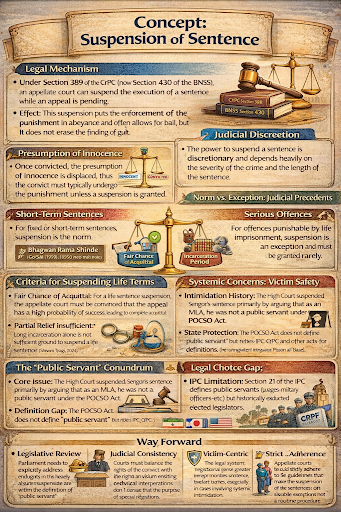
Concept: Suspension of Sentence
- Legal Mechanism: Under Section 389 of the CrPC (now Section 430 of the BNSS), an appellate court can suspend the execution of a sentence while an appeal is pending.
- Effect: This suspension puts the enforcement of the punishment in abeyance and often allows for bail, but it does not erase the finding of guilt.
- Presumption of Innocence: Once convicted, the presumption of innocence is displaced; thus, the convict must typically undergo the punishment unless a suspension is granted.
- Judicial Discretion: The power to suspend a sentence is discretionary and depends heavily on the severity of the crime and the length of the sentence.
Norm vs. Exception: Judicial Precedents
- Short-Term Sentences: For fixed or short-term sentences, suspension is the norm. In Bhagwan Rama Shinde Gosai (1999), the SC held that courts should be liberal in suspending such sentences.
- Serious Offences: For offences punishable by life imprisonment, suspension is an exception and must be granted rarely.
- Objective Assessment: As reiterated in Shivani Tyagi (2024), courts must objectively assess factors like the gravity of the offence and the manner of its commission before suspending a life sentence.
- Strict Standard: In life sentence cases, the convict must demonstrate a palpable or gross error in the trial judgment that suggests a fair chance of acquittal (Chhotelal Yadav, 2025).
The “Public Servant” Conundrum
- Core Issue: The High Court suspended Sengar’s sentence primarily by arguing that as an MLA, he was not a public servant under the POCSO Act.
- Definition Gap: The POCSO Act does not define “public servant” but refers to the IPC, CrPC, and other acts for definitions.
- IPC Limitation: Section 21 of the IPC defines public servants (judges, military officers, etc.) but historically excludes elected legislators.
- Legal Precedent: Relying on R.S. Nayak vs. A.R. Antulay (1984), the HC held that an MLA does not fit the IPC definition, unlike the broader definition in the Prevention of Corruption Act (PCA) used by the trial court.
Interpretive Challenge: Literal vs. Purposive
- HC’s Approach: The High Court adopted a literal interpretation, concluding that since the POCSO Act did not explicitly adopt the PCA’s broader definition, it could not be applied to an MLA.
- SC’s Approach: The Supreme Court generally favors a purposive interpretation for child protection laws to advance the statute’s protective intent.
- Precedents: In Attorney General vs. Satish (2021), the SC rejected a narrow view on “skin-to-skin” contact, and in Independent Thought (2017), it read down marital rape exceptions to protect minors.
- The Anomaly: The literal view creates a situation where lower-level officials (like patwaris) are liable for aggravated penalties under POCSO, but powerful elected representatives are not.
Criteria for Suspending Life Terms
- Fair Chance of Acquittal: For a life sentence suspension, the appellate court must be convinced that the appeal has a high probability of success leading to complete acquittal.
- Partial Relief Insufficient: The HC failed to examine if the non-applicability of Section 5(c) (aggravated assault) would result in a full acquittal or just a modification of the charge.
- Incarceration Period: While the HC cited Sengar’s 7-year imprisonment, the SC clarified in Shivani Tyagi that long incarceration alone is not a sufficient ground to suspend a life sentence.
- Fact-Finding Finality: In Jamna Lal (2025), the SC held that factual findings (like the age of the victim) by a trial court cannot be lightly unsettled at the suspension stage.
Systemic Concerns: Victim Safety
- Intimidation History: The case is marked by a documented history of violence, including the custodial death of the survivor’s father and a suspicious accident killing her aunts.
- State Protection: The HC relied on the fact that the survivor had CRPF protection, ruling that threat apprehension alone cannot deny suspension of sentence.
- Institutional Failure: The case highlights how structural barriers and entrenched power dynamics can delay justice and endanger survivors.
- Equality before Law: The distinction allowing MLAs to escape “public servant” liability under POCSO raises questions about Article 14 (Right to Equality), where powerful actors may face different legal standards than ordinary citizens.
Way Forward
- Legislative Review: Parliament needs to address the ambiguity in the POCSO Act to explicitly include elected representatives within the definition of “public servant.”
- Judicial Consistency: Courts must balance the rights of the convict with the rights of the victim, ensuring that technical interpretations do not defeat the purpose of special legislations.
- Victim-Centric Justice: The legal system must accord greater weight to the safety and trauma of survivors, especially in cases involving systemic intimidation.
- Strict Adherence: Appellate courts should strictly adhere to SC guidelines that make the suspension of life sentences an absolute exception, not a routine procedure.