


 Profile
 Settings
 Refer your friends
 Sign out




Why in News?
- The Supreme Court has agreed to decide a very important legal question: Can the Enforcement Directorate (ED) file a case (writ petition) in a High Court against a State Government? This comes after Kerala and Tamil Nadu challenged a High Court order that allowed the ED to do so.
The Story Behind the Conflict (Context)
- The Gold Smuggling Case: In July 2020, gold was seized from diplomatic baggage in Kerala. The ED started investigating money laundering aspects of this case.
- Allegations of Pressure: The main accused, Swapna Suresh, alleged that ED officials were forcing her to name top political leaders of the Kerala government (including the Chief Minister) in the crime.
- Kerala’s Retaliation: Angered by this, the Kerala Government set up a Commission of Inquiry (CoI) to investigate the ED officials for allegedly coercing witnesses and fabricating evidence.
- ED’s Counter-Move: The ED went to the Kerala High Court to stop this Commission of Inquiry, arguing that the State cannot investigate a central agency’s probe. The High Court agreed with the ED, which led the State Government to appeal in the Supreme Court.
The Core Legal Dispute: Who is the ED?
- Kerala’s Argument (It’s just a Department): The State argues that the ED is just a department under the Ministry of Finance (Central Government). It is not an independent legal entity (like a company or specific statutory bodies like SEBI) that can file cases on its own.
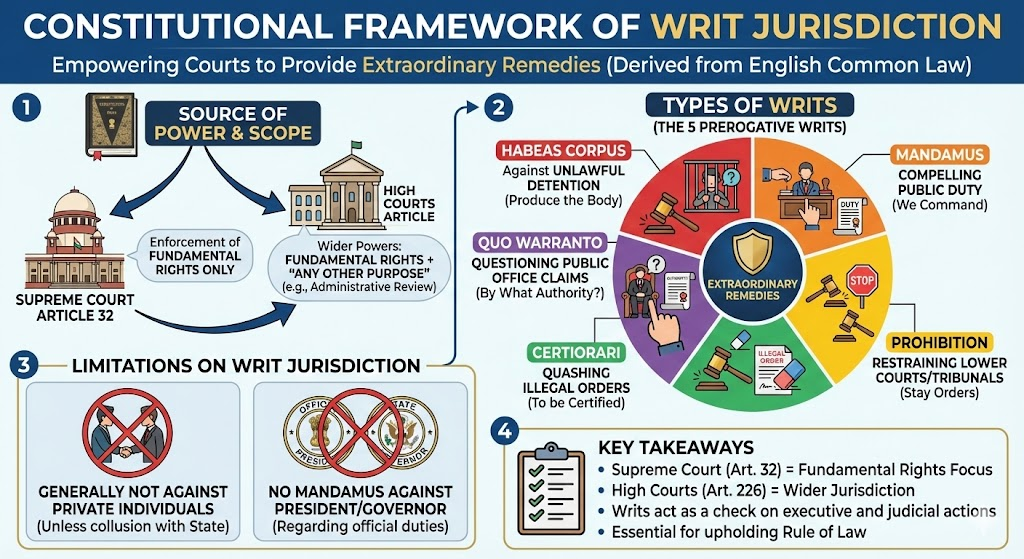
- The “Centre vs State” Rule: If the Central Government has a problem with a State Government, the Constitution (under Article 131) says they must go directly to the Supreme Court, not a High Court.
- High Court’s View (It’s a Statutory Body): The Kerala High Court had ruled that the ED is a special body created by a law (PMLA Act) and has specific statutory powers. Therefore, it is distinct enough to approach the High Court under Article 226 if its work is being blocked.
Why did Tamil Nadu Join the Fight?
- Similar Experience: The Tamil Nadu government is supporting Kerala because it faces a similar situation. The ED filed a writ petition in the Madras High Court regarding an Illegal Sand Mining case.
- Fear of Precedent: Tamil Nadu fears that if the Kerala High Court’s ruling stands, it will become a standard practice for the ED to drag State Governments to High Courts whenever there is a political or administrative conflict.
- Abuse of Process: Both states argue that allowing a central investigation agency to sue a state government in High Court bypasses the federal structure of the Constitution.
Why Does This Case Matters?
- Redefining Federalism: If the Supreme Court allows the ED to file writs, it could lead to more direct legal confrontations between Central agencies and State governments in various High Courts across India.
- Accountability of Agencies: It will decide if agencies like the ED are independent bodies with their own legal rights or simply arms of the ruling Central Government.
- Political Stability: Since many Opposition-ruled states are currently facing ED investigations, this judgment will clarify the legal limits of how these investigations interact with State machinery.
