


 Profile
 Settings
 Refer your friends
 Sign out




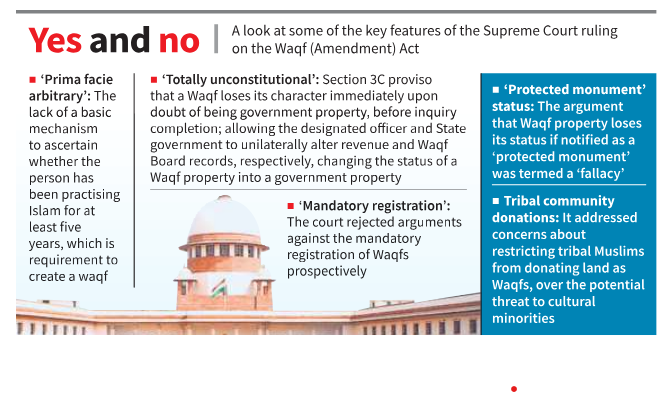
- Five-Year Faith Clause: The Act required a person to prove practising Islam for five years before creating a Waqf.
- The Court said this was arbitrary as no procedure existed to verify it. The clause is stayed until a mechanism is framed.
- Section 3C – Government Property Doubt: A Waqf would automatically lose its status if someone claimed it was government land.
- The Court called this unconstitutional, saying only Waqf Tribunals (under Section 83) can decide ownership.
- Protection of Waqf Property: Until final decisions, Waqfs cannot be dispossessed, and their records cannot be changed. Mutawallis (managers) cannot create third-party rights during disputes.
- Composition of Waqf Bodies:
- Central Waqf Council: max 4 non-Muslims out of 22.
- State Waqf Boards: max 3 non-Muslims out of 11.
- CEOs of State Waqf Boards should be from the Muslim community “as far as possible”.
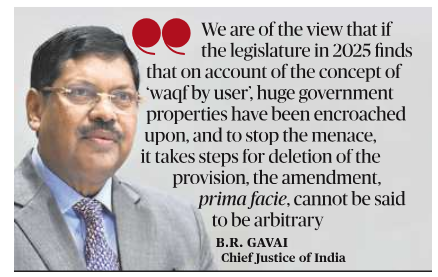
- Upheld the legislative decision to remove the concept of “Waqf by user”: The court asked to make registration of Waqfs mandatory, saying it was needed to prevent large-scale encroachment on government land.
- Earlier, under the Waqf Act, 1995, “Waqf by user” allowed property to be treated as Waqf if used for religious or charitable purposes, even without a formal deed.
- The 2025 Amendment Act removed this concept and required a formal Waqf deed plus registration.
- Reinforces judicial control over property disputes, preventing arbitrary executive action.
- Balances protection of government land with safeguarding religious endowments.
- Highlights the principle of separation of powers and minority rights under the Constitution.
- The Supreme Court stayed certain provisions of the Waqf (Amendment) Act, 2025, finding them prima facie arbitrary, while refusing to suspend the entire law.
