


 Profile
 Settings
 Refer your friends
 Sign out




Why in News?
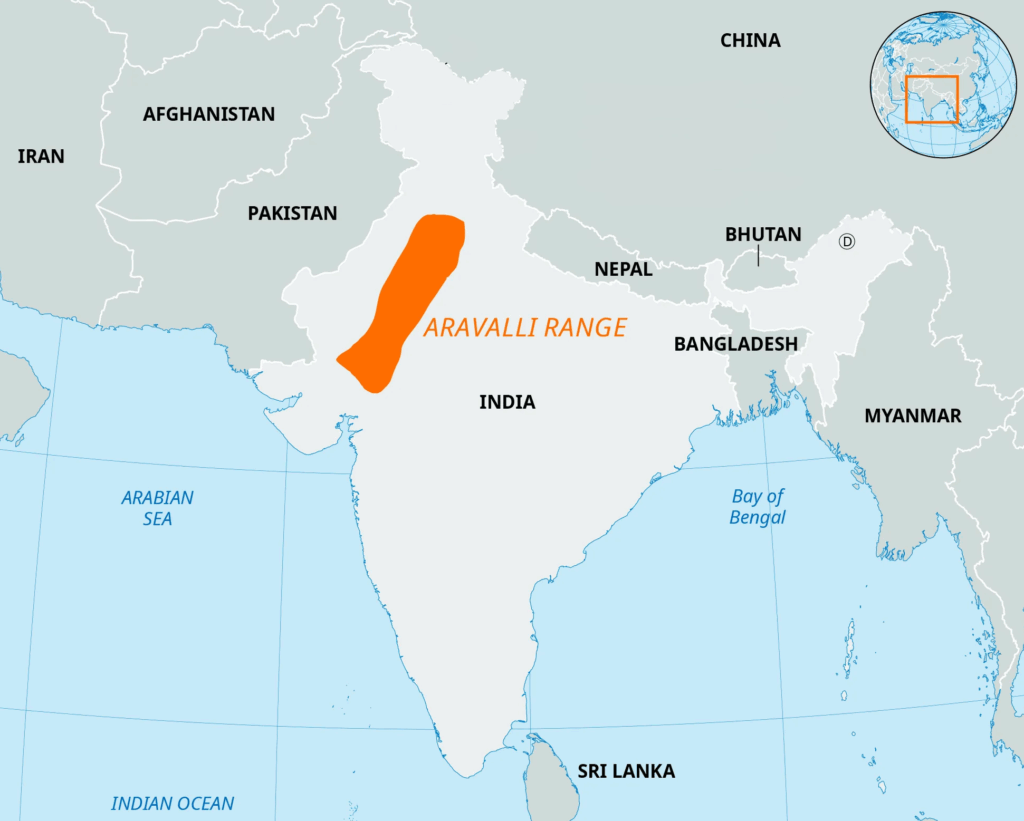
- The Supreme Court has laid down a uniform definition of the Aravalli hills, paused fresh mining leases, and issued detailed directions to ensure scientific, sustainable protection of the Aravalli range across multiple States.
Background of the Supreme Court Intervention
- The Aravalli range has faced decades of unregulated and illegal mining, particularly for stone and sand.
- Environmental degradation led to groundwater depletion, air pollution, biodiversity loss, and desertification risks.
- Despite regulatory frameworks since the 1990s, State-level enforcement failures persisted.
- The Supreme Court intervened to ensure constitutional environmental protection and compliance with India’s international obligations.
Supreme Court’s Rationale for a Uniform Definition
- States were using inconsistent and selective definitions, allowing mining in ecologically sensitive areas.
- Expert bodies such as the Forest Survey of India (FSI) had proposed varying criteria based on slope, buffers, and inter-hill distance.
- The Court found that fragmented definitions undermined continuity and integrity of the Aravalli ecosystem.
- To resolve this, the Court constituted a multi-institutional expert committee to develop a single scientific definition.
Final Definition Adopted by the Supreme Court
- The Court accepted the committee’s recommendation that only hills above 100 metres in height would qualify as Aravalli hills and ranges.
- The government argued this threshold was more inclusive and practical than complex slope- or buffer-based criteria.
- Concerns were raised that hills below 100 metres could be exposed to mining.
- The Court balanced ecological protection with administrative feasibility, treating the definition as a starting point for regulation, not deregulation.
Mining Restrictions and Regulatory Approach
- The Court paused the grant of fresh mining leases and renewals across the Aravalli range.
- Existing legal mining operations are allowed to continue under strict regulatory oversight.
- Total mining bans were avoided because past experience showed they encouraged illegal mining and sand mafias.
- The approach adopted is calibrated, precautionary, and science-based, rather than absolutist.
Role of the Central Empowered Committee (CEC)
- The CEC conducted a detailed examination of mining and ecological impacts across States.
- It recommended scientific mapping of the entire Aravalli range and a macro-level environmental impact assessment.
- The CEC urged absolute prohibition of mining in protected habitats, water bodies, tiger corridors, aquifer recharge zones, and NCR areas.
- It also proposed strict regulation of stone-crushing units, a major pollution source.
Management Plan for Sustainable Mining (MPSM)
- The Supreme Court directed preparation of a comprehensive MPSM for the entire Aravalli range.
- The plan must clearly demarcate:
- No-mining zones in ecologically sensitive areas.
- Limited and highly regulated mining zones, if any.
- It must assess cumulative ecological impacts, carrying capacity, and restoration needs.
- Rehabilitation, reclamation, and long-term ecosystem restoration are mandatory components.
Complementary Executive Measures: Aravalli Green Wall
- In June 2025, the Centre launched the Aravalli Green Wall Project.
- It aims to expand green cover in a 5-km buffer zone across 29 districts of Delhi, Haryana, Rajasthan, and Gujarat.
- The initiative targets restoration of 26 million hectares of degraded land by 2030.
- The Court viewed this as a supporting measure, not a substitute for mining regulation.
