


 Profile
 Settings
 Refer your friends
 Sign out




Why in News?
- The Union government has introduced the Sustainable Harnessing and Advancement of Nuclear Energy for Transforming India (SHANTI) Bill, 2025 in the Lok Sabha to enable private and foreign participation in nuclear power generation.
Background of the SHANTI Bill
- India’s nuclear power sector has so far been governed by the Atomic Energy Act, 1962 and the Civil Liability for Nuclear Damage (CLND) Act, 2010.
- These laws restricted nuclear power operations largely to the public sector, especially the Nuclear Power Corporation of India Limited (NPCIL).
- Concerns over high liability risks discouraged private and foreign investment.
- The SHANTI Bill, 2025 seeks to replace both Acts with a new, integrated legal framework.
DO YOU KNOW?Atomic Energy Act, 1962
Civil Liability for Nuclear Damage (CLND) Act, 2010
|
Key Objective of the SHANTI Bill
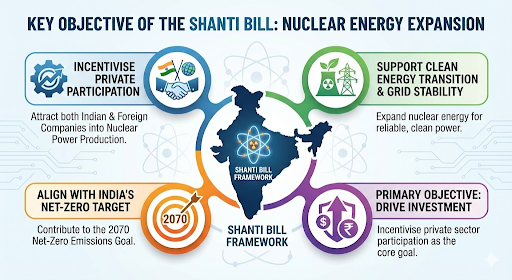
- The primary objective of the Bill is to incentivise private sector participation in nuclear energy.
- It aims to attract both Indian and foreign companies into nuclear power production.
- The Bill seeks to expand nuclear energy to support clean energy transition and grid stability.
- It aligns nuclear power expansion with India’s net-zero emissions target for 2070.
Changes in Nuclear Regulatory Structure
- The Bill grants statutory status to the Atomic Energy Regulatory Board (AERB).
- The AERB will now be answerable to Parliament, strengthening accountability and transparency.
- Regulatory oversight over safety, security, safeguards, and quality assurance is enhanced.
- Emergency preparedness mechanisms are also strengthened under the new framework.
DO YOU KNOW?
Atomic Energy Regulatory Board (AERB)
|
End of NPCIL Monopoly
- The SHANTI Bill removes the exclusive monopoly of NPCIL in operating nuclear power plants.
- Private entities will now be allowed to own and operate nuclear facilities, subject to regulation.
- This marks a major shift from India’s long-standing state-controlled nuclear policy.
- The change is expected to accelerate capacity addition and innovation.
DO YOU KNOW?
NPCIL (Nuclear Power Corporation of India Limited)
|
Revised Civil Liability Framework
- The Bill introduces a revised and pragmatic civil liability regime for nuclear damage.
- It restricts operators’ right to claim compensation from equipment suppliers, addressing a key concern under the CLND Act, 2010.
- This aligns India’s liability framework with global nuclear liability conventions.
- The changes are expected to reassure foreign suppliers and technology partners.
Limits on Operator Liability and Penalties
- The SHANTI Bill caps the financial liability of operators based on the size of nuclear plants.
- Even in cases of a “severe breach”, the maximum penalty is limited to ₹1 crore.
- This provision is intended to reduce uncertainty and financial risk for investors.
- Critics, however, raise concerns about whether safety accountability could be diluted.
Role in India’s Clean Energy and Net-Zero Goals
- Nuclear energy currently accounts for 1.5% of installed power capacity and about 3% of electricity generation in India.
- The government aims to scale up nuclear capacity from 8.8 GW to 100 GW by 2047.
- Initiatives include a ₹20,000 crore mission on Small Modular Reactors (SMRs) and new 220 MW PHWRs.
- Nuclear power is seen as critical for baseload clean energy and grid reliability.
DO YOU KNOW?
Small Modular Reactors (SMRs)
|
- The SHANTI Bill marks a structural shift in India’s nuclear energy governance.
- It balances investment facilitation with regulatory oversight.
- Successful implementation could position nuclear energy as a major pillar of India’s energy transition.
- Parliamentary scrutiny will be crucial to address safety, environmental, and liability concerns.
