


 Profile
 Settings
 Refer your friends
 Sign out




Why in News?
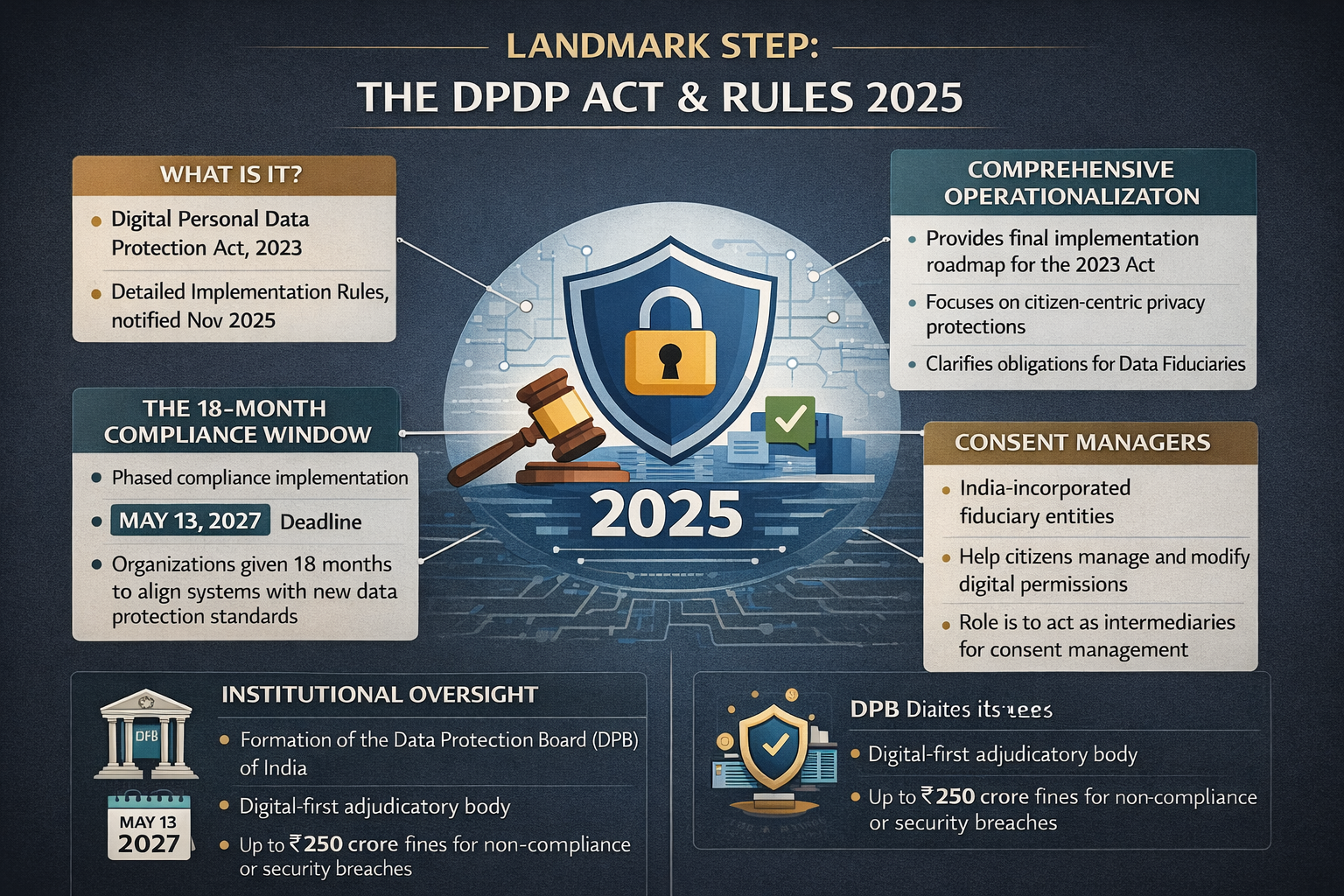
- In early 2026, the Indian government fully operationalized the Digital Personal Data Protection (DPDP) Rules, 2025, marking a watershed moment in India’s transition from a “data colony” to a sovereign digital power with indigenous control over its data and infrastructure.
Defining Digital Sovereignty in the Indian Context
- Strategic Autonomy: Digital sovereignty is the ability of a nation to govern its digital destiny, including independent control over citizens’ data, local digital infrastructure, and the laws regulating the internet.
- Economic Value Retention: It ensures that the economic value generated from the data of 1.4 billion Indians benefits the domestic economy rather than being siphoned off by foreign tech giants.
- National Security Imperative: With over 2.4 million cybersecurity incidents reported in 2025, securing critical national data within domestic boundaries is vital to prevent digital espionage and foreign coercion.
- Technological Independence: The goal is to reduce reliance on foreign-controlled “proprietary stacks” by building indigenous alternatives in cloud computing, AI, and hardware.
Building Sovereign Infrastructure: IndiaAI and Bhashini
- The IndiaAI Mission: With an allocation of over ₹10,300 crore, this mission is deploying 38,000 GPUs to provide affordable, sovereign compute power for Indian startups and researchers.
- Sovereign LLMs: In 2025, the government-funded BharatGen AI was launched as the world’s first homegrown multimodal large language model, supporting 22 Indian languages to ensure linguistic sovereignty.
- Digital Public Infrastructure (DPI): India Stack (Aadhaar, UPI, DigiLocker) continues to be the backbone of sovereignty, with UPI surpassing 20 billion monthly transactions in August 2025, freeing the economy from foreign payment rails.
- Project Bhashini: This AI-led translation platform prevents “digital colonization” by enabling real-time services in local languages, ensuring that the internet is accessible to all Indians without English-language barriers.
Addressing Hardware and Supply Chain Vulnerabilities
- Semiconductor Mission: To achieve “hardware sovereignty,” India is aggressively pushing the India Semiconductor Mission (ISM), aiming to build local fabrication plants (fabs) and reduce dependence on imported chipsets.
- Data Centre Boom: Following the 2026 Union Budget, data centres have been granted infrastructure status, with capacity projected to reach 1.8 GW by 2027 to support mandatory data localization.
- Strategic Banned Lists: Citing national security, India has maintained its ban on over 250 Chinese apps, signaling its refusal to allow hostile foreign entities access to its citizens’ behavioral data.
- Cyber Resilience: The government is investing in Advanced Threat Intelligence and indigenous cybersecurity platforms to protect the “BFSI” (Banking, Financial Services, and Insurance) sector from state-sponsored hacks.
