


 Profile
 Settings
 Refer your friends
 Sign out




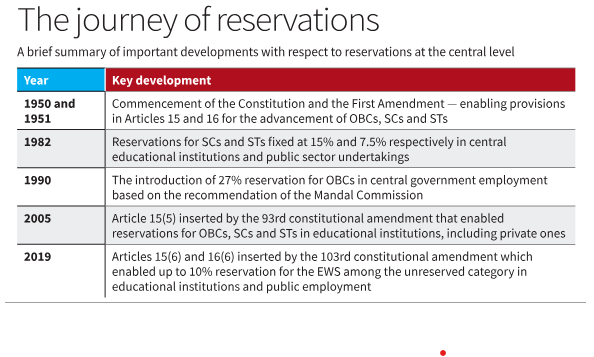
Constitutional Basis:
- Article 15 & 16: Allow special provisions and reservation in education and jobs for OBCs, SCs, STs.
- Current central quota: OBC 27% + SC 15% + ST 7.5% + EWS 10% = 59.5%.
- States vary depending on demographics.
Key Court Rulings:
- Balaji Case (1962): Reservations must be within reasonable limits, capped at 50%.
- N.M. Thomas Case (1975): Saw reservation as part of equality, not an exception.
- Indra Sawhney Case (1992): Upheld 27% OBC quota, reaffirmed 50% cap, introduced creamy layer exclusion for OBCs.
- Janhit Abhiyan Case (2022): Upheld 10% EWS quota, said 50% cap applies only to backward classes.
- Davinder Singh Case (2024): Judges suggested extending creamy layer to SC/ST, but Centre rejected.
Pros of Expanding/Continuing Reservations:
-
Ensures substantive equality for historically oppressed groups.
-
Helps correct under-representation in education, jobs, and politics.
-
Caste census and higher quotas can make policy more evidence-based.
-
Social justice tool aligned with Ambedkar’s vision.
Cons of Expanding/Continuing Reservations:
-
May violate formal equality and merit principle if raised beyond 50%.
-
Many reserved seats remain vacant (40–50% in central govt).
-
Benefits are concentrated: 97% of OBC benefits go to 25% sub-castes (Rohini Commission).
-
Risk of politicisation and vote-bank politics.
-
Extending creamy layer to SC/ST may worsen vacancy backlogs.
Way Forward:
-
Use 2027 Census caste data for rational policy.
-
Sub-categorisation within OBCs to ensure fair distribution.
-
Explore two-tier system for SC/ST, prioritising the most marginalised.
-
Focus on skill development, private jobs, entrepreneurship, as public sector jobs are shrinking.
Why in News?
- Bihar opposition leader Tejashwi Yadav promised to raise reservations to 85% if voted to power. Also. the Supreme Court has sought the Centre’s view on introducing a “creamy layer system” for SCs and STs, similar to OBCs.
