


 Profile
 Settings
 Refer your friends
 Sign out




Why in News?
- Opposition MPs of the INDIA bloc have submitted a notice to the Lok Sabha Speaker seeking impeachment of Justice G.R. Swaminathan of the Madras High Court under Articles 124 and 217 of the Constitution.
Constitutional Basis for Removal of Judges
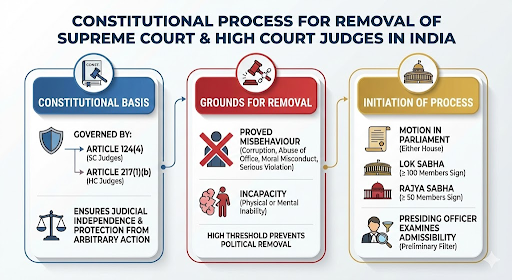
- The removal of Supreme Court and High Court judges is governed by Article 124(4) and Article 217(1)(b) of the Constitution of India.
- Article 124 deals with the appointment and removal of Supreme Court judges.
- Article 217 applies the same removal process to High Court judges.
- The Constitution provides this procedure to ensure judicial independence and protection from arbitrary executive action.
Grounds for Removal of Judges
- A judge can be removed only on the grounds of “proved misbehaviour or incapacity”.
- “Misbehaviour” generally includes corruption, abuse of office, moral misconduct, or serious violation of constitutional duties.
- “Incapacity” refers to physical or mental inability to perform judicial functions.
- The high threshold ensures that judges are not removed for political or ideological reasons.
Initiation of the Removal Process
- The removal process begins with a motion in either House of Parliament.
- The motion must be signed by at least 100 members in the Lok Sabha or 50 members in the Rajya Sabha.
- The Presiding Officer (Speaker or Chairman) examines whether the motion is admissible for further consideration.
- This stage acts as a preliminary filter to prevent frivolous or motivated motions.
Judicial Inquiry under the Judges Inquiry Act, 1968
- If the motion is admitted, a three-member inquiry committee is constituted.
- The committee consists of a Supreme Court judge, a High Court Chief Justice, and a distinguished jurist.
- The committee conducts a detailed investigation into the charges.
- The judge concerned is given full opportunity to defend himself or herself, following the principles of natural justice.
Parliamentary Approval and Special Majority Requirement
- If the inquiry committee finds the judge guilty of misbehaviour or incapacity, the motion is taken up for discussion in Parliament.
- Each House must pass the motion by a special majority.
- The special majority requires a majority of the total membership of the House and a two-thirds majority of members present and voting.
- This extremely strict requirement ensures that removal is possible only with very wide political consensus.
Role of the President in the Removal Process
- After both Houses of Parliament pass the motion, it is sent to the President of India.
- The President issues an order for the removal of the judge.
- The President acts only on the basis of the parliamentary resolution.
- This preserves the constitutional balance between the legislature, executive, and judiciary.
Significance for Judicial Independence and Accountability
-
- The difficult removal process ensures that judges can decide cases without fear of political retaliation.
- It reinforces the principle of separation of powers and rule of law.
- At the same time, it balances independence with limited but meaningful accountability.
- The system reflects the constitutional vision that judicial office is a high trust, not subject to ordinary political control.
