


 Profile
 Settings
 Refer your friends
 Sign out



Why in News?
- The Election Commission’s recent directives for the Bihar Assembly elections have highlighted the struggle of existing regulations to keep pace with a campaign ecosystem increasingly driven by digital intermediaries and third-party influencers.
The Shift in Political Campaigning
- India’s election rules currently govern a system that is assumed to run primarily on political parties and candidates.
- However, political persuasion has decisively shifted to digital platforms and intermediaries, creating a disjunction with existing laws.
- The Election Commission’s press note on October 14 mandated pre-certification of political advertisements by the Media Certification and Monitoring Committee (MCMC).
- It also reiterated the requirement under Section 77(1) of the Representation of the People Act, 1951, for parties to disclose social media expenditure.
Limitations of Current Directives
- The current regulations remain focused on parties and candidates, ignoring the third-party actors that mediate electoral outreach.
- A subsequent notification on October 21 restricted political advertisements in print media on polling day and the preceding day.
- This restriction applies to a narrow pre-poll window and is confined to print, failing to address digital platforms where campaigns are most active.
- The regulatory imagination exposes a gap regarding stakeholders (influencers/firms) and time, as digital influence peaks well before polling.
Dominance of Third-Party Campaigners
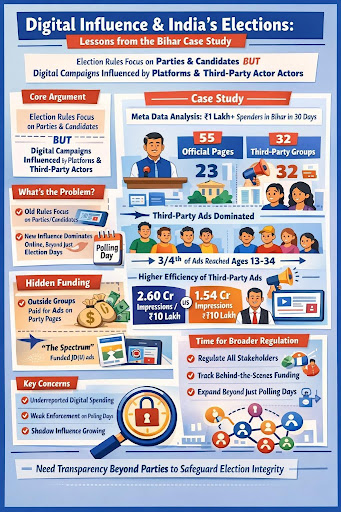
- An analysis of the Bihar Assembly election using Meta’s Ads Library reveals that digital campaigning is dominated by non-party actors.
- Out of 55 entities spending over ₹1 lakh on digital ads, 32 were third-party or surrogate campaigners, while only 23 were official parties.
- In digital elections, the reach of a campaign is shaped as much by who speaks as by the amount of money spent.
- Third-party actors not only outspent official candidates but also achieved far greater visibility in terms of impressions.
Asymmetry in Reach and Efficiency
- Despite similar average spending, third-party campaigns generated almost twice the average impressions of official parties.
- Official party advertisements remain sharply concentrated among the 13-24 and 25-34 age cohorts.
- In contrast, third-party advertisements show a dispersed pattern, effectively reaching older demographics aged 25-44 and beyond.
- Third-party advertisers are markedly more cost-efficient, generating 2.60 crore impressions per ₹10 lakh compared to 1.54 crore for parties.
The Unaccountable Financial Nexus
- The analysis reveals direct financial entanglements where external entities fund advertisements on official party pages.
- For instance, ads on the Janata Dal (United) official page were sponsored by an entity identified as “The Spectrum”.
- This creates a risk that expenditure incurred by third parties may not be reflected in the expenditure statements submitted to the EC.
- It points to a dual-directional relationship where third parties amplify messaging and directly finance it, blurring the lines of authorized expenditure.
The Accountability and Legal Gap
- In the Gemini TV case (2004), the Supreme Court held that no entity may publish advertisements benefiting a party without authorization.
- However, EC guidelines for the Bihar elections fell short of applying this standard to third-party actors effectively.
- Many third-party entities continued campaigning even on the evening of polling and on polling day itself, bypassing restrictions.
- Unless regulatory obligations are extended in substance and scope, opaque arrangements will continue to escape scrutiny.
Ambiguity in Campaign Finance Reporting
- Digital spending is often disclosed ambiguously in expenditure reports, with payments listed under platform names like ‘Facebook’.
- This practice hides the specific entities that actually design, fund, or manage the advertisements.
- The reverse flow of funding, where third parties pay for ads on official party pages, poses a significant threat to transparency.
- Current rules require parties to report what they spend, but not necessarily what others spend on their behalf, leaving influence formally invisible.
The Need for Temporal Recalibration
- Electoral influence now builds over months through sustained digital exposure, making last-minute regulations ineffective.
- Rules that activate only on the eve of polling cannot address harms that have already been set in motion weeks in advance.
- Conducting elections without a framework attuned to this reality leads to a gradual erosion of trust in fair digital democracy.
- The challenge for regulators is no longer just one of recognition, but of resolve to enforce accountability in the digital age.
