Profile
 Settings
 Refer your friends
 Sign out




Why in News?
- The Government has recently updated the Scheduled Tribes list for several states to include left-out communities, ensuring they receive constitutional benefits like reservations and forest rights.
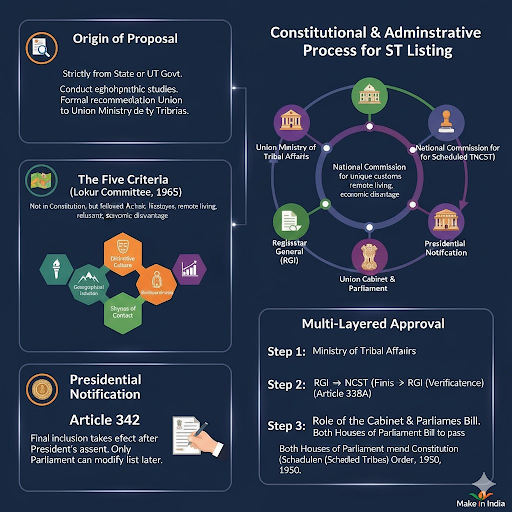
Constitutional & Administrative Process for ST Listing
- Origin of Proposal: The process must strictly originate from the State or Union Territory government. They conduct ethnographic studies to justify the community’s “tribalness” before sending a formal recommendation to the Union Ministry of Tribal Affairs.
- The Five Criteria (Lokur Committee, 1965): While not explicitly defined in the Constitution, the government follows these five established benchmarks:
- Primitive Traits: Indications of an archaic or traditional lifestyle.
- Distinctive Culture: Unique customs, language, and social norms.
- Geographical Isolation: Living in remote or inaccessible areas.
- Shyness of Contact: Reluctance to interact with the larger community.
- Backwardness: Relative social and economic disadvantage.
- Multi-Layered Approval:
- Step 1: The Ministry of Tribal Affairs reviews the proposal and forwards it to the Registrar General of India (RGI) for verification.
- Step 2: If the RGI approves, the proposal goes to the National Commission for Scheduled Tribes (NCST) a constitutional body under Article 338A for its final concurrence.
- Role of the Cabinet & Parliament: Once the RGI and NCST agree, the Union Cabinet approves a Bill to amend the Constitution (Scheduled Tribes) Order, 1950. This Bill must then be passed by both Houses of Parliament.
- Presidential Notification: Under Article 342, the final inclusion only takes effect after the President of India gives assent to the Act. Only Parliament has the power to later modify this list; the President cannot change it independently after the first notification.