


 Profile
 Settings
 Refer your friends
 Sign out




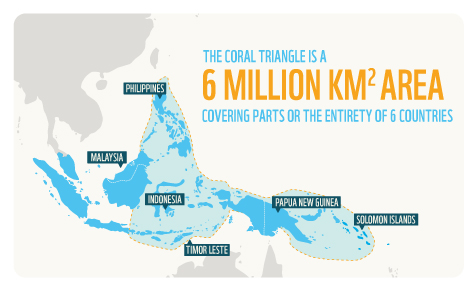
About the Coral Triangle:
- It covers 5.7 million sq. km across Indonesia, Malaysia, Papua New Guinea, the Philippines, Solomon Islands, and Timor-Leste.
- It hosts 75% of global coral species, 33% of reef fish, 6 of 7 marine turtle species, and vast mangrove forests.
- It supports the livelihoods of over 120 million people dependent on fisheries and coastal ecosystems.
Threats to the Coral Triangle:
- Coral bleaching, habitat loss, and species decline due to climate change, pollution, and destructive fishing.
- The Status of Coral Reefs 2020 Report warns that 14% of global corals were lost between 2009–2018, and up to 90% may vanish by 2050 if warming exceeds 1.5°C.
About the Cryobank Initiative:
- It is set up by the University of the Philippines Marine Science Institute with partners from Taiwan, Indonesia, Malaysia, and Thailand.
- It aims to create a network of cryobanks across the Coral Triangle for coral larvae and their symbiotic algae.
- It uses vitrification, a process where coral larvae are frozen at –196°C in liquid nitrogen, preserving them in a glass-like state.
- Laser melting rapidly revives the larvae without damaging their cells, ensuring survival for reef restoration.
- Aims to create a network of cryobanks across the Coral Triangle for coral larvae and their symbiotic algae.
Why in News?
- The Philippines has launched the cryobank under a regional initiative to protect and restore reefs across the Coral Triangle, the world’s richest marine ecosystem.
