


 Profile
 Settings
 Refer your friends
 Sign out




Meaning of OOPE:
- Out-of-Pocket Expenditure (OOPE) means the money that people pay directly from their own pockets for health care.
- It includes payments for doctor fees, medicines, hospital charges, tests, and transport.
- It does not include costs paid by the government or insurance.
OOPE in India:
- In India, households mainly pay for health care through OOPE.
- Families often use savings, sell assets, or borrow money when someone falls ill.
- The poor are forced to skip care or face deeper poverty.
- This creates a cycle of ill-health and poverty.
NHA Estimates:
- The National Health Accounts (NHA) track health spending by households, government, and others.
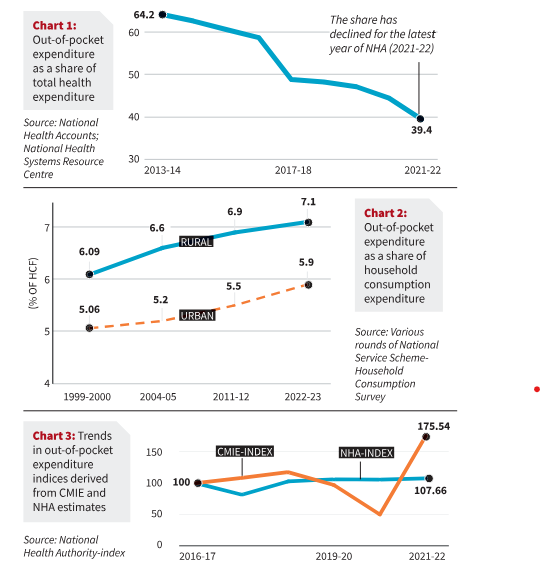
- NHA 2017-18 reported OOPE fell from 64% in 2013-14 to 49% in 2017-18.
- NHA 2021-22 shows OOPE further down to 39% of total health spending.
Concerns Raised:
- The decline may reflect less reporting of illness and hospital use, not cheaper health care.
- The Consumer Expenditure Survey (2022-23) shows OOPE share in household budgets rising (rural 5.5% → 5.9%, urban 6.9% → 7.1%).
- This suggests that healthcare is becoming more expensive, not cheaper.
Why in News?
- Recent analyses have questioned the official decline in OOPE reported by NHA, pointing out gaps in data coverage and the non-reflection of COVID-19 costs.
