The annual breeding and mating season for Olive Ridley turtles has begun along India’s coastline, with record-breaking mass nesting (Arribada) recently observed in Odisha and new hatcheries established in Goa and Tamil Nadu.
About Olive Ridley Turtles
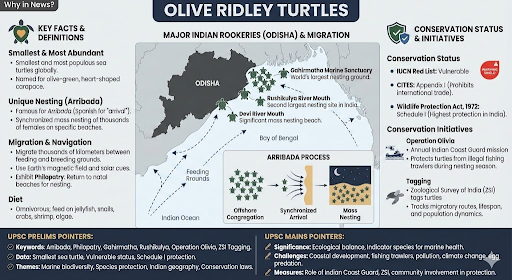
Smallest & Most Abundant: These are the smallest and most populous sea turtles in the world. They get their name from the olive-green color of their heart-shaped shell (carapace).
Unique Nesting (Arribada): They are famous for Arribada (Spanish for “arrival”), a unique synchronized mass nesting behavior where thousands of females converge on the same beach to lay eggs.
Major Indian Rookeries (Odisha):
Gahirmatha Marine Sanctuary: The world’s largest nesting ground.
Rushikulya River Mouth: The second largest nesting site in India.
Devi River Mouth: Another significant mass nesting beach.
Migration & Navigation: They migrate thousands of kilometers between feeding and breeding grounds. They use the Earth’s magnetic field and solar cues for navigation to return to their natal beaches (Philopatry).
Diet: They are omnivorous, feeding on jellyfish, snails, crabs, and shrimp, as well as algae.
Conservation Status:
IUCN Red List: Vulnerable.
CITES: Appendix I (prohibits international trade).
Wildlife Protection Act, 1972: Schedule I (highest protection in India).
Conservation Initiatives:
Operation Olivia: An annual mission by the Indian Coast Guard to protect these turtles from illegal fishing trawlers during their nesting season.
Tagging: Metal tagging by the Zoological Survey of India (ZSI) helps track their migratory routes and lifespan.



 Profile
 Settings
 Refer your friends
 Sign out