


 Profile
 Settings
 Refer your friends
 Sign out




Why in News?
- The Government clarified in Parliament that offshore mining blocks offered for auction were carved out only after excluding all notified Marine Protected Areas, following widespread protests in Kerala.
Offshore Mining Blocks
- Offshore blocks refer to designated sea areas identified for mineral exploration and mining, including sand, lime mud, and polymetallic nodules.
- In 2024, the Government proposed 23 offshore blocks, including 13 sand blocks off Kerala, 3 lime mud blocks off Gujarat, and 7 polymetallic blocks near Great Nicobar.
- These blocks are part of efforts to utilise marine mineral resources and reduce dependence on terrestrial mining.
- No offshore block can begin production without an approved plan with environmental safeguards, as mandated under the Offshore Areas Mineral Conservation and Development Rules, 2024.
Marine Protected Areas (MPAs)
- Marine Protected Areas are officially notified zones aimed at conserving marine biodiversity and protecting critical habitats.
- India has 130 notified MPAs across coastal States and island territories.
- In addition, 106 Important Coastal and Marine Biodiversity Areas (ICMBAs) have been identified for conservation prioritisation.
- MPAs restrict or regulate activities like fishing, mining, and industrial operations to safeguard marine ecosystems.
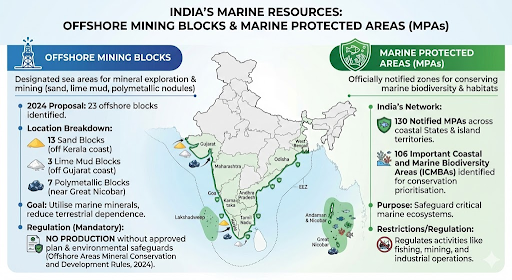
Offshore Blocks vs MPAs
- The Government stated that all proposed offshore mining blocks were mapped only after fully excluding MPAs and ICMBAs.
- This ensures that mining activity does not occur in ecologically sensitive areas crucial for biodiversity, breeding grounds, or fish stocks.
- The exclusion was based on spatial mapping and environmental data from the Earth Sciences and Environment Ministries.
- The objective is to balance resource extraction with marine conservation obligations.
