Profile
 Settings
 Refer your friends
 Sign out




Why in News?
- The Central Drug Standards Control Organization (CDSCO) has granted a commercial license for Biolumpivaxin, the world’s first DIVA (Differentiating Infected from Vaccinated Animals) marker vaccine, significantly enhancing India’s ability to monitor and control outbreaks.
About Lumpy Skin Disease
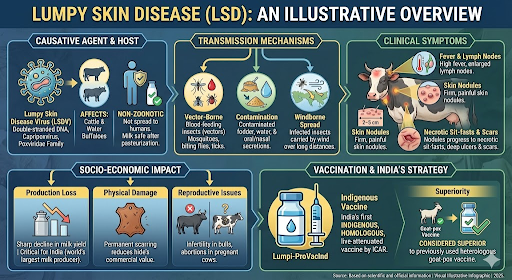
- Causative Agent: It is caused by the Lumpy Skin Disease Virus (LSDV), a double-stranded DNA virus belonging to the Capripoxvirus genus and the Poxviridae family. It is genetically related to sheep-pox and goat-pox viruses.
- Host Specificity: Primarily affects cattle and water buffaloes. It is a non-zoonotic disease, meaning it does not spread from animals to humans, and milk from infected cattle is safe for consumption after pasteurization.
- Transmission Mechanisms:
- Vector-Borne: Primarily spread by blood-feeding insects (vectors) such as mosquitoes, biting flies, and certain ticks.
- Contamination: Spread through contaminated fodder, water, and oral/nasal secretions.
- Windborne Spread: Infected insects can be carried over long distances by prevailing wind currents, facilitating rapid transboundary spread.
- Clinical Symptoms: Characterized by high fever, enlarged lymph nodes, and the appearance of firm, painful skin nodules (2–5 cm). These nodules can progress to necrotic sit-fasts, leaving deep ulcers and scars on the hide.
- Socio-Economic Impact:
- Production Loss: Causes a sharp decline in milk yield, which is critical given India is the world’s largest milk producer.
- Physical Damage: Permanent scarring reduces the commercial value of animal hides.
- Reproductive Issues: Leads to infertility in bulls and abortions in pregnant cows.
- Vaccination & India’s Strategy: Lumpi-ProVacInd: India’s first indigenous, homologous, live-attenuated vaccine developed by ICAR. It is considered superior to the previously used heterologous goat-pox vaccine.