


 Profile
 Settings
 Refer your friends
 Sign out




Why in News?
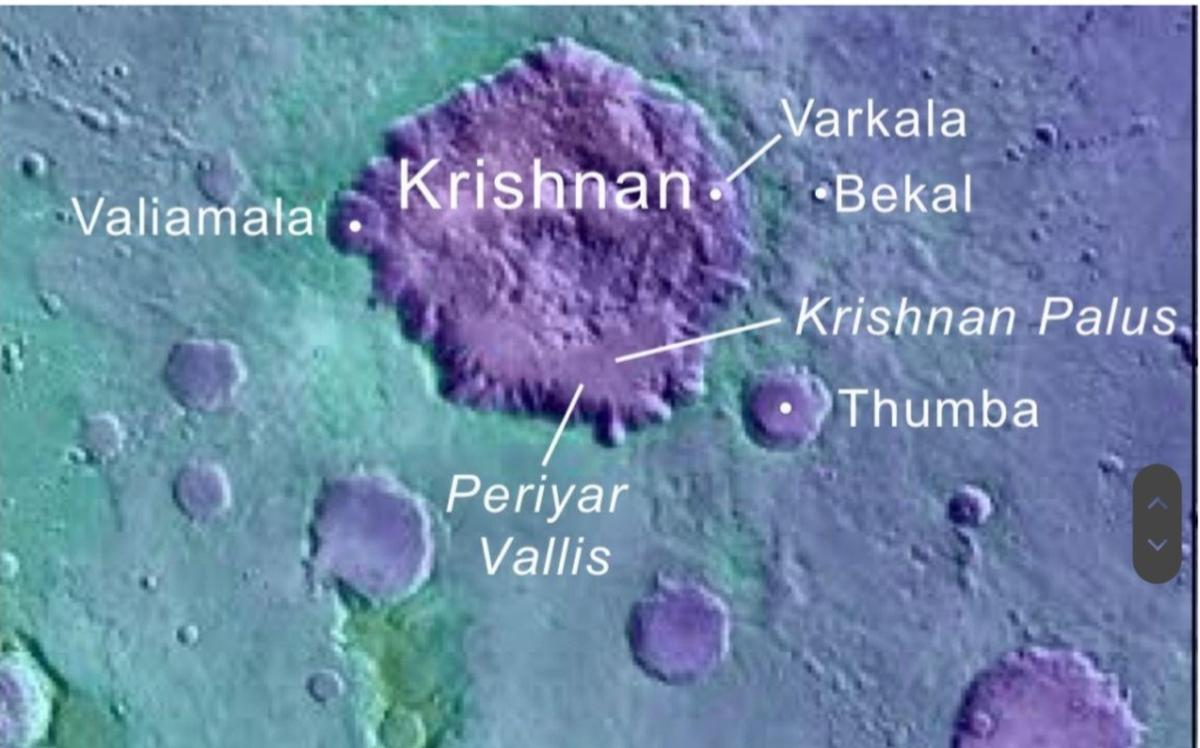
- A 3.5-billion-year-old Martian crater has been named “Krishnan” after Indian geologist M.S. Krishnan, along with several Kerala place names approved by the International Astronomical Union.
Background
- A crater on Mars has been officially named “Krishnan”.
- It is named after M. S. Krishnan, a pioneering Indian geologist.
- The name was approved by the International Astronomical Union (IAU), the global authority for naming planetary features.
DO YOU KNOW?
International Astronomical Union (IAU)
|
Who Was M. S. Krishnan?
- M. S. Krishnan was one of India’s early and leading geologists.
- He made major contributions to:
- Indian stratigraphy (rock layering)
- Mineral exploration
- Geological mapping of India
- He also served as:
- Director General of the Geological Survey of India (GSI)
- He played a key role in building modern geological studies in India.
About the Krishnan Crater on Mars
- It is an impact crater, formed by a meteorite hitting the Martian surface.
- Martian craters help scientists study:
- The age of the Martian surface
- Past climatic and geological conditions
- Such craters preserve evidence of:
- Water activity
- Volcanism
- Surface erosion on Mars.
- Along with the main crater, several smaller Martian landforms have been given names of places in Kerala:
- Valiamala, Thumba, Bekal, Varkala (craters)
- Periyar Vallis (a valley
- The plain inside the crater is named Krishnan Palus.
Scientific Importance of Martian Craters
- Help in:
- Estimating the relative age of Mars’ surface
- Studying impact history of the Solar System
- Understanding past presence of water
- Some Martian craters show signs of:
- Ancient lakes
- River channels
- Sediment deposition
Significance for India
- The naming:
- Brings international recognition to Indian scientific contributions
- Highlights India’s strong heritage in Earth and planetary sciences
- Coincides with India’s growing role in space exploration through:
- Mars Orbiter Mission (Mangalyaan)
- Future interplanetary missions
