Profile
 Settings
 Refer your friends
 Sign out




Why in News?
- India has been recently re-elected to the ICAO Council (Part II) for the 2025–2028 term, reinforcing its status as a major contributor to global air navigation and safety.
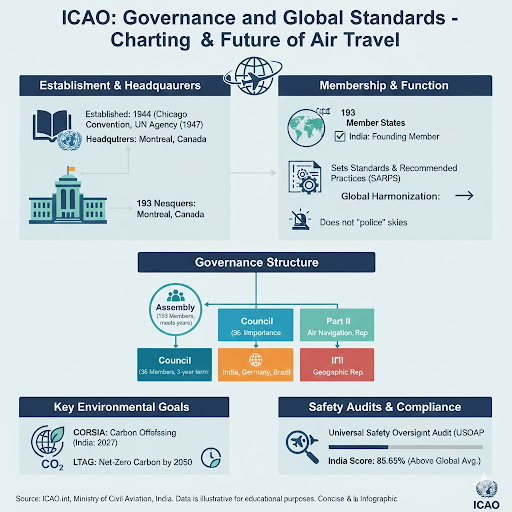
ICAO: Governance and Global Standards
- Establishment: Created in 1944 under the Convention on International Civil Aviation, popularly known as the Chicago Convention. It officially became a specialized agency of the United Nations in 1947.
- Headquarters: Located in Montreal, Canada.
- Membership: Comprises 193 Member States (including India as a founding member). It covers virtually every UN member except Liechtenstein (which lacks an international airport).
- Core Function: It does not “police” the skies or regulate individual airlines; instead, it sets Standards and Recommended Practices (SARPs). Member States use these to ensure their local aviation laws are globally harmonized.
- Governance Structure:
- Assembly: The sovereign body that meets every three years; includes all 193 members.
- Council: A permanent body of 36 members elected by the Assembly for a 3-year term. It is divided into three parts:
- Part I: States of chief importance in air transport (e.g., USA, UK, China).
- Part II: States making the largest contribution to air navigation (e.g., India, Germany, Brazil).
- Part III: States ensuring geographic representation.
- Key Environmental Goals:
- CORSIA: Carbon Offsetting and Reduction Scheme for International Aviation. India has decided to participate starting in 2027.
- LTAG: Long-Term Aspirational Goal for international aviation to reach net-zero carbon emissions by 2050.
- Safety Audits: It conducts the Universal Safety Oversight Audit Programme (USOAP). India recently scored 85.65%, significantly above the global average.