


 Profile
 Settings
 Refer your friends
 Sign out




Why in News?
- India’s vision of becoming a global power is currently impeded by a deep-seated insufficiency in research and development (R&D) investment and output, necessitating urgent structural reforms.
The Scale of the Challenge
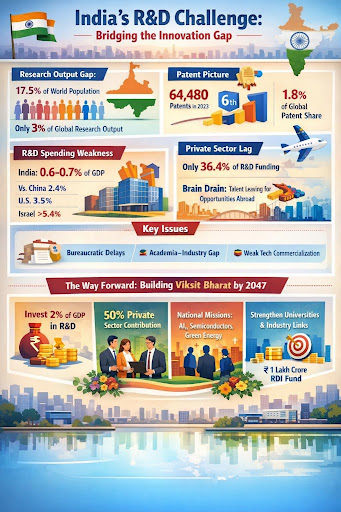
- Despite housing 17.5% of the world’s population, India produces only a meagre 3% of the world’s research output.
- This disparity highlights a fundamental failure in leveraging the country’s massive demographic dividend for high-value research.
- The deficit is not just in funding but in the ability to translate human capital into global research dominance.
- The current trajectory suggests that numbers alone are not translating into impactful innovation.
Intellectual Property Trends
- India ranked sixth globally for total patent filings in 2023, recording a significant growth of 15.7%.
- However, India’s share is still low, at approximately 1.8% of the 3.55 million global patent applications.
- In terms of resident applications per million inhabitants, which reflects true domestic innovation intensity, India ranks significantly lower at 47th.
- This indicates that overall growth in filings has not yet translated into widespread population-level innovation.
Expenditure Disparity
- India’s Gross Expenditure on R&D has consistently hovered between 0.6% and 0.7% of GDP, and is slipping as GDP grows.
- This pales in comparison to innovation hubs like China (2.4%), the United States (3.5%), and Israel (5.4%).
- The lack of concentrated investment prevents India from competing in high-stakes global technology races.
- Without increasing this spend, India struggles to build the technological muscle required for a developed economy.
The Huawei Benchmark
- A stark illustration of the deficit is that the Chinese tech giant Huawei invested approximately $23.4 billion (CNY 164.7 billion) in R&D in 2023.
- This single company’s spending exceeds the total combined R&D expenditure of all public and private entities in India.
- Such corporate-level intensity is described as the engine of next-generation technological power.
- This comparison exposes India’s inability to muster concentrated, strategic investment in crucial areas like semiconductors.
Private Sector Inertia
- In developed nations, the private sector typically accounts for two-thirds of R&D expenditure, but in India, the government contributes 63.6%.
- The Indian private sector contributes only around 36.4%, displaying a preference for technology licensing over domestic development.
- Indian industry is characterized by a risk-averse culture and a focus on incremental improvements rather than disruptive innovation.
- Business leaders are urged to overcome complacency and rise to the challenge of funding R&D.
Academia-Industry Disconnect
- There is a persistent silo mentality in Indian academia, where research remains theoretical and disconnected from market needs.
- The mechanisms for technology transfer and commercialization between universities and industries are underdeveloped.
- Unlike in the U.S., there is no strong culture of companies funding student researchers to develop marketable innovations.
- This disconnect creates a valley of death that prevents valuable research from reaching the marketplace.
Strategic Solutions and National Missions
- The immediate goal is to raise the R&D expenditure to GDP ratio to at least 2% within the next five to seven years.
- The government has launched a ₹1 lakh crore Research, Development and Innovation (RDI) Fund to catalyze private sector participation.
- India must focus on national missions in high-value domains like semiconductors, AI, quantum computing, and green energy.
- These missions require long-term, uninterrupted funding tied to measurable outcomes for economic sovereignty.
Education and Structural Reform
- Universities must transition from purely teaching institutions to centres of excellence in research by boosting PhD funding.
- Mandatory mechanisms for industry-sponsored research chairs must be established to bridge the academic-industry gap.
- A robust intellectual property culture needs to be inculcated by simplifying patent filing and enforcing rights.
- Without these structural foundations, the goal of Viksit Bharat (Developed India) by 2047 will remain out of reach.
