


 Profile
 Settings
 Refer your friends
 Sign out




- What is a Patent?
- A patent is an exclusive legal right granted to an inventor for an invention that is new, non-obvious, and industrially applicable.
- In India, patents are granted by the Office of the Controller General of Patents, Designs, and Trade Marks (CGPDTM), under the Ministry of Commerce & Industry.
- Tenure: A patent in India is valid for 20 years from the date of filing.
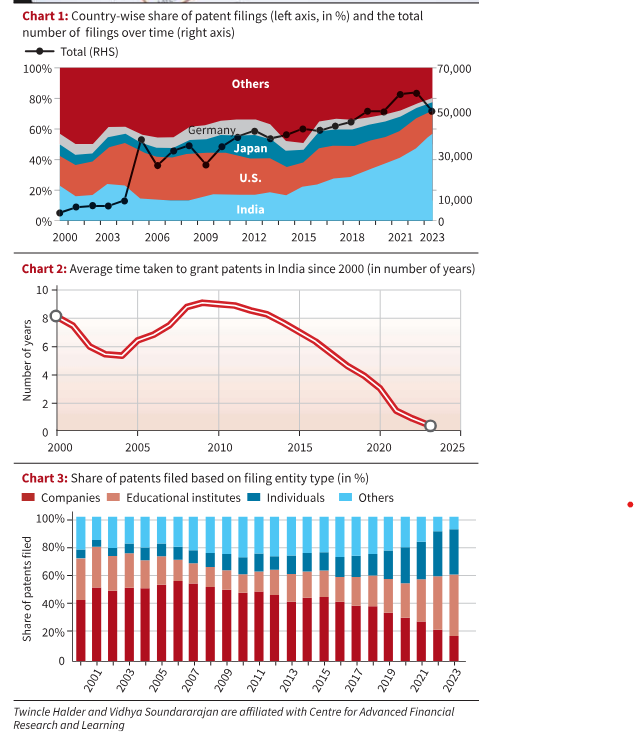
- Patent Filings: In 2023, Indian-origin filings (57%) surpassed foreign ones for the first time. India also overtook the U.S. in 2021 as the second-largest patent recipient.
- Shift in Technology Areas: Computer science patents rose from 1.27% (2000) → 26.5% (2023); biomedical patents from 0.6% → 10%.
- Faster Processing: Earlier 8–10 years, now many patents cleared in 2–3 years.
- Changing Profile of Filers: Companies’ share fell (43% → 17%), while educational institutions (43%) and individuals (32%) now dominate.
- National IPR Policy, Atal Innovation Mission, KAPILA program for IP literacy.
- Reforms: expedited examination, 80% fee reduction for startups/MSMEs/educational institutions, digital filing.
- Universities like IIT Bombay (421 patents in 2023-24) are emerging as leaders.
- Low R&D spending: 0.67% of GDP (vs. China 2.5%, U.S. 3.5%).
- 80% of filings pending due to legal/administrative complexities.
- Weak link between patents and commercialization.
- Raise R&D investment to 2% of GDP.
- Support university labs and startups with funding.
- Improve industry–academia collaboration.
- Strengthen patent–market linkage to ensure ideas become products.
- At the Quantum India Bengaluru Summit 2025, Nobel laureate David Gross stressed that for Make in India to succeed, India must “first discover, then invent, and then make,” highlighting the need for stronger R&D and innovation capabilities.
