Profile
 Settings
 Refer your friends
 Sign out




Why in News?
- India and Oman signed the Comprehensive Economic Partnership Agreement (CEPA) last week, significantly deepening their economic and strategic engagement.
DO YOU KNOW?
Comprehensive Economic Partnership Agreement (CEPA)
|
Background and Strategic Context
- Oman is a key partner for India in West Asia, located at the strategic mouth of the Strait of Hormuz.
- India–Oman relations are anchored in energy security, trade, diaspora ties, and maritime cooperation.
- The CEPA aligns with India’s strategy to expand economic engagement with the Gulf region.
- It complements India’s broader West Asia outreach under the India–Middle East–Europe Economic Corridor vision.
Objectives of the India–Oman CEPA
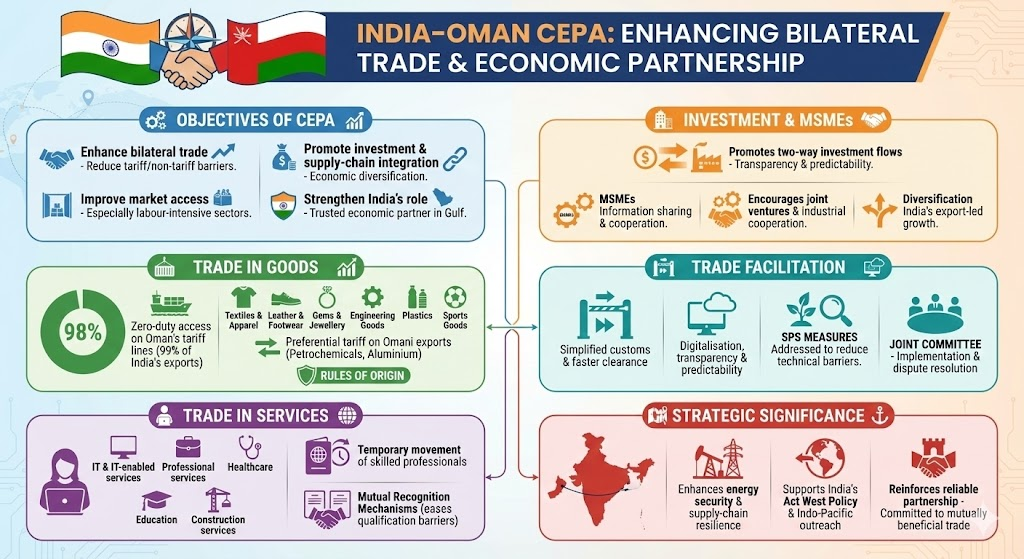
- To enhance bilateral trade in goods and services by reducing tariff and non-tariff barriers.
- To improve market access for Indian exports, especially labour-intensive sectors.
- To promote investment flows, supply-chain integration, and economic diversification.
- To strengthen India’s role as a trusted economic partner in the Gulf region.
Provisions Related to Trade in Goods
- Oman has granted zero-duty access on about 98% of its tariff lines, covering over 99% of India’s exports by value.
- Key Indian export sectors benefiting include textiles and apparel, leather and footwear, gems and jewellery, engineering goods, plastics, and sports goods.
- India has offered preferential tariff concessions on selected Omani exports, including petrochemicals and aluminium products.
- Rules of origin provisions are included to prevent misuse and trade deflection.
Provisions Related to Trade in Services
- The CEPA provides greater market access for Indian service providers in Oman.
- Key sectors covered include IT and IT-enabled services, professional services, healthcare, education, and construction services.
- It facilitates temporary movement of skilled professionals, improving employment opportunities for Indians.
- Mutual recognition mechanisms are envisaged to ease professional qualification barriers.
Investment, MSMEs and Economic Cooperation
- The agreement promotes two-way investment flows by ensuring transparency and predictability.
- Special emphasis is placed on MSMEs, including information sharing and cooperation mechanisms.
- It encourages joint ventures and industrial cooperation in manufacturing and logistics.
- The CEPA supports Oman’s economic diversification goals and India’s export-led growth strategy.
Trade Facilitation, Customs and Regulatory Provisions
- The CEPA includes provisions for simplified customs procedures and faster clearance of goods.
- It promotes digitalisation, transparency, and predictability in trade procedures.
- Sanitary and phytosanitary measures are addressed to reduce technical barriers to trade.
- A joint committee mechanism is established for implementation, monitoring and dispute resolution.
Strategic and Geopolitical Significance
- The CEPA strengthens India’s economic footprint in the strategically vital Gulf region.
- It enhances India’s energy security and supply-chain resilience.
- The agreement supports India’s Act West Policy and Indo-Pacific economic outreach.
- It reinforces India’s image as a reliable partner committed to mutually beneficial trade.