


 Profile
 Settings
 Refer your friends
 Sign out




Why in News?
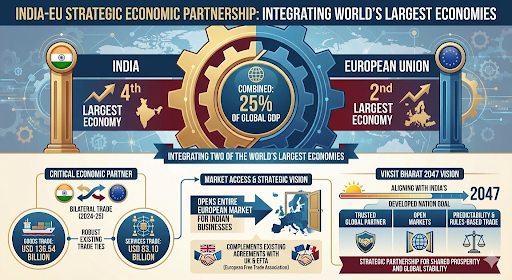
- Prime Minister Narendra Modi and European Commission President Ursula von der Leyen jointly announced the conclusion of the India–European Union Free Trade Agreement (FTA) during the 16th India–EU Summit in New Delhi.
Boost to Goods and Manufacturing
- India has secured unprecedented market access for more than 99% of Indian exports by value, significantly bolstering the Make in India initiative.
- The agreement eliminates tariffs on nearly USD 33 billion of Indian exports, providing a decisive competitive edge to labour-intensive sectors such as textiles, leather, footwear, and gems and jewellery.
- For the Automobile Sector, a calibrated quota-based liberalisation package will allow EU automakers access to the Indian market while opening export opportunities for Indian-made vehicles.
- The deal integrates Indian MSMEs and artisans more deeply into global value chains, ensuring that the benefits of trade reach women, youth, and smaller enterprises.
Services, Mobility, and Social Security
- The EU has offered market access commitments in 144 sub-sectors, including key areas of Indian strength such as IT/ITeS, professional services, education, and financial services.
- A comprehensive Mobility Framework has been established to facilitate the smooth movement of skilled professionals, including Intra-Corporate Transferees (ICT), business visitors, and their dependents.
- India has secured specific access for Contractual Service Suppliers and Independent Professionals in 37 and 17 sectors respectively, enhancing opportunities for its dynamic workforce.
- The agreement includes a forward-looking provision to engage on Social Security Agreements over a five-year horizon and allows Traditional Medicine practitioners to work under their home titles in unregulated EU member states.
Agriculture, Regulations, and Sustainability
- The FTA creates a level playing field for Indian farmers by boosting exports of key commodities like Tea, Coffee, Spices, and processed foods while strictly safeguarding sensitive sectors like Dairy and Poultry.
- To address the EU’s Carbon Border Adjustment Mechanism (CBAM), the deal includes technical cooperation on carbon price recognition and financial assistance to help Indian industries transition to green technologies.
- The agreement focuses on reducing Non-Tariff Barriers by streamlining Sanitary and Phytosanitary (SPS) procedures and enhancing regulatory transparency.
- Intellectual Property Rights protections have been reinforced in line with TRIPS, including specific recognition for India’s Traditional Knowledge Digital Library (TKDL) project.
Future-Ready Cooperation
- The partnership extends beyond traditional trade to cover emerging sectors like Artificial Intelligence, clean technologies, and Semiconductors, supporting India’s technological advancement.
- The deal includes robust mechanisms for Digital Trade, facilitating cross-border electronic payments and deepening financial integration between the two regions.
- Recognizing the dynamic nature of global trade, the agreement embeds multiple Review and Consultation Mechanisms to handle future regulatory complexities and sudden economic challenges.
- With this agreement, the EU becomes India’s 22nd FTA partner, marking a defining achievement in India’s strategy to secure balanced and mutually beneficial global partnerships.
