


 Profile
 Settings
 Refer your friends
 Sign out




- A Dark Sky Reserve is an area recognized by the International Dark-Sky Association (IDA) where the quality of the night sky and the natural nocturnal environment are protected.
- It typically consists of a core area (with minimal light pollution) surrounded by a buffer zone (where lighting is managed to protect the core).
- Such reserves encourage sustainable lighting practices, awareness of light pollution, and protection of nocturnal ecosystems.
Objectives:
- To protect the natural night environment from light pollution.
- To promote astronomical research and education.
- To encourage astro-tourism and community involvement.
- To conserve nocturnal wildlife and improve human health by maintaining natural light cycles.
- Hanle, a small village in Ladakh, has one of the darkest skies globally.
- The area is now India’s first dark sky reserve, protected to reduce light pollution.
- Hanle Dark Sky Reserve is managed through an MoU between:
- Indian Institute of Astrophysics (IIA), Bengaluru
- Union Territory of Ladakh
- Ladakh Hill Development Council, Leh
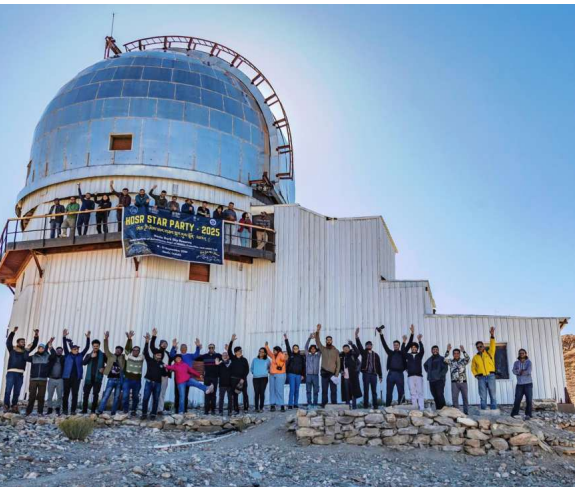
- The reserve lies within the Changthang Wildlife Sanctuary and surrounds the Indian Astronomical Observatory.
- Optical telescopes: Himalayan Chandra Telescope, GROWTH India Telescope
- Cherenkov telescopes: High Altitude Gamma-Ray Telescope Array, Major Atmospheric Cherenkov Experiment
- Hanle Dark Sky Reserve has emerged as India’s first government-protected dark sky reserve, promoting astronomy, astrotourism, and sustainable local development.
